The Law of Nature
In Locke's state of nature — the hypothetical condition of human beings without political authority — human beings are free and equal but not lawless. The law of nature, which reason makes available to anyone who will consult it, establishes a clear framework: no person may take another's life, health, liberty, or possessions. This law is not the positive command of any human or divine legislator but a rational principle derivable from the equal God-given dignity of all persons. Its authority is not dependent on any enforcement mechanism; it binds in conscience even without a human judge to apply it.
The Right of Property
Locke's famous labour theory of property holds that when a person mixes her labour with the natural world — clears land, cultivates crops, shapes timber — she incorporates her own person into the thing and thereby acquires a right of property in it. The crucial proviso is that there must be "enough and as good left for others": the natural world begins as the common inheritance of all, and its appropriation is legitimate only when it does not disadvantage others. In the early state of nature, before money, this condition is easily met. The introduction of money — a medium of exchange that does not spoil — permits indefinite accumulation and generates the inequalities of property that characterise civil society.
Why Government Is Needed
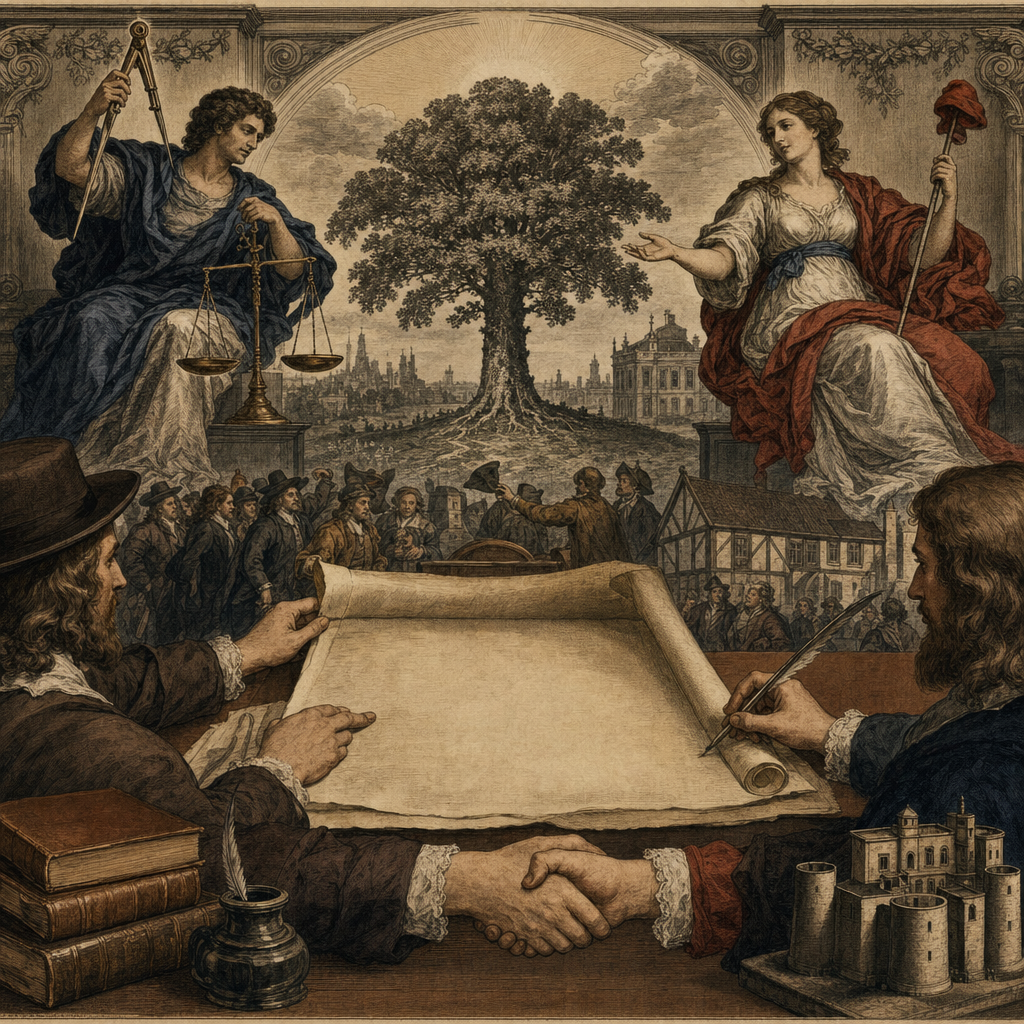
The state of nature is not miserable, but it has three inconveniences: the absence of a settled and known law, the absence of an impartial judge, and the absence of a power to enforce just judgments. Where each person is judge in her own case, the biases of self-interest distort every dispute, and the result is the gradual escalation of conflict. It is to remedy these inconveniences — not to surrender their rights but to protect them better — that rational individuals consent to civil government. Government is constituted by and for the protection of natural rights; it has no authority beyond that mandate.
The analysis of the state of nature, natural rights, and the labour theory of property occupies Chapters II–V of the Second Treatise. Locke's concept of natural rights influenced Jefferson's "life, liberty, and the pursuit of happiness" (adapting Locke's "life, liberty, and property"), the French Declaration of the Rights of Man, and the Universal Declaration of Human Rights.
Related Concepts