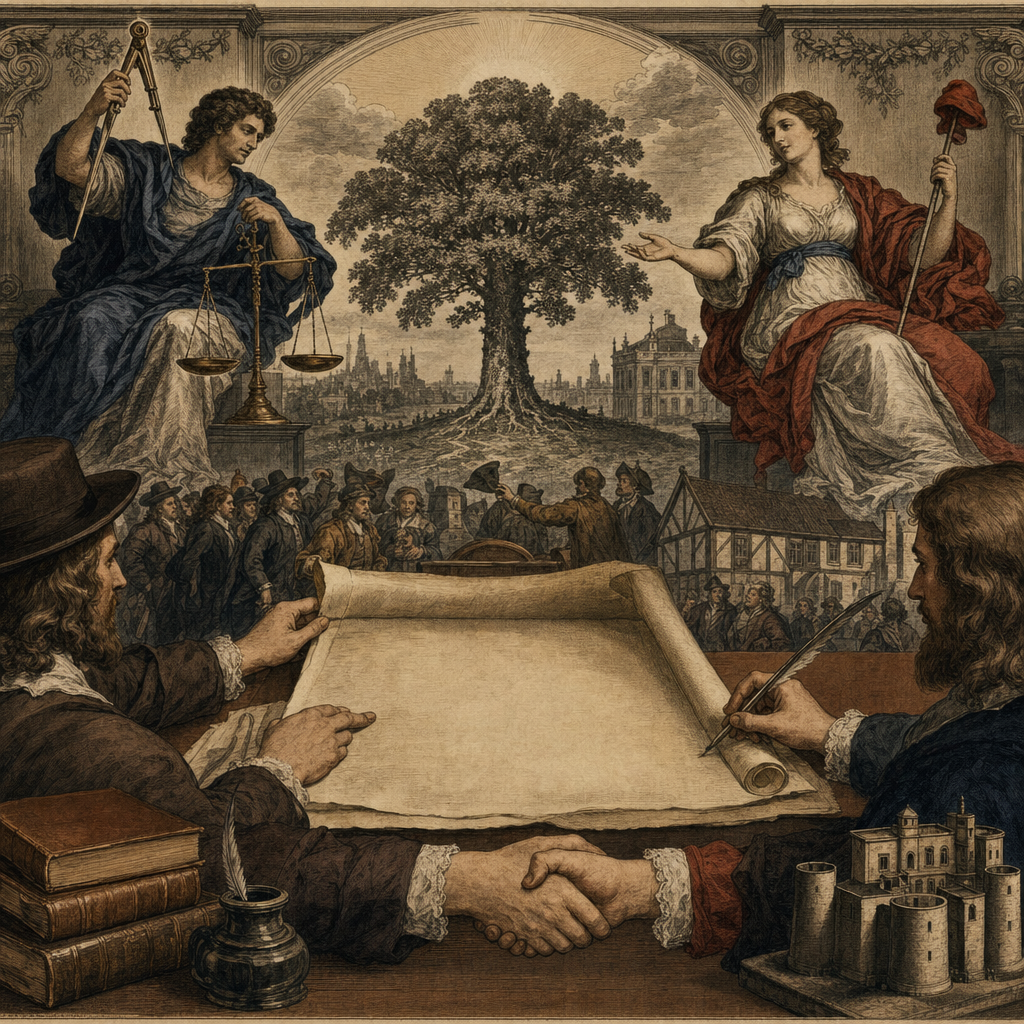
Two Treatises of Government is the founding text of liberal political philosophy and the most influential work of political theory in the English language. Published anonymously in 1689 to justify the Glorious Revolution, its arguments extend far beyond any particular constitutional settlement to articulate a theory of government whose consequences were still being felt in the American Declaration of Independence, the French Revolutionary constitutions, and the Universal Declaration of Human Rights. The First Treatise is a detailed and polemical refutation of Robert Filmer's Patriarcha (1680), which had argued for the divine right of kings by analogy with paternal authority; Locke dismantles the scriptural and logical foundations of this claim line by line. The Second Treatise constructs a positive theory of political authority from scratch: beginning with a state of nature governed by the law of nature (the rational principle that no person may harm another's life, liberty, or property), Locke argues that the inconveniences of the state of nature (the lack of a common judge, the partiality of self-enforcement) lead rational individuals to consent to civil government, which is granted only a fiduciary trust and retains no authority over natural rights. Government that violates the terms of this trust — that governs without consent, that taxes without representation, that destroys the property or liberty it was created to protect — dissolves the political bond and returns individuals to the state of nature, where they may legitimately resist. The theory of natural rights, consent, separation of powers, and the right of revolution makes this work the direct ancestor of all modern liberal constitutionalism.
This work isn't available here yet. In the meantime you can purchase a copy on Amazon, or check back later, as we are always adding books to our library.
As an Amazon Associate we earn from qualifying purchases.