The Building Blocks
Every household is constituted by two primary relationships: the union of male and female for reproduction, and the union of natural ruler and natural subject for preservation. From these basic elements, the household provides for daily needs — food, shelter, the raising of children.
Now of these two societies the domestic is the first, and Hesiod is right when he says, "First a house, then a wife, then an ox for the plough," for the poor man has always an ox before a household slave.
The Qualitative Leap to the City
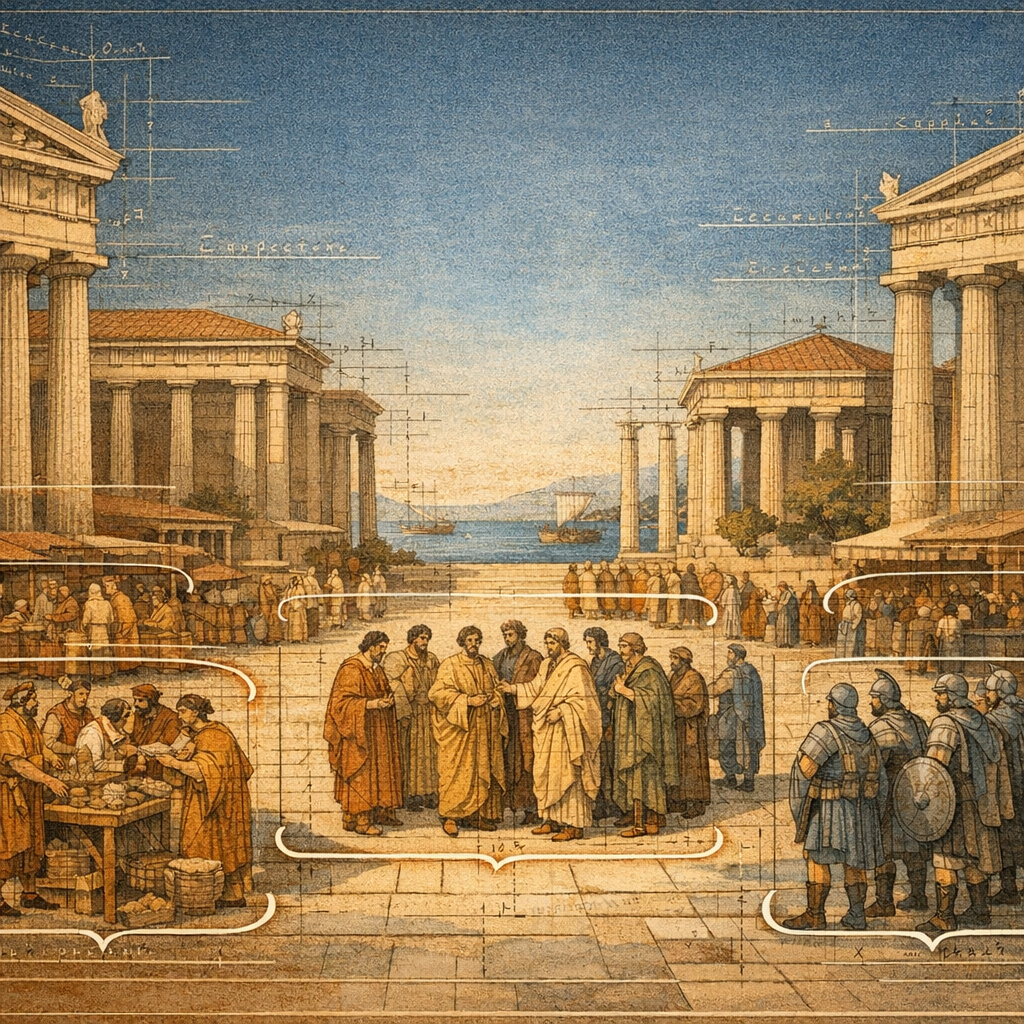
The city emerges when several villages unite for more than survival. This is a qualitative leap, not a quantitative one. The city achieves self-sufficiency — not just economic self-sufficiency, but the kind of completeness in which human nature can be fully expressed and human happiness genuinely pursued.
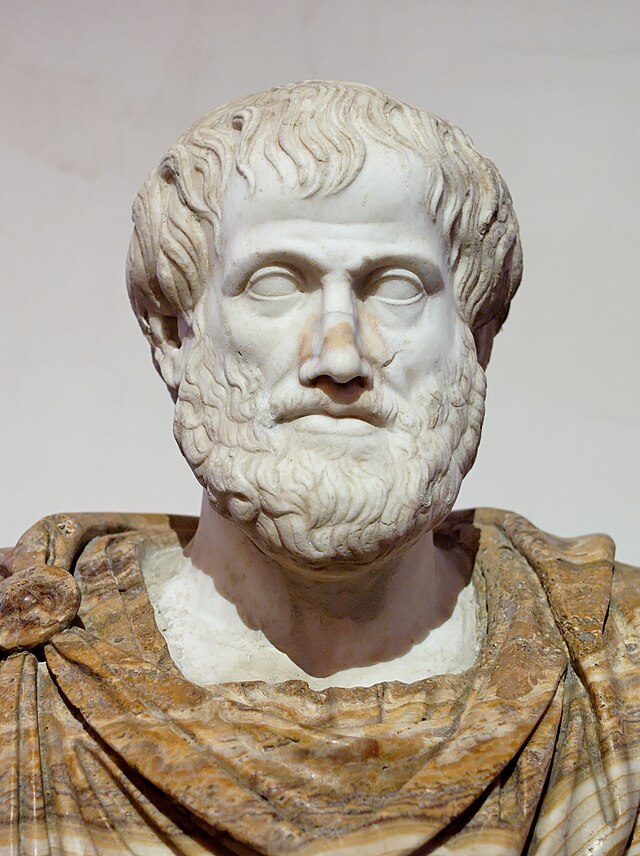
This is why Aristotle insists that the state is prior by nature to the household and the individual. Not in time — clearly households came before cities — but in the sense that the city is what the household is always aiming at. The end is logically prior to the means, even when the means come first in time.
The Household Is Not a Small City
Aristotle's key polemical point, directed against his predecessors, is that household management (oikonomia) and political governance (politike) are fundamentally different in kind. The household is a natural monarchy — the authority of a father over children, or a husband over wife, though each form of authority is different. Political rule is rule among equals who take turns governing and being governed.
A city that is run like a household — where one person commands absolutely and all others obey — is not a city at all in the full sense. It is a tyranny, even if benevolent. The defining feature of political life is reciprocal rule: the recognition that those who are governed are themselves fit to govern.
Economics and Its Limits
The discussion of the household leads Aristotle to one of his most influential economic arguments. There is natural wealth-getting — the management of resources in service of the good life. And there is unnatural wealth-getting — the unlimited accumulation of money as an end in itself. The latter is not merely useless but actively corrupting, because it directs human energy toward an end that has no natural limit and can therefore never be satisfied.
Book I of the Politics is the locus classicus for Aristotle's analysis of the household and its relationship to the political community.
Related Concepts