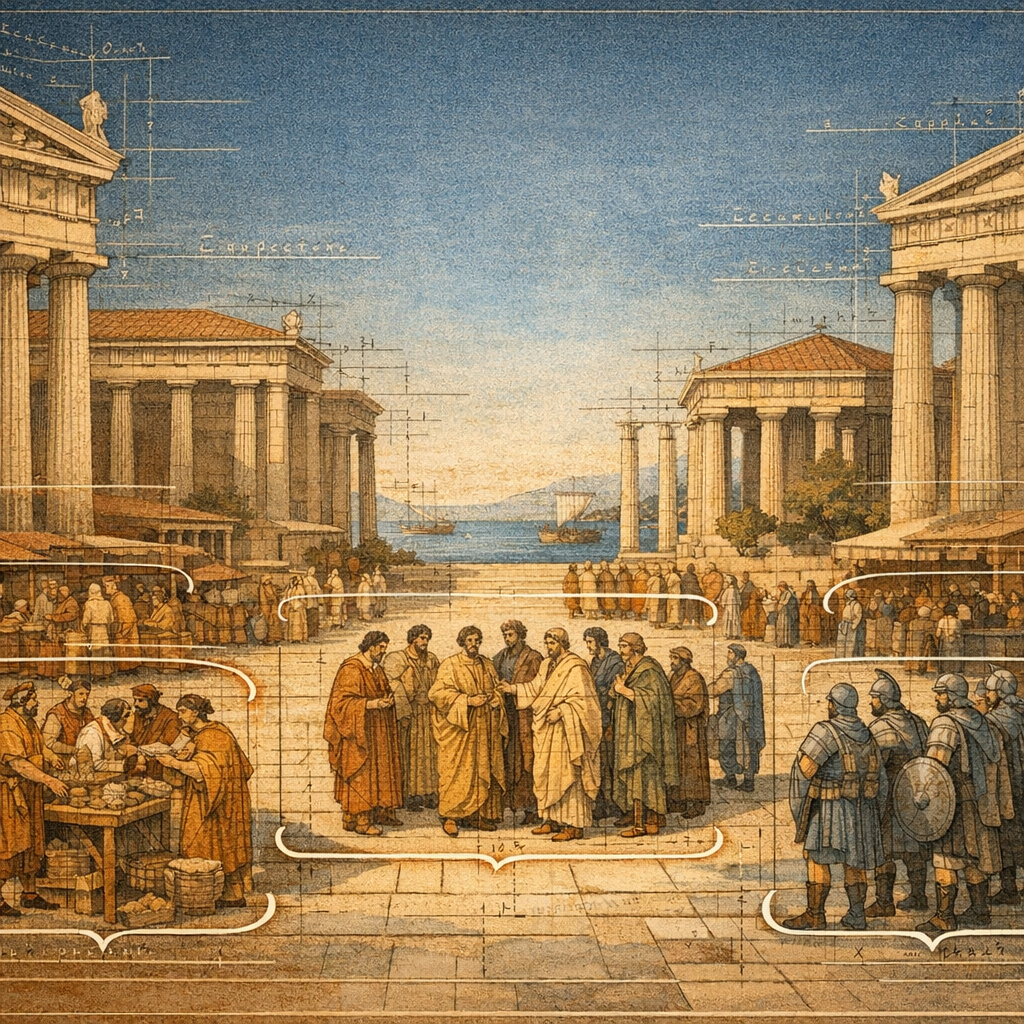
Justice as the Bond
Aristotle argues that all human communities share some notion of justice — some sense that certain distributions are fair and others are not. But partial or distorted conceptions of justice generate the characteristic failures of real constitutions. Democracies make the mistake of inferring from equality in one respect (citizenship) to equality in all respects. Oligarchies make the mirror-image error, inferring from inequality in wealth to inequality in all respects.
Since in every art and science the end aimed at is always good, so particularly in this, which is the most excellent of all, the founding of civil society, the good wherein aimed at is justice; for it is this which is for the benefit of all.
The Purpose of the City
Justice is intelligible only against the background of the city's proper purpose. A city founded for mutual defence or trade has one conception of justice. A city founded for the good life has another. Aristotle insists, against contractarian views, that the city exists not merely to enable people to live together without killing each other, but to enable them to live well.
A constitution that pursues only the rulers' advantage falls short of genuine justice even if it keeps the peace. The test is always whether the common good — the flourishing of all citizens in their capacity for political participation and virtuous life — is genuinely served.
Correct and Perverted Constitutions
This analysis grounds Aristotle's famous sixfold classification. Monarchy, aristocracy, and polity are correct because they aim at the common good. Tyranny, oligarchy, and democracy in the pejorative sense are perverted because they serve the rulers' interest. The classification is normative, not merely descriptive — it tells us what a constitution should be, not only what it is.
Now a tyranny is a monarchy where the good of one man only is the object of government, an oligarchy considers only the rich, and a democracy only the poor; but neither of them have a common good in view.
Justice Beyond Procedure
The deeper point is that justice cannot be reduced to procedure. A city that follows fair procedures but systematically produces outcomes in which some citizens are prevented from exercising their distinctly human capacities is not truly just. Justice requires attention not only to how decisions are made but to what kinds of lives those decisions make possible.
Justice as the common good is developed across Book III, particularly in Chapters 6-9, where Aristotle classifies constitutions and distinguishes correct from perverted forms.
Related Concepts