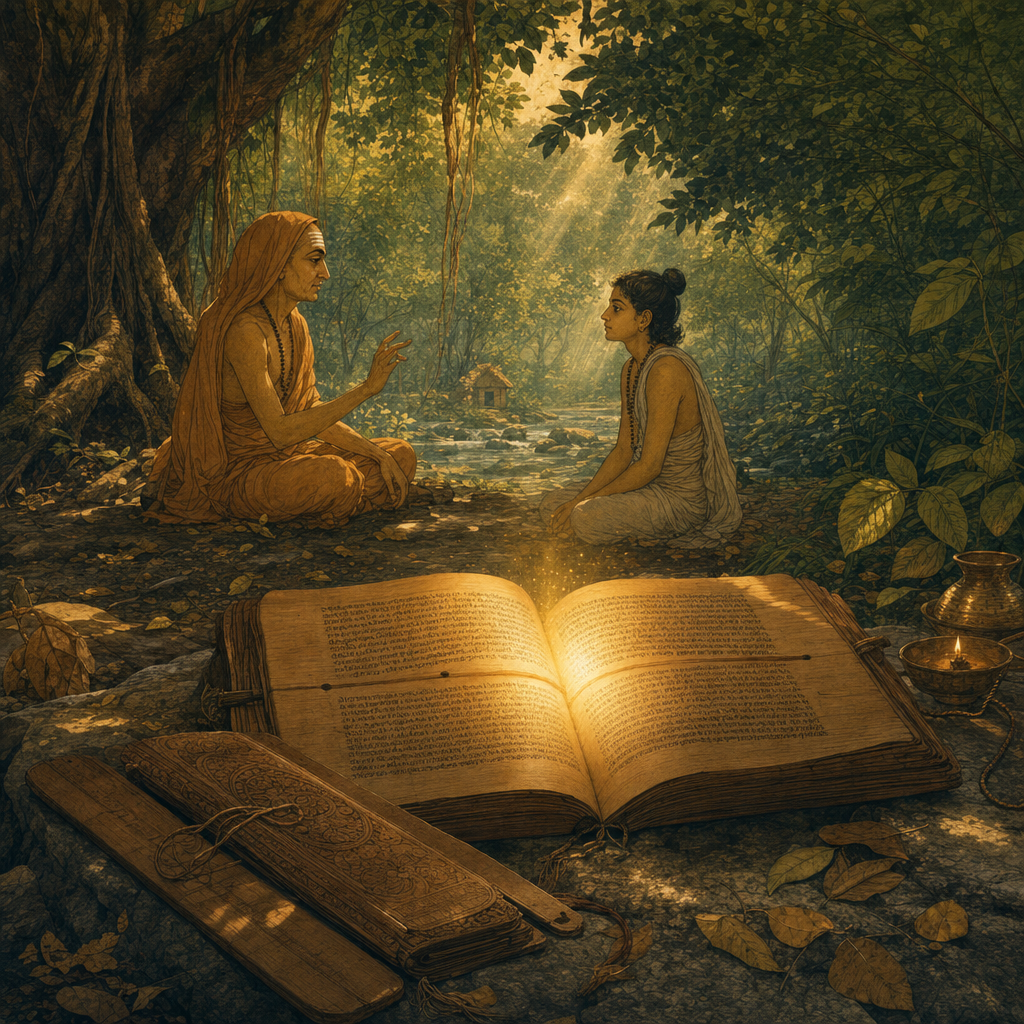
The Qualified Teacher
Shankara specifies the qualities of the teacher who can transmit the Advaita teaching with liberating effect. The teacher must have realised Brahman directly, not merely studied the texts: knowledge of the texts without direct realisation produces a scholar, not a liberator. The teacher must be established in equanimity — free from desire and aversion, unaffected by the teacher-student dynamic — and must be motivated not by personal gain or reputation but by genuine compassion for the student's liberation. The teacher must understand the stages of the student's development and know how to adapt the teaching to the student's current state: when to use negation, when to use affirmation, when to press harder, when to wait.
The Qualified Student
Equally important is the qualification of the student. The Upadeśasāhasrī's opening specifies that the teaching is for one who has already practised the preliminary disciplines: ethical behaviour (yama and niyama), stable attention (dharana and dhyana), and above all the four qualifications — discrimination, dispassion, the sixfold inner accomplishments, and the desire for liberation. A student without these preparations will hear the words of the teaching but will not be transformed by them: the mind that is agitated, attached, or indifferent cannot receive the recognition that the teaching is attempting to produce. The preparation is not arbitrary hoops to jump through; it is the removal of the specific obstacles that will otherwise prevent the teaching from landing.
The Function of Instruction
In the Upadeśasāhasrī, the teacher does not give the student something the student lacks. The student already is Brahman; the recognition is already present in principle. What the teacher gives is a context — the right questions, the right framings, the right systematic pressure — in which the student's own recognition can surface. The teacher's sentences function like surgical instruments: they remove what is obstructing the recognition without themselves producing it. When the student finally says "I understand — this self that I am is Brahman," the teacher has not transferred a piece of knowledge from one mind to another but has removed the last obstacle to what the student's own consciousness was always showing. This is why Shankara insists that liberation through the Upanishadic teaching is distinct from liberation through ritual, devotion, or ethical practice: it is a function of direct recognition, and direct recognition can only be transmitted in the live encounter of teacher and student.
The guru-shishya (teacher-student) relationship is central to all Indian philosophical traditions but is given particular doctrinal weight in Advaita Vedanta, where it is understood as a lineage of direct non-dual recognition passing from teacher to student. Shankara himself is traditionally regarded as having four principal disciples — Suresvara, Padmapada, Hastamalaka, and Totaka — each representing a different dimension of the Advaita teaching. The living guru lineage he established (the Shankaracharya mathas) continues to function in India today.
Related Concepts