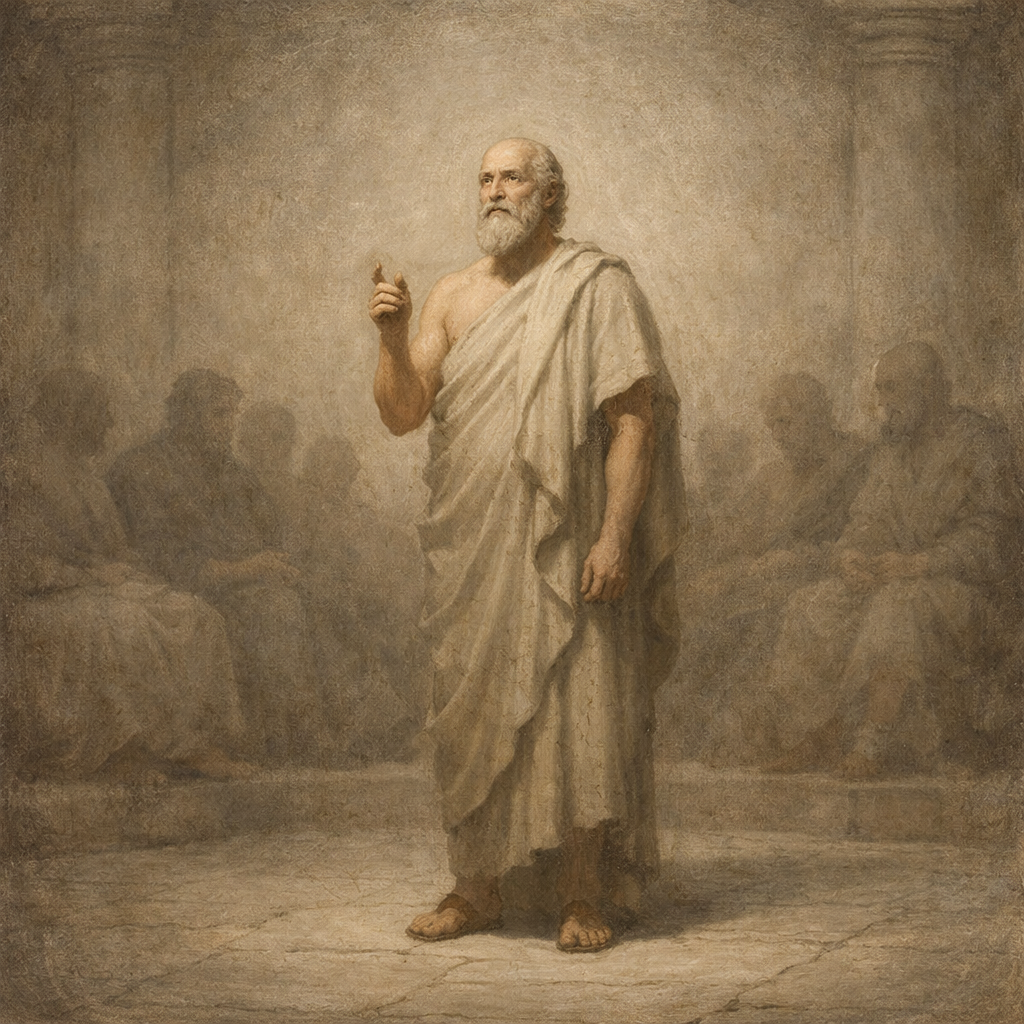
The Structure of Superimposition
Shankara defines adhyasa as "the cognition of something in terms of something else" — the error of taking what belongs to one thing and attributing it to another. The paradigm case is the snake-rope illusion: in dim light, a coiled rope is mistaken for a snake. The properties of snakehood — danger, movement, the capacity to bite — are superimposed on the rope, which has none of them. The rope is real; the snake is an appearance that vanishes when the light improves and the rope is seen clearly. This is the structural template for all cosmic ignorance: the properties of the body-mind complex (mortality, pain, desire, limitation) are superimposed on the self, which has none of them; and conversely, the properties of the self (consciousness, being, bliss) are attributed to the body-mind complex, which has none of them.
Mutual Superimposition
What makes the situation more complex than a simple perceptual mistake is that the superimposition runs in both directions simultaneously. Not only is the self identified with the body ("I am this physical person") but the body is identified with the self ("this person is conscious, this person feels pain"). This mutual superimposition creates the basic framework of ordinary human experience: the sense of being an embodied, limited, mortal individual who experiences pleasure and pain, who acts and suffers the consequences of action, who was born and will die. From within this framework, the whole edifice of desire, aversion, effort, and worldly life follows with iron necessity. Liberation begins when the superimposition is clearly seen for what it is — not an experience that contradicts it, but knowledge that dissolves it.
Beginningless Ignorance
Shankara insists that the ignorance responsible for superimposition is anaadi — beginningless. There is no first moment at which the self was correctly known and then forgotten; the confusion is as old as individual experience itself. This is not a pessimistic claim but a clarifying one: it means that there is no question of tracing the origin of bondage in time, no narrative of a "fall" to be redeemed by a narrative of "redemption." What is needed is not a return to a prior state but the recognition of what always already is the case — that the self is Brahman, now and without interruption, that the confusion is superimposed on an unchanging reality that the confusion cannot touch.
The adhyasa section is Shankara's own introduction to the Brahmasūtra Bhāṣya, not part of the sutras themselves. It is arguably the most original philosophical contribution he makes in the commentary — a structural analysis of the cognitive mechanism that drives all bondage, prior to any metaphysical claim about what reality ultimately is.
Related Concepts