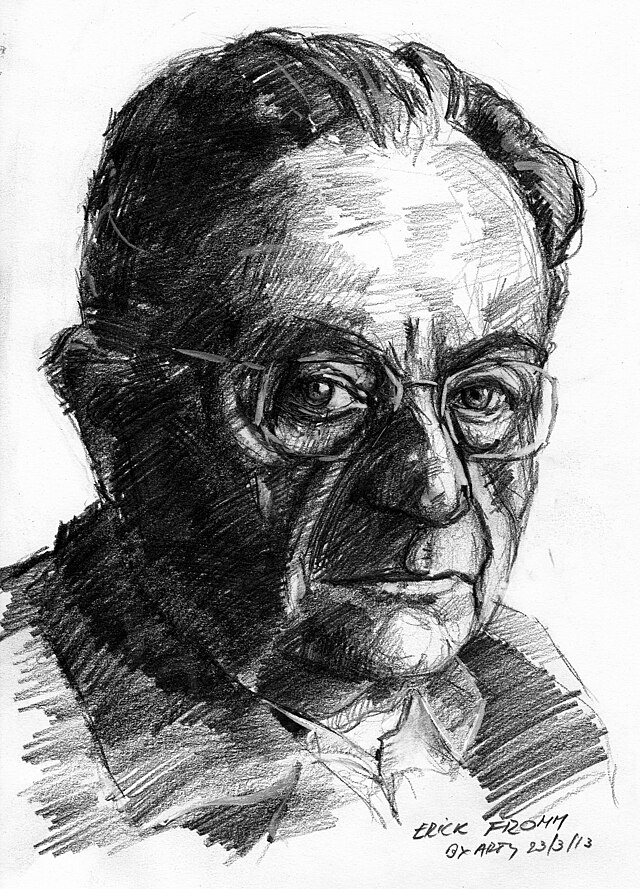
The Marketing Personality
Modern capitalism has produced what Fromm calls the "marketing orientation" — a character structure in which persons experience themselves as commodities to be exchanged at the best available price. One's value is not intrinsic but determined by the market: by how successfully one "packages" oneself, how well one sells one's personality. Love in this context becomes a transaction: two lonely persons trade their packages and call it love.
The Alienation of Feeling
Alienation — Marx's concept of the worker's estrangement from their labour and its products — extends, in Fromm's analysis, to feeling itself. Modern persons are alienated from their own emotional lives: they are taught to manage, perform, and commodify their feelings rather than to have them. The result is an emotional shallowness that makes genuine love — which requires intense, active, disciplined feeling — structurally difficult.
The Revolutionary Demand of Love
Fromm concludes that genuine love is not merely personally demanding but politically radical. It is incompatible with the market orientation, the acquisitiveness, and the narcissism of capitalist society. A person who has genuinely developed the capacity to love cannot remain satisfied with the consumer satisfactions that capitalist society offers as substitutes. The art of loving is thus implicitly a critique of the society that makes it so difficult.
Fromm develops the concept of the marketing orientation at length in Man for Himself (1947). The connection between alienation and the failure of love draws on his earlier Escape from Freedom (1941).
Related Concepts