Seeing Without Being Seen
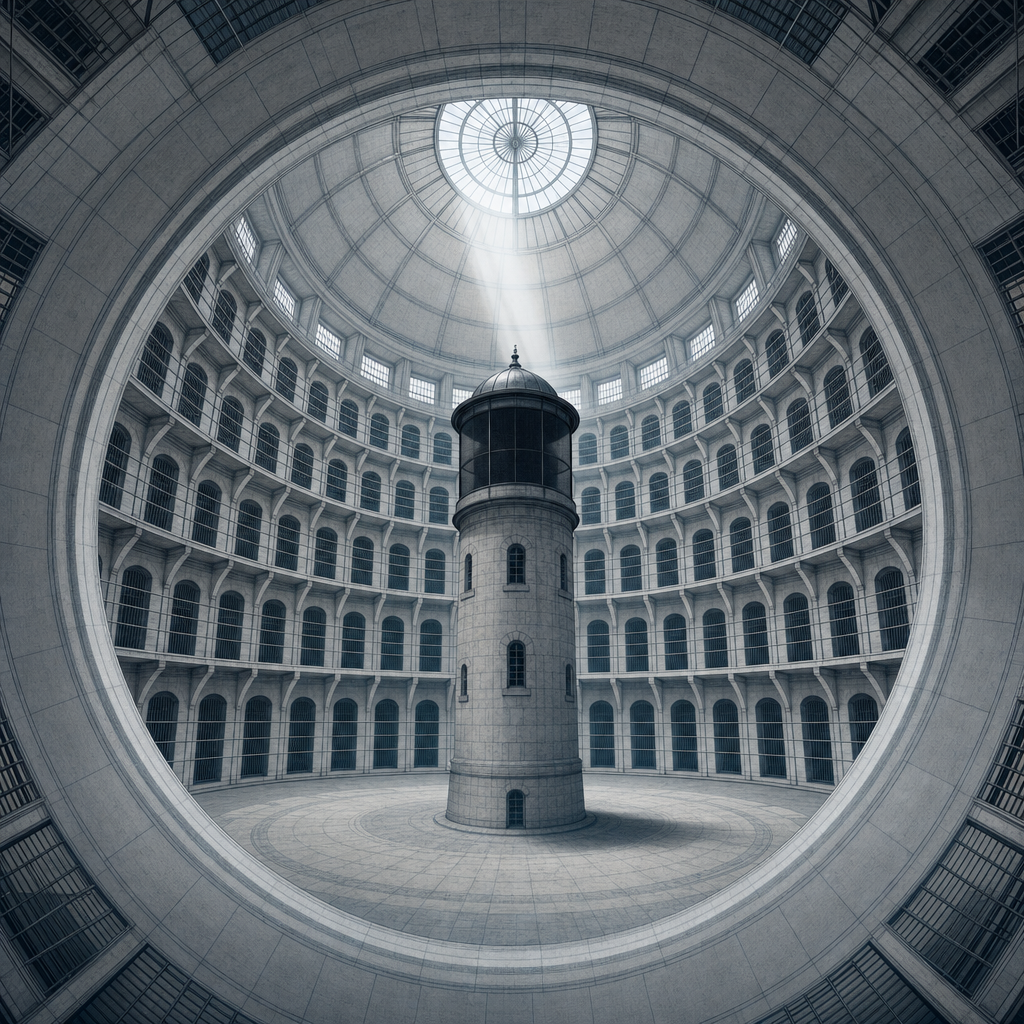
In the Panopticon, an inspector occupies a central tower surrounded by a circular ring of cells. Each cell is backlit from outside windows, making every prisoner permanently visible from the tower; the tower itself is screened, leaving the inspector invisible. The prisoner can never know whether they are being watched at any given moment — and this uncertainty produces a more effective discipline than perpetual observation would, because the prisoner must always behave as if watched. Power becomes automatic.
The Architecture of Reform
Bentham is at pains to distinguish his scheme from mere punishment. The Panopticon is not designed to inflict suffering but to reform character through the graduated internalisation of oversight. The inspector's role is not vindictive but managerial: to ensure that conditions are hygienic, that labour is productive, and that infractions are detected and corrected. The physical design makes cruelty by guards unnecessary and visible, since the inspector himself can be watched by trustees from outside.
Beyond the Prison
Bentham immediately extended the inspection principle beyond prisons to hospitals, schools, workhouses, and factories — any institution where management requires oversight of many by few. In each case, the same architecture of universal visibility in one direction produces reliable compliance at minimal cost. The Panopticon is not merely a prison design but a general technology of institutional management, and Bentham understood it as such from the outset.
The Panopticon Writings (1787–1791) consist of letters written from Russia, where Bentham had gone to visit his brother Samuel, who developed the circular inspection design for a factory.
Related Concepts