The Right Eye and the Left Eye
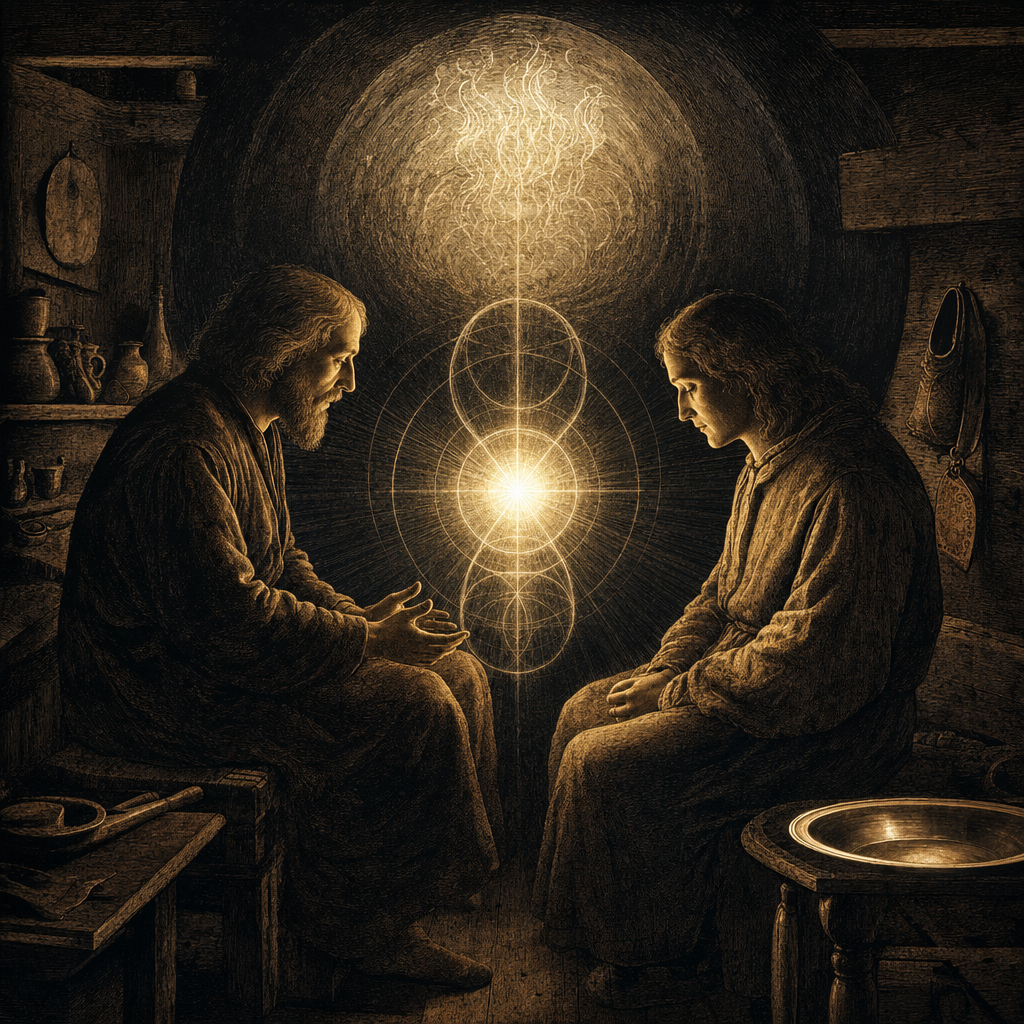
The image arises in the second dialogue when the disciple asks how the light of God and the light of nature can coexist in one soul without confusion. The master's answer is structural: they operate through distinct perceptual organs. The right eye — the eye of eternity — sees from the perspective of the divine ground, where time is contained rather than unfolding. The left eye — the eye of time — operates within the natural world, registering change, difference, succession. Both are necessary; neither is evil in itself. The problem comes when the left eye commands the right.
The Right Eye looketh forward in thee into Eternity. The Left Eye looketh backward in thee into Time. If thou now sufferest thyself to be always looking into Nature, and the Things of Time, it will be impossible for thee ever to arrive at the Unity, which thou wishest for.
The Danger of the Natural Light
An unsanctified or unregenerated reason — what Böhme calls the natural light or the "dim Light of Nature" — can process only what the left eye presents: temporal change, natural cause, worldly value. It is not worthless, but it is insufficient and, when treated as the highest faculty, actively misleading. The natural light classifies, compares, and calculates within time but cannot perceive the unity that underlies all temporal difference. The confusion of worldly wisdom for spiritual wisdom is, for Böhme, one of the fundamental errors of fallen life.
Active and Contemplative Unified
The resolution is not to close the left eye but to bring it into the right. The disciple protests that one cannot stare into eternity while engaged in ordinary work. The master's counsel is unexpectedly practical and integrative: one need not choose between contemplation and action. The heart may rest in God even when the hands and head are at labour. The key is the direction of inner desire, not the content of outer occupation.
Let the hands or the head be at labour, thy Heart ought nevertheless to rest in God. God is a Spirit; dwell in the Spirit; work in the Spirit; pray in the Spirit; and do every thing in the Spirit; for remember thou also art a Spirit, and thereby created in the Image of God.
The two-eyes image allows Böhme to affirm ordinary life without reducing spiritual vision to it. The world of time is real and must be inhabited — but it must be inhabited from within eternity, with the right eye open and commanding. This is not mystical escapism but a description of what it means to act from one's true ground rather than from the surface will.
The "Two Eyes" image appears in Dialogue II and is Böhme's most cited psychological metaphor. A close parallel exists in Eckhart's distinction between the "inner eye" (oculus mentis) and the outward-facing faculty. William Law, the translator, made related distinctions in his sermons on the inner life.
Related Concepts