The Wheel That Must Be Stopped
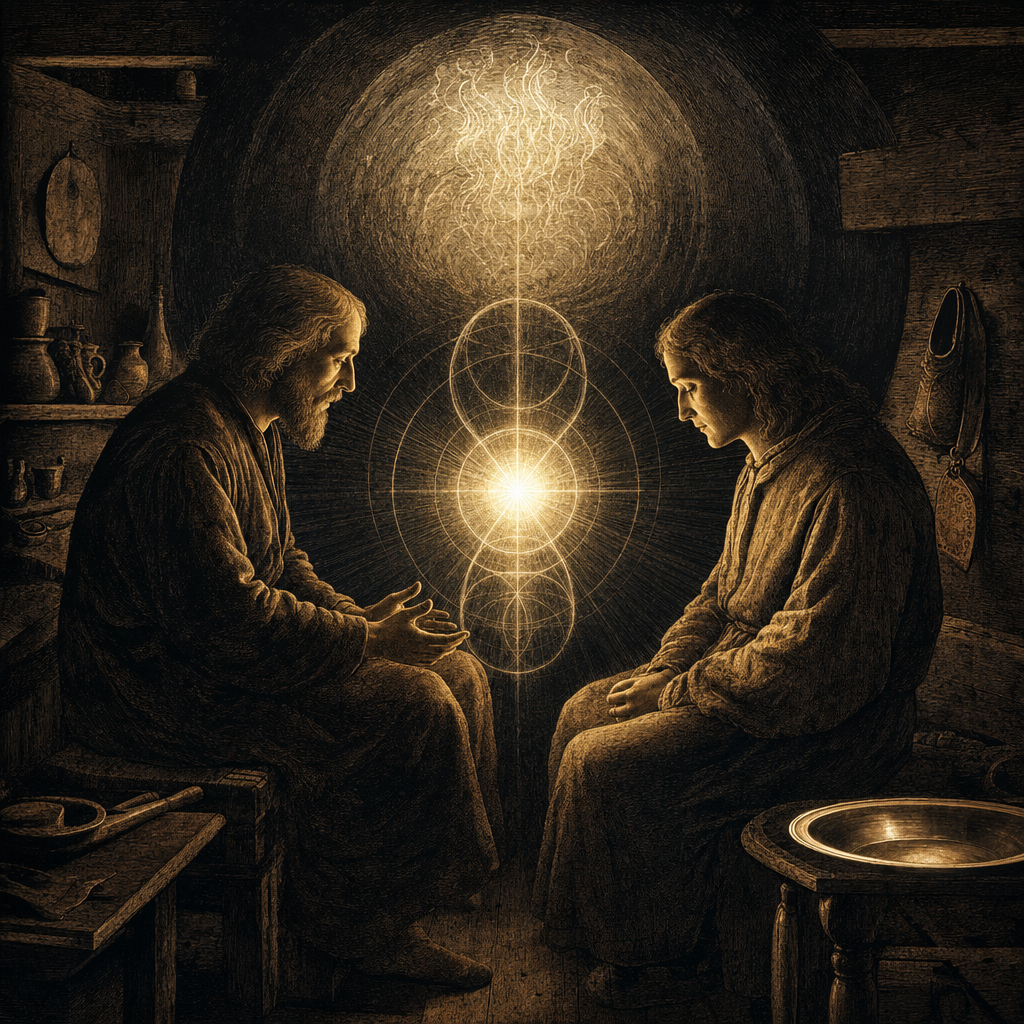
The master in Dialogue I names the obstacle plainly: "thine own willing, hearing, and seeing do keep thee back." The creaturely will is not a weakness but a faculty that has turned in the wrong direction. It spins like a wheel — generating thought, desire, imagery, and sensation — and in that spinning it fills every available space with self-produced noise, leaving no room for the Word of God to be heard. Silence is not simply the absence of external sound; it is the cessation of this internal machinery.
Blessed art thou therefore if thou canst stand still from self-thinking and self-willing, and canst stop the wheel of thy imagination and senses; forasmuch as hereby thou mayest arrive at length to see the great Salvation of God, being made capable of all manner of divine sensations and heavenly communications.
Three Things Required
When the disciple asks how he may pass through nature into the supernatural ground, Böhme does not recommend asceticism or intellectual effort. He offers three dispositions: resign the will to God; hate the own will and refuse to act from it; bow thy will to God and suffer his will to work in thee. The sequence is important. Resignation comes first, active hatred of the self-will second, and only then does the divine will begin to operate — not as an alien imposition but as what the will always most deeply was.
The second disposition — hating the own will — is deliberately stark. Böhme does not soften it. The creaturely will has a tenacity that mild preference cannot overcome. It must be actively disavowed, not merely quieted. This is what he means by dying to self: not annihilation of the person but the death of the pretension that the self is its own source and ground.
The Will Seeking Nothing
In Dialogue II the master explains the mechanism more precisely. The will's power lies in its capacity for imaginative union: when it imagines or desires something, it enters into that thing and is shaped by it. The self-will is imprisoned by whatever it reaches for. The paradoxical liberation is to reach for nothing — to let the will hasten after nothing — at which point it enters the Nothing that is God, and there receives, rather than grasps, the divine light.
The diagnosis of self-will as the root of spiritual failure runs through Dialogues I and II and echoes throughout Böhme's mature writings, especially The Way to Christ. William Law, his translator here, developed the same theme independently in his own spiritual writings.
Related Concepts