The Refutation of Agathon
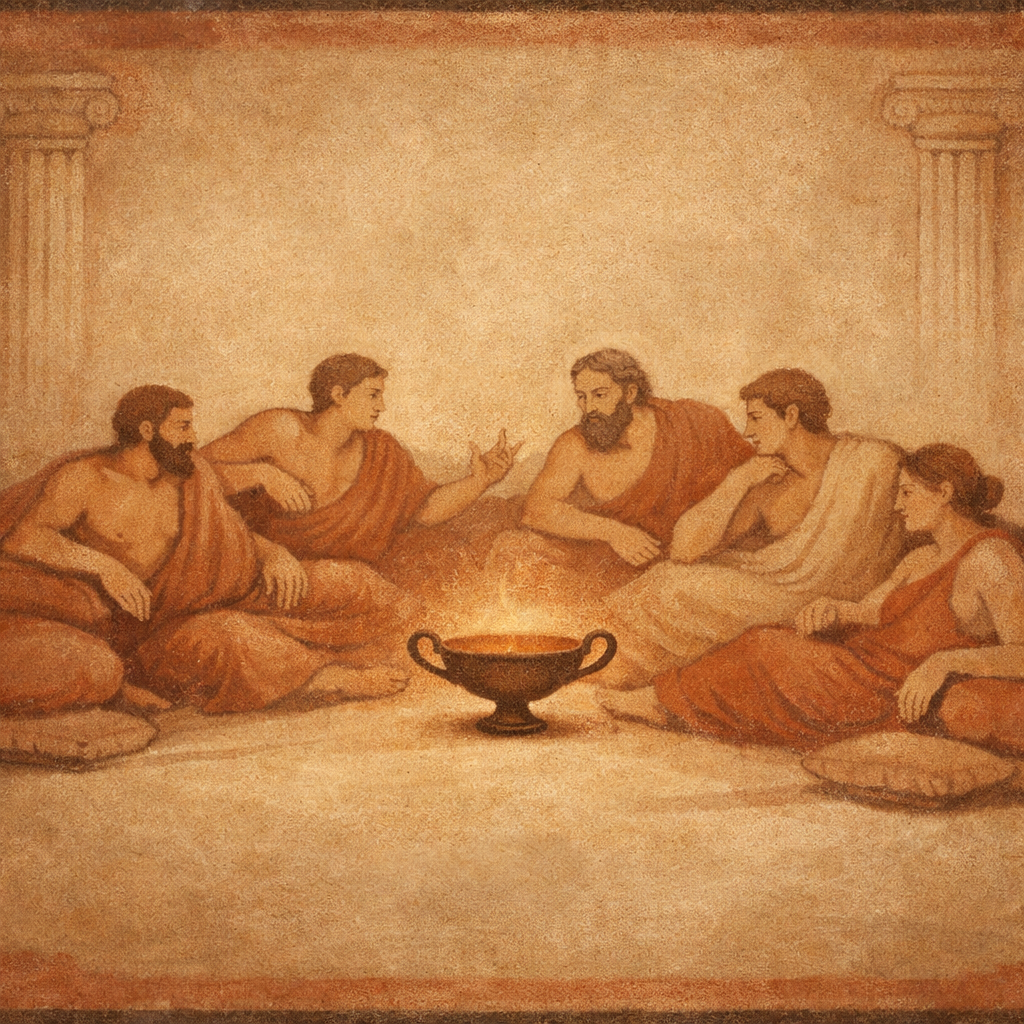
Agathon's speech, the most beautiful of the evening, has praised Love as the youngest and fairest of gods, the source of all virtue. Socrates dismantles this through a simple dialectical argument: love is always the love of something one lacks. If Love desires beauty, Love does not already possess beauty. Therefore Love cannot be beautiful — and so cannot be a god in the conventional sense of the divine as supremely beautiful and blessed. What then is Love?
'He is a great spirit (daimon), and like all spirits he is intermediate between the divine and the mortal.'
The Mediator
Diotima explains what a daimōn does: it mediates. Through Love, prayers and sacrifices pass from mortals to gods; commands and revelations pass back. The whole realm of religious practice — prophecy, ritual, incantation — depends on this intermediary function. Without Love, the divine and the human would remain in sealed separation, with no traffic between them. The philosopher's life is lived in this middle space: not divine (already wise) but not merely human (content with ignorance). It is a life of perpetual mediation.
The Parentage of Love
Love's nature follows from his birth. His father is Poros (Plenty or Resourcefulness), son of Metis (Wisdom), who fell drunk into Zeus's garden after Aphrodite's birthday feast. His mother is Penia (Poverty), who came begging at the feast and contrived to conceive a child by the sleeping Plenty. From his father, Love inherits the drive toward beauty, boldness, and resourcefulness. From his mother, he inherits neediness, roughness, and the permanent absence of what he seeks. He is always plotting, always hunting, always in love with the beautiful — and always lacking it.
The daimōn theory of Love appears in Diotima's teaching in the Symposium, Chapter 6. The idea of intermediary spiritual beings between gods and humans influenced Neoplatonism and, through it, the concept of angels in Christian theology.
Related Concepts