The Place Where No Creature Dwells
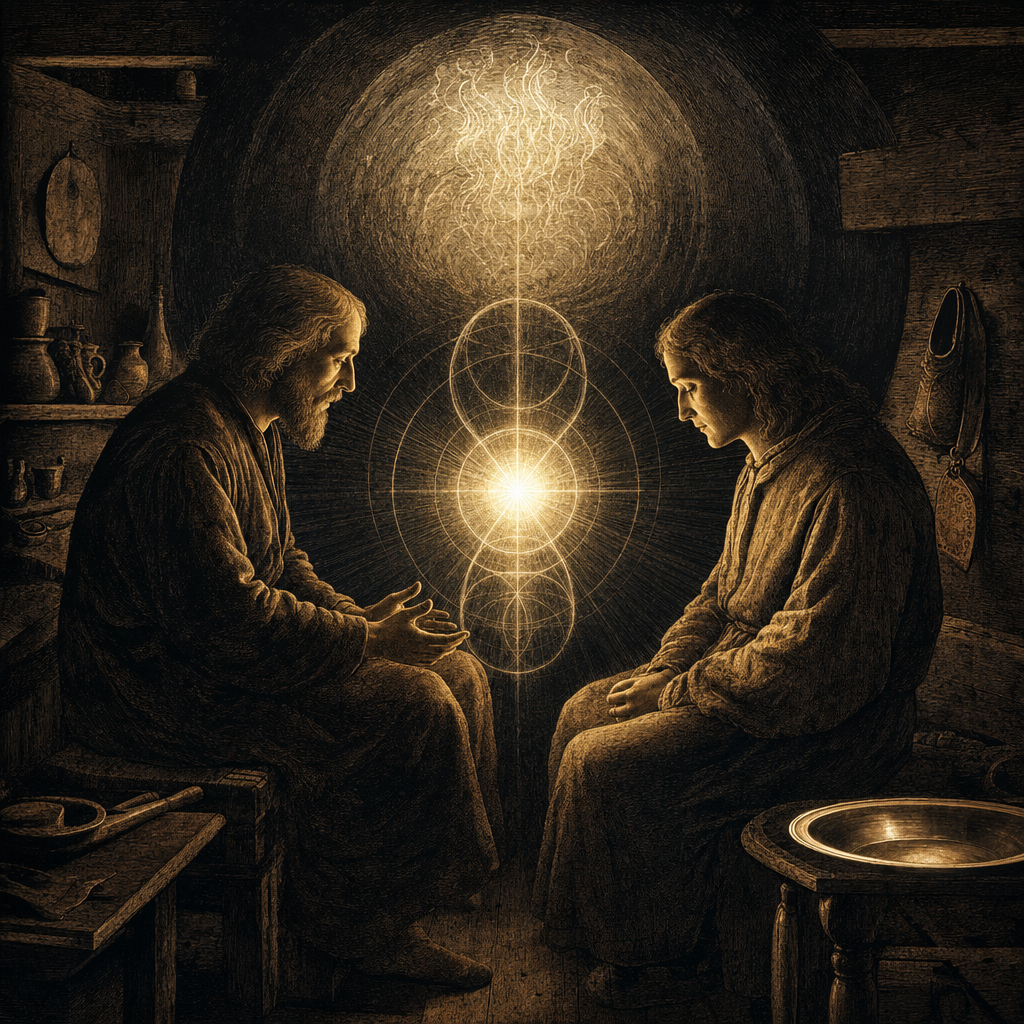
The disciple opens the first dialogue with the oldest question of mystical life: how may I see and hear God? The master's answer is precise and unsettling — God is already speaking, but the noise of self-will drowns him out. The ground where God speaks is not distant; it is the inner place where no creature dwells, which is simultaneously the deepest centre of the soul. To reach it requires nothing that looks like an action. It requires a cessation.
Son, when thou art quiet and silent, then art thou as God was before Nature and Creature; thou art that which God then was; thou art that whereof he made thy nature and creature. Then thou hearest and seest even that wherewith God himself saw and heard in thee, before ever thine own willing or thine own seeing began.
Stillness as Ontological Return
This is not ordinary quietism. Böhme is making a metaphysical claim: the soul in silence returns to its origin in the eternal, pre-creational moment. The "Supersensual Ground" is not above the soul in a spatial sense but beneath it — before individuation, before desire, before the distinction of subject and object. In that ground, the soul does not merely perceive God; it becomes the organ through which God perceives himself. Hearing and seeing are restored to their source.
The paradox is characteristic of Böhme's mystical logic: the more thoroughly a person empties themselves of self, the more completely they become what they essentially are. The creaturely will — that ceaseless motion of wanting, imagining, and judging — is not the true self but an obscuring layer. Strip it away and what remains is not nothing but the original image of God, the divine likeness that preceded the fall of the will into nature.
Practice and the Hourly Plunge
Böhme does not leave this as an abstract mystical ideal. When the disciple protests that worldly life prevents sustained stillness, the master offers a practical counsel: the practice need not be permanent; it can be performed once every hour, throwing the soul by faith beyond all creatures into the mercy of God. The intensity of the act matters more than its duration.
If thou dost once every hour throw thyself by faith beyond all creatures, beyond and above all sensual perception and apprehension, yea, above discourse and reasoning into the abyssal mercy of God, into the sufferings of our Lord, and into the fellowship of his interceding, and yieldest thyself fully and absolutely thereinto; then thou shalt receive power from above to rule over Death and the Devil and to subdue Hell and the World unto thee.
The consequence of this plunge, Böhme insists, is not passive absorption but active sovereignty. To enter the ground is to receive power — not over others in the worldly sense, but over the forces that normally tyrannise the soul from within: death, the devil, the world. The supersensual ground is not an escape from reality but the only vantage point from which reality can be ruled.
The concept of the Supersensual Ground is developed throughout Dialogue I; the hourly practice counsel appears near its close. The term reflects Böhme's debt to German speculative mysticism, particularly Meister Eckhart's notion of the Grunt (ground) of the soul.
Related Concepts