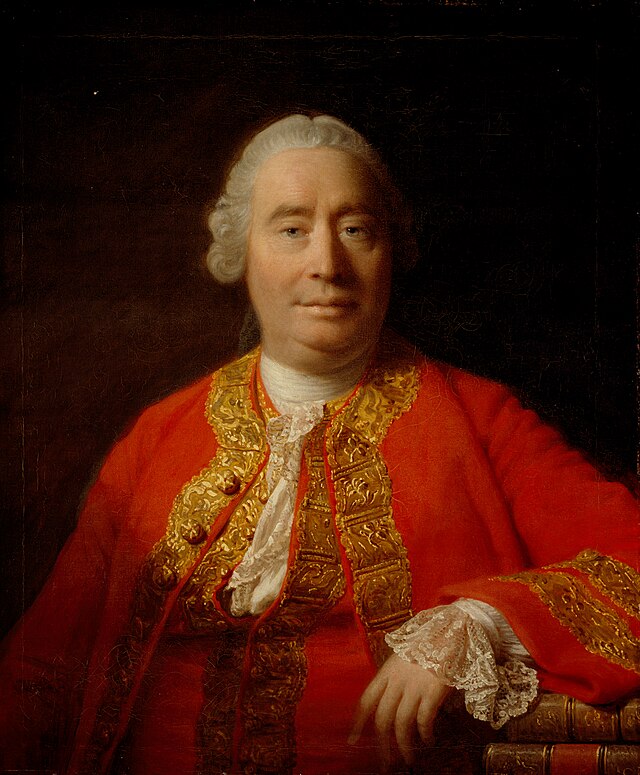
The Introspective Search
Philosophers who assert the existence of a substantial self — a persistent "I" that underlies and unifies all experience — claim to be reporting a self-evident fact of consciousness. Hume challenges them to point to it. When he enters most intimately into what he calls "himself," he always stumbles on some particular perception or other — of heat or cold, light or shade, love or hatred, pleasure or pain. He never catches himself at any time without a perception, and can never observe anything but the perception.
The Bundle
From this failure of introspection, Hume concludes that the mind is "nothing but a bundle or collection of different perceptions, which succeed each other with inconceivable rapidity, and are in perpetual flux and movement." There is no owner of these perceptions — the perceptions are all there is. Personal identity over time is not a metaphysical fact but a useful fiction: we attribute identity to a sequence of related perceptions (connected by resemblance and causation) in the same way we attribute identity to a river whose waters are constantly changing.
The Significance of the Bundle Theory
Hume's bundle theory was deeply influential and deeply troubling in equal measure. Kant took it as a reduction to absurdity: if there is no persistent self to unify experience, the unity of experience itself becomes inexplicable. The bundle theory also challenges the coherence of first-person reasoning about the future: if I am merely a bundle of present perceptions, why should I care about the welfare of the future bundle that will succeed me? The theory anticipates both Buddhist analyses of the self and contemporary neuroscientific models of personal identity as narrative construction.
The bundle theory of personal identity is developed in Book I, Part IV, Section VI of the Treatise, "Of Personal Identity." In the Appendix, Hume admits to being dissatisfied with his own account, confessing that he sees a difficulty in explaining how disparate perceptions are united into a connected sequence without either a binding principle he cannot find or a self he cannot admit.
Related Concepts