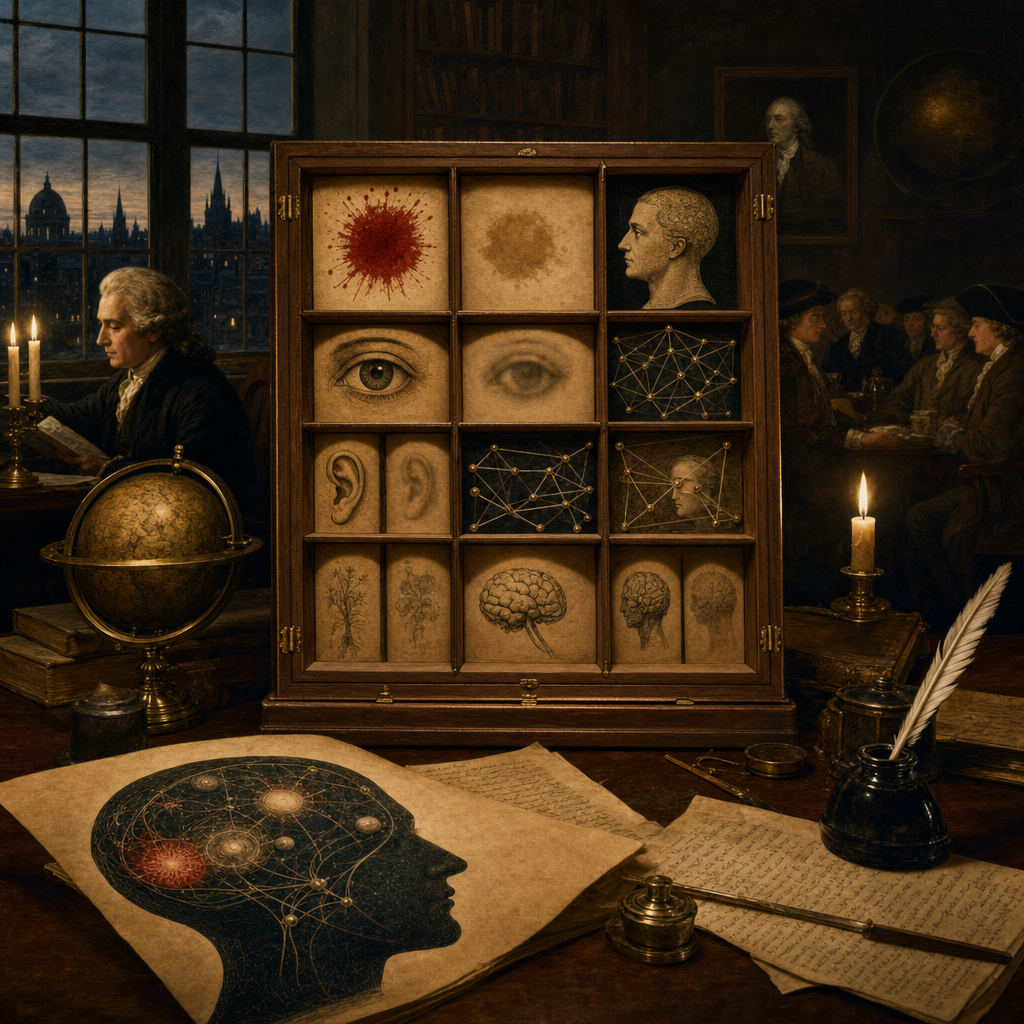
A Treatise of Human Nature is Hume's earliest and most systematic philosophical work, published in three volumes when he was just twenty-six years old, and the foundation on which all his later philosophy rests. Subtitled "An Attempt to Introduce the Experimental Method of Reasoning into Moral Subjects," it applies Newtonian scientific method — observation, experiment, and cautious generalisation — to the study of human nature itself. Book I, "Of the Understanding," develops Hume's epistemology: the distinction between impressions (vivid sense perceptions) and ideas (fainter mental copies), the copy principle, the association of ideas by resemblance, contiguity, and causation, the sceptical analysis of causation as nothing more than constant conjunction and the mind's habit of expectation, the denial of a substantial self (the "bundle theory" of personal identity), and the demonstration that abstract reasoning alone cannot motivate action or ground moral judgment. Book II, "Of the Passions," presents a detailed empirical psychology of the emotions, distinguishing calm and violent passions, direct and indirect passions, and arguing that reason is and ought only to be the slave of the passions. Book III, "Of Morals," grounds ethics in sentiment rather than reason: moral judgments express the approval or disapproval of the spectator's sympathetic emotional responses, not the deliverances of pure reason. The Treatise was ignored on publication ("it fell dead-born from the press," Hume later wrote) but became one of the most influential philosophical works in the Western tradition, shaping Kant, Reid, and the entire subsequent course of analytic and continental philosophy.
Full text not available
This work isn't available here yet. In the meantime you can purchase a copy on Amazon, or check back later, as we are always adding books to our library.
As an Amazon Associate we earn from qualifying purchases.
More by David Hume

An Enquiry Concerning Human Understanding
David Hume
1748
Free
An Enquiry Concerning Human Understanding
David Hume
An Enquiry Concerning the Principles of Morals
David Hume
1751
An Enquiry Concerning the Principles of Morals
David Hume