Appearance as Inner Truth
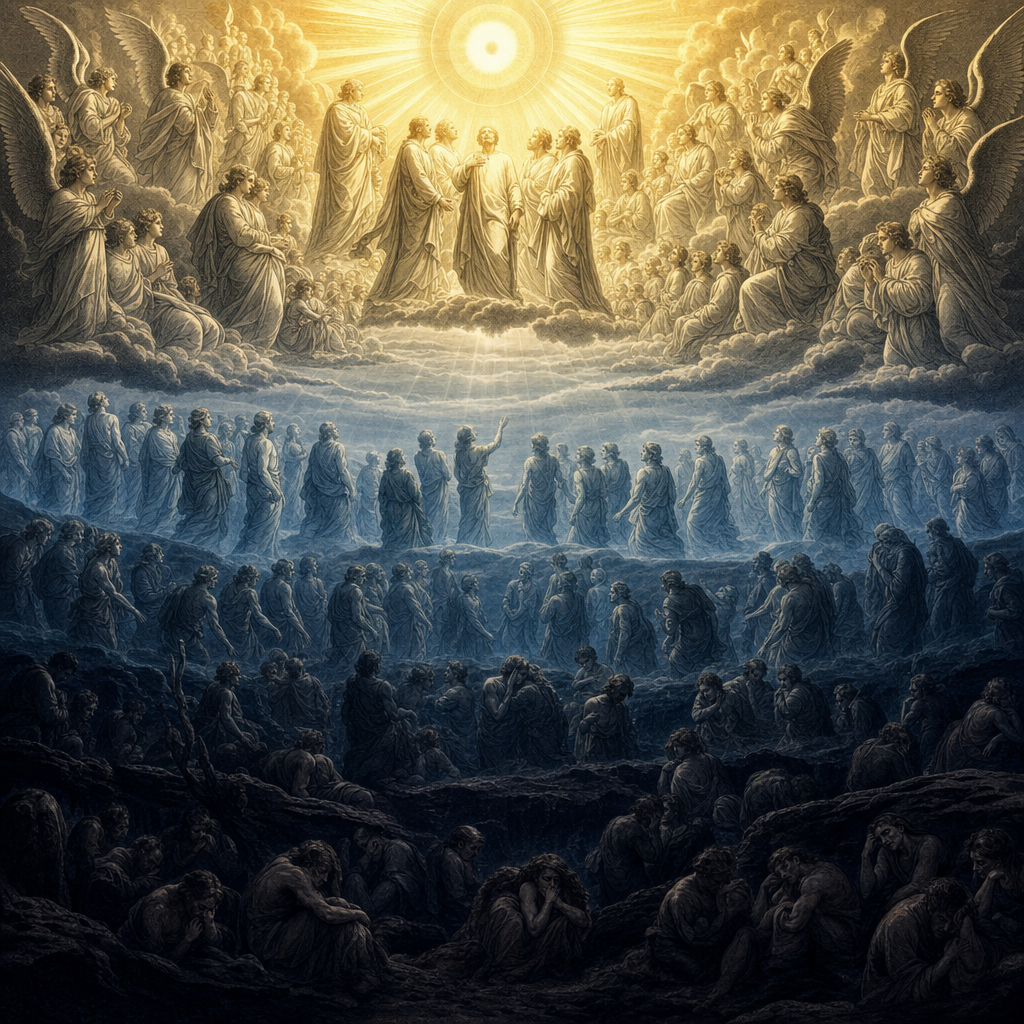
Swedenborg reports that in the spirit world, faces, gestures, clothing, and environment all correspond directly to the quality of the spirit's inner life. A spirit that harbours a loving, wise character will appear beautiful and luminous; one whose inner life is dominated by malice or pride will appear correspondingly distorted and shadowed. This is not judgment from outside — no one assigns these appearances — but the direct outward expression of inward reality under conditions where the usual mechanisms of concealment no longer operate.
all who are in heaven are forms of love and charity, and appear in ineffable beauty, with love shining forth from their faces, and from their speech and from every particular of their life.
Freedom and the Absence of Pretence
The practical consequence is that spirits naturally and inevitably find themselves among those who share their quality of love. Communities in heaven are not organised by administrative decree but by affinity: spirits flow toward what loves them and are repelled by what is unlike them. This is what Swedenborg means when he says that hell is self-chosen — not that spirits are forced into hell as punishment but that they are drawn there by their own dominant loves, which find their natural home there.
those that had been in good affections appeared with beautiful faces; but those that had been in evil affections with misshapen faces; for man's spirit, viewed in itself, is nothing but his affection; and the face is its outward form. Another reason why faces are changed is that in the other life no one is permitted to counterfeit affections that are not his own, and thus assume looks that are contrary to his love. All in the other life are brought into such a state as to speak as they think, and to manifest in their looks and gestures the inclinations of their will.
In the intermediate state between death and final settlement, spirits undergo a process of exteriorisation: whatever was most truly theirs in life gradually comes to dominate and express itself fully. Swedenborg describes this as a stripping away of the layers of social performance that overlay the genuine character during earthly life. What was innermost becomes outermost — and what remains is the real person, more fully themselves than they were able to be in the body.
The transparency of inner and outer is a pervasive theme throughout Heaven and Hell. Swedenborg uses it to ground his account of why spirits end up in communities that suit their loves — a principle he calls "association by affinity."
Related Concepts