The Intuition to Be Overcome
The intuition Dennett wants to overcome is what he calls the "intentional fallacy" applied to nature: the assumption that wherever there is purpose or meaning, there must be a purposer or meaner who intended it. A heart has the function of pumping blood, and this seems to presuppose someone who meant it to pump blood. A word means something, and this seems to presuppose a speaker who meant it. If Darwinian evolution removes the designer from biology, does it remove meaning from biology too? And if it removes meaning from biology, does it threaten the meaningfulness of human intentions and language as well?
Free-Floating Rationales
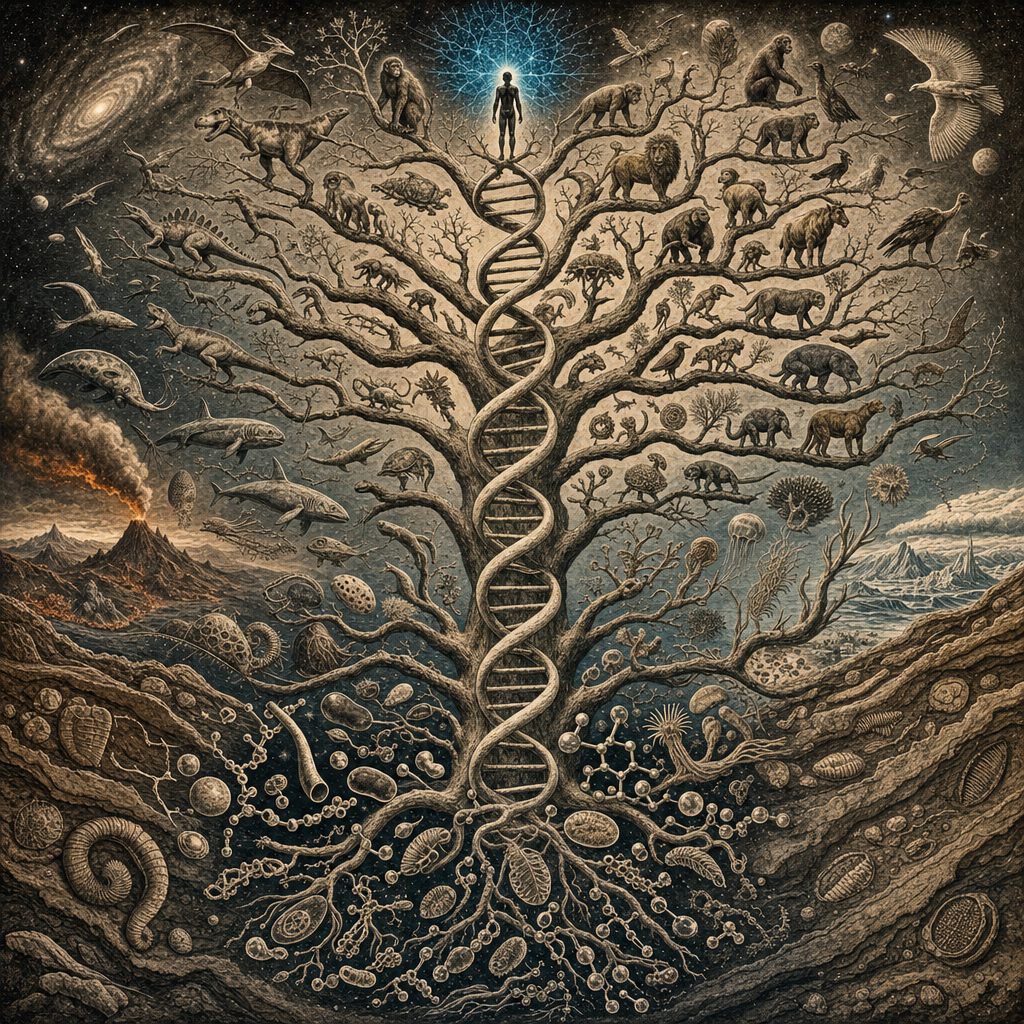
Dennett's response is that natural selection generates what he calls "free-floating rationales" — reasons for features of organisms that are genuinely explanatory without requiring that anyone thought of them. The heart pumps blood because organisms with hearts that pumped blood survived better than those with hearts that didn't. This is a genuine reason — a genuine explanation of why hearts pump blood — even though no one intended it. The rationale floats free of any intender; it is real as a structure of evolutionary explanation even though it was never in anyone's mind.
The Ascent to Human Meaning
The same logic applies, mutatis mutandis, to human meaning and intention. Human beings are products of evolution; their capacity for intentionality — for genuinely meaning things — is itself a product of the mindless algorithm. But this does not reduce human meaning to mere mechanism or show that it is illusory. Rather, it shows that genuine meaning can be generated bottom-up, by processes that do not themselves have it. Our intentions are real; our meanings are genuine; our values matter — not in spite of their evolutionary origins but by virtue of being the kind of complex, adaptive phenomena that the algorithm produces at sufficient complexity. Darwin's dangerous idea, properly understood, does not undermine meaning but explains how it came to be.
Dennett's treatment of meaning and intentionality in Darwin's Dangerous Idea connects to his earlier work in Intentional Stance (1987) and Brainstorms (1978). The view that intentionality and meaning are real patterns in complex systems — not reducible to physics but not requiring anything beyond physics — is called by Dennett "mild realism" about the intentional stance. It is one of the most contested positions in contemporary philosophy of mind.
Related Concepts