What a Crane Is
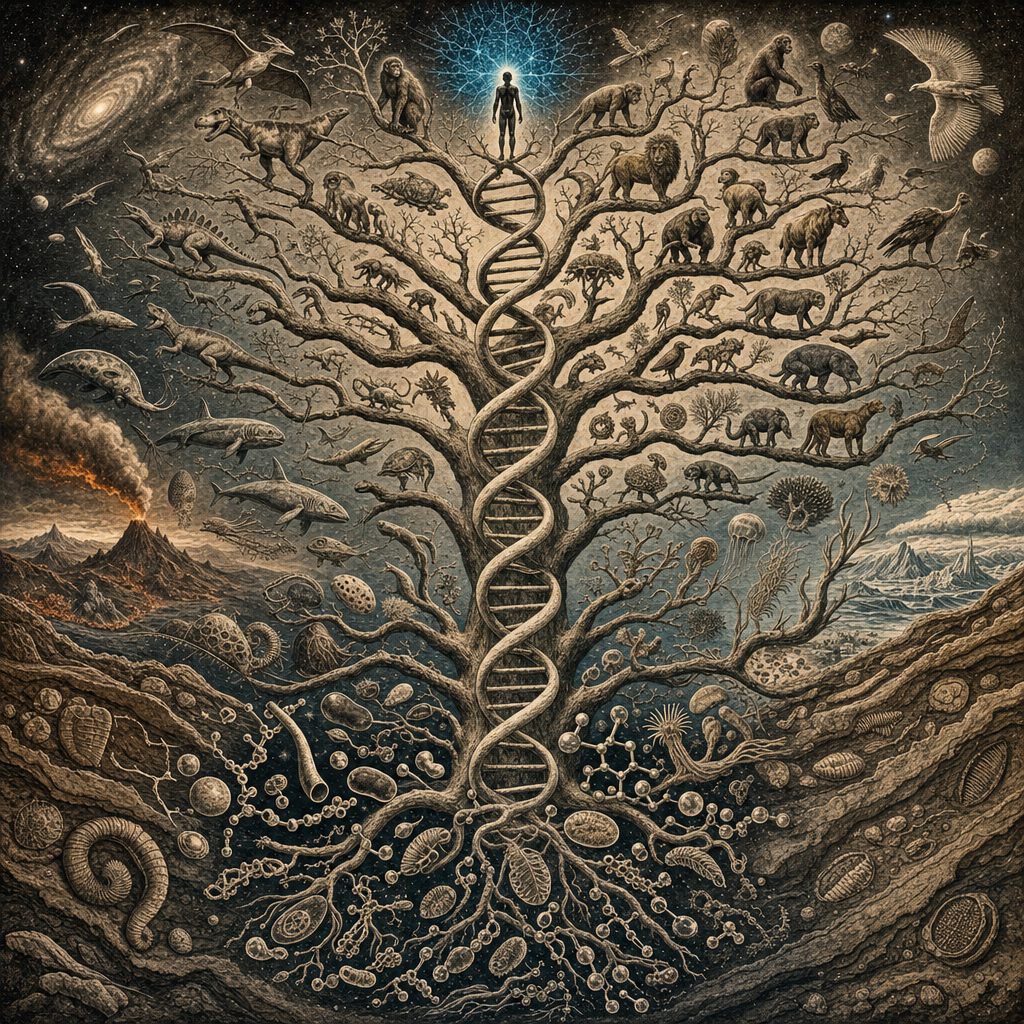
A crane is a device that allows you to lift things to greater heights than you could without it — but it is itself constructed from materials at ground level, by processes that begin from simpler components. In Dennett's metaphor, a crane is any process that generates higher levels of complexity or order by building on what is already at a lower level. Natural selection is the paradigm crane: it builds adapted complexity from the bottom up, one small step at a time, using only the materials available at each stage. Each step is possible given what preceded it; no step requires importing anything from outside the causal order.
What a Skyhook Is
A skyhook is an imaginary device that hangs from the sky — not supported from below but reaching down from above. In Dennett's usage, a skyhook is any explanatory move that posits a source of order that is not itself explained by lower-level processes: a divine creator, a life force, a directional tendency in evolution, a strong version of the anthropic principle, consciousness as a non-physical causal force. Skyhooks are tempting because the complexity of life seems to demand explanation from something equally complex or more so. But Dennett argues that this is the wrong intuition: genuine explanation must be bottom-up, or it is not explanation at all.
Against Gould's Skyhooks
Dennett's most sustained polemic in Darwin's Dangerous Idea is against Stephen Jay Gould, whom he accuses of repeatedly invoking skyhooks — of claiming that natural selection is insufficient to explain various biological phenomena and therefore invoking additional top-down principles (punctuated equilibrium as saltation, spandrels as architectural constraints that limit selection, the contingency of the Cambrian explosion as showing that replay would be radically different). Dennett argues that each of these phenomena is explicable by cranes alone — by the interaction of many bottom-up processes — and that Gould's skyhooks are motivated by a desire to protect a domain of culture and meaning from Darwinian reduction.
The skyhook/crane distinction is Dennett's most vivid contribution to the philosophy of evolutionary biology and has been widely adopted as a useful framework in discussions of explanation in biology. The debate with Gould was one of the liveliest in evolutionary biology's public life in the 1990s; Gould died in 2002 before it could be fully resolved. Dennett's position aligned with Richard Dawkins's adaptationism, though Dennett and Dawkins disagreed on some details.
Related Concepts