Parallel Editing, Not a Single Stream
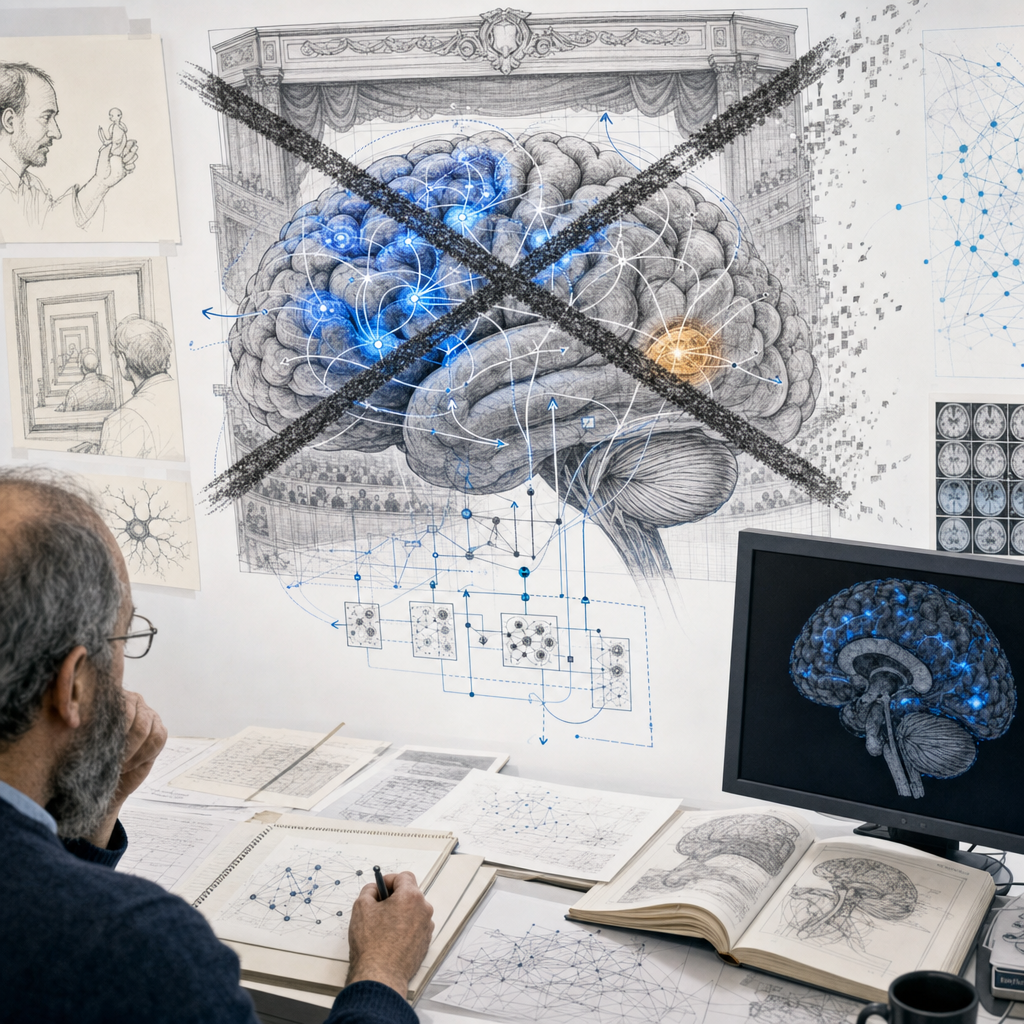
The brain receives sensory input and immediately begins processing it in multiple places and at multiple levels simultaneously. Each processing stream generates its own "draft" — its own preliminary interpretation of what is happening. These drafts are constantly being revised, updated, and replaced as new information comes in and as different processing streams interact. There is no master draft that serves as the final, authoritative version of what is experienced; there are only more-or-less stable, more-or-less influential drafts, none of which has privileged status as "what was really experienced."
No Fact of the Matter About Timing
One of the most striking consequences of the Multiple Drafts model concerns temporal consciousness. Dennett argues that there is no single "moment of consciousness" at which an experience happens — and therefore no fact of the matter about when exactly a given experience occurred in the brain. The intuition that there must be such a moment is an artefact of the Cartesian Theater model: if there were a place where everything came together for a unified observer, there would be a moment when information arrived there. Without the Theatre, there is no privileged moment of arrival, only a continuous process of parallel editing.
The Self as a Narrative Centre of Gravity
If there is no single place or moment of consciousness, what becomes of the self — the apparently unified experiencer? Dennett's answer is that the self is a "centre of narrative gravity": a useful fiction generated by the brain's storytelling processes, not a real entity that has experiences. Just as a centre of gravity is a useful calculational tool that does not correspond to any particular atom, the self is a useful way of organising the brain's representations of itself and its history — without any single neuron or brain region actually being the self. This is not eliminativism (the self does not exist) but a deflationary account (the self exists as a pattern, not as a thing).
The Multiple Drafts model was first published in Consciousness Explained (1991) and has been refined in subsequent papers, most notably in "Time and the Observer" (with Marcel Kinsbourne, 1992). It is one of the most debated theories in philosophy of mind, with critics arguing that it does not so much explain consciousness as explain it away.
Related Concepts