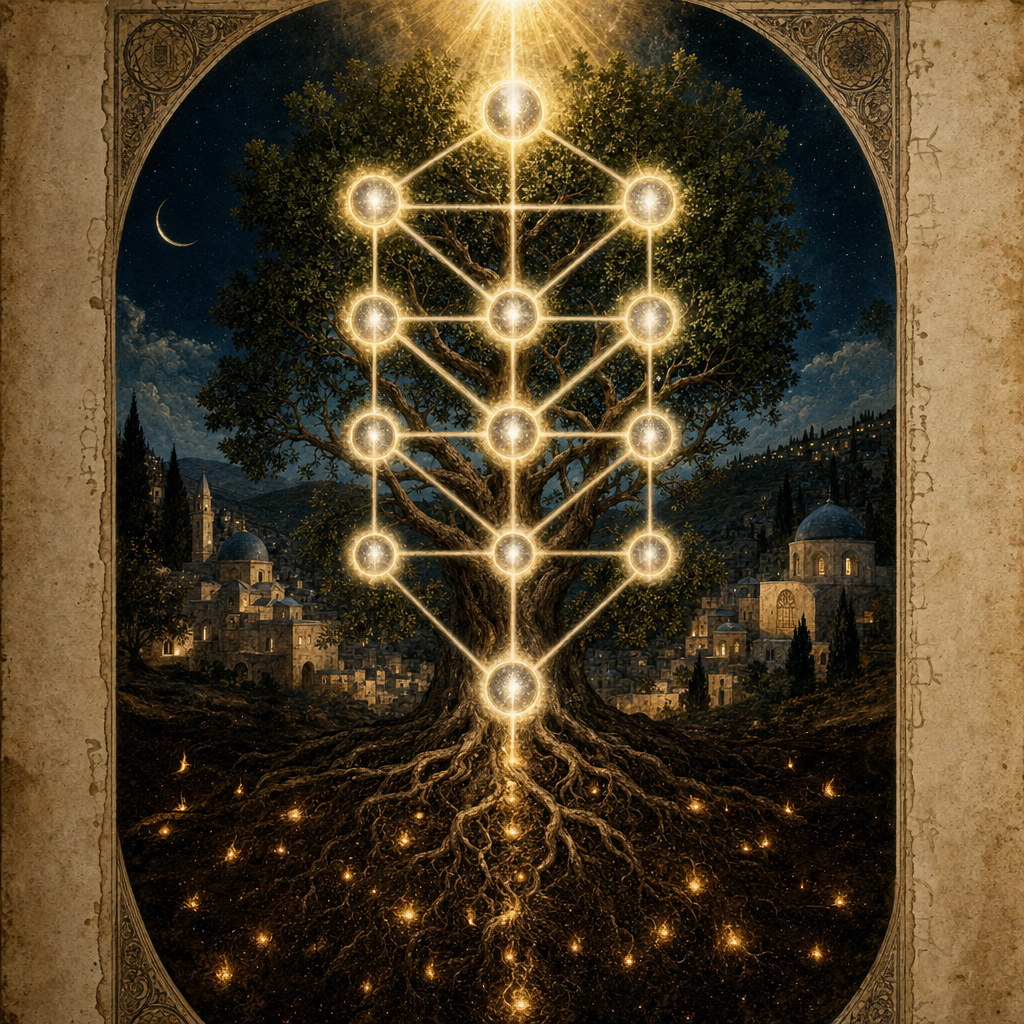
The Tree of Life
The sefirot are traditionally arranged in the form of a tree (the Etz Chaim that gives Vital's compilation its name): three columns, ten nodes, twenty-two connecting paths. The ten sefirot are: Keter (Crown), Chokhmah (Wisdom), Binah (Understanding), Chesed (Loving-kindness), Gevurah (Strength/Judgement), Tiferet (Beauty/Harmony), Netzach (Eternity), Hod (Splendour), Yesod (Foundation), and Malkhut (Kingdom/Presence). They form pairs of opposing qualities — expansion and contraction, mercy and judgement — balanced by harmonising sefirot between them.
Partzufim: The Divine Faces
Luria's most significant innovation was the doctrine of the partzufim — the divine faces or configurations. After the shattering of the vessels and the beginning of tikkun, the sefirot are reorganised into larger structures called partzufim: Arikh Anpin (the Long Face — patience and divine mercy), Abba (Father — Chokhmah), Imma (Mother — Binah), Zeir Anpin (the Short Face — the six sefirot from Chesed to Yesod, associated with active divine providence), and Nukva (the Feminine — Malkhut). These partzufim interact dynamically — their relationships, unions, and separations constitute the inner life of the divine and determine the condition of the created world.
The Human as Microcosm
A central axiom of Kabbalah is that the human being is a microcosm of the divine — the sefirot are simultaneously the structure of God, the structure of the cosmos, and the structure of the human soul. This correspondence means that human actions — including mental, emotional, and volitional states — have direct effects on the divine configurations. When a person practises patience (emulating Arikh Anpin) or acts with loving-kindness (Chesed) in the world, they are not merely performing moral acts but actively participating in and supporting the divine self-expression. The inner life of the human being is the inner life of the cosmos in miniature.
The sefirot are the shared inheritance of all branches of Kabbalah, from the early Sefer Yetzirah through the Zohar to Luria's system. Luria's specific contribution — the partzufim and the dynamic account of their interactions — is developed extensively in Etz Chaim.
Related Concepts