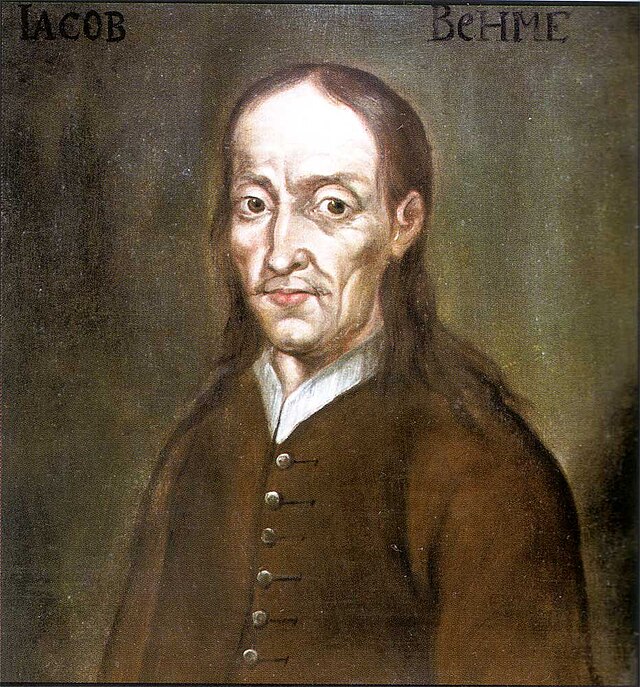
Imagination as Forming Power
Böhme's concept of Einbildung — literally "forming-into" — treats imagination not as the production of mental images but as the active forming of one thing within another. When God imagines himself in Sophia, he gives shape to the infinite potentiality of the Ungrund. Creation, similarly, is God's imagination expressing itself in time: the eternal images made temporal, the inner forms externalised in matter. To imagine, in the deepest sense, is to make real.
Human Imagination
Human imagination carries a corresponding power, though in degraded form. Böhme takes seriously the idea that what we imagine affects what we become and what we attract. The soul that imagines evil draws the dark fire toward itself; the soul that imagines the divine light draws toward it the second principle. Imagination is not merely representational but participatory: it touches the reality it images and is touched in return. This is why prayer, for Böhme, is a form of holy imagination.
Sophia as the Divine Image
Sophia, the divine wisdom, is the image in which God sees himself — the perfect product of divine imagination. She is not a second God but the self-image of the divine nature, containing all the archetypes of creation. Mysticism, for Böhme, is ultimately the soul's coming to see itself in Sophia's mirror — recognising, in the divine image, its own original nature before it was darkened by self-will.
Böhme's concept of imagination significantly influenced Coleridge, who developed his famous distinction between Imagination and Fancy partly in dialogue with Böhme's ideas. The Romantic elevation of imagination from a merely reproductive faculty to a creative, world-forming power has deep roots in Böhme's theosophical framework.
Related Concepts