Permission Is Not Willing
Swedenborg draws a firm distinction between what God wills and what God permits. God wills only good. But God permits evil because the alternative — the elimination of the freedom to do evil — would also eliminate the freedom to do good, since freedom is indivisible. A will that can only choose rightly is not a will at all but a mechanism. To create beings capable of genuine love, God must create beings capable of genuine refusal.
This does not mean evil is without consequence in Swedenborg's system. Evil is its own punishment — not because God inflicts suffering but because evil is, by its nature, the distortion of the will's capacity for love, and a distorted will suffers the consequences of its own distortion. Hell is not an external imposition but the natural condition of a love that has turned entirely in on itself.
Providence and the Appearance of Accident
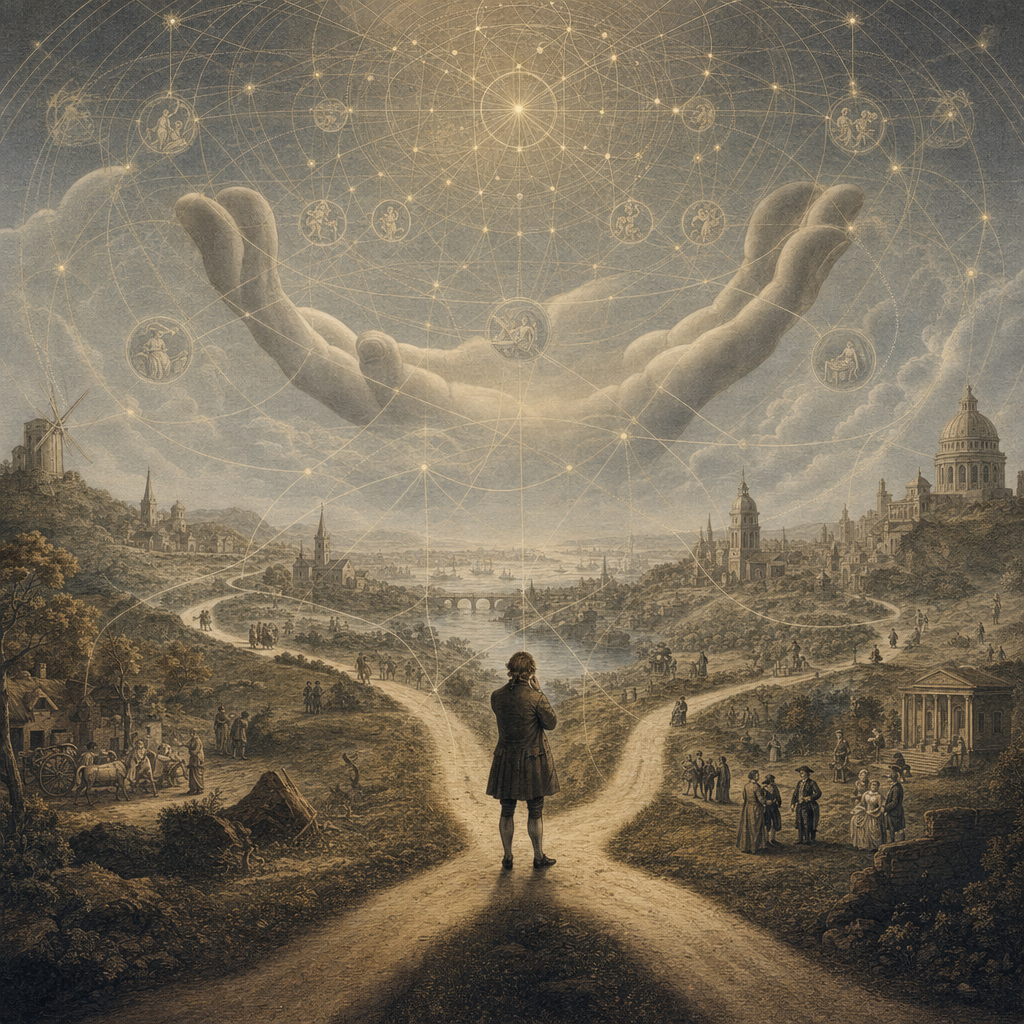
One of Swedenborg's most audacious claims is that nothing happens by chance — that every event, however contingent it appears, is ordered by providence toward ends that take eternity into account. This does not mean individual events are obviously good; Swedenborg acknowledges that from within temporal life, providence is largely invisible. But the order it maintains is not the order of each moment but the order of the whole — and the whole has an end which is the eternal happiness of all who are willing to receive it.
The treatment of evil in Divine Providence complements Swedenborg's earlier accounts in Heaven and Hell of why hell is self-chosen. Together they constitute a theodicy that is more consequentialist than retributive — evil is permitted because the alternative is worse, and its consequences are the consequence of its own nature rather than divine punishment.
Related Concepts