The Covenant
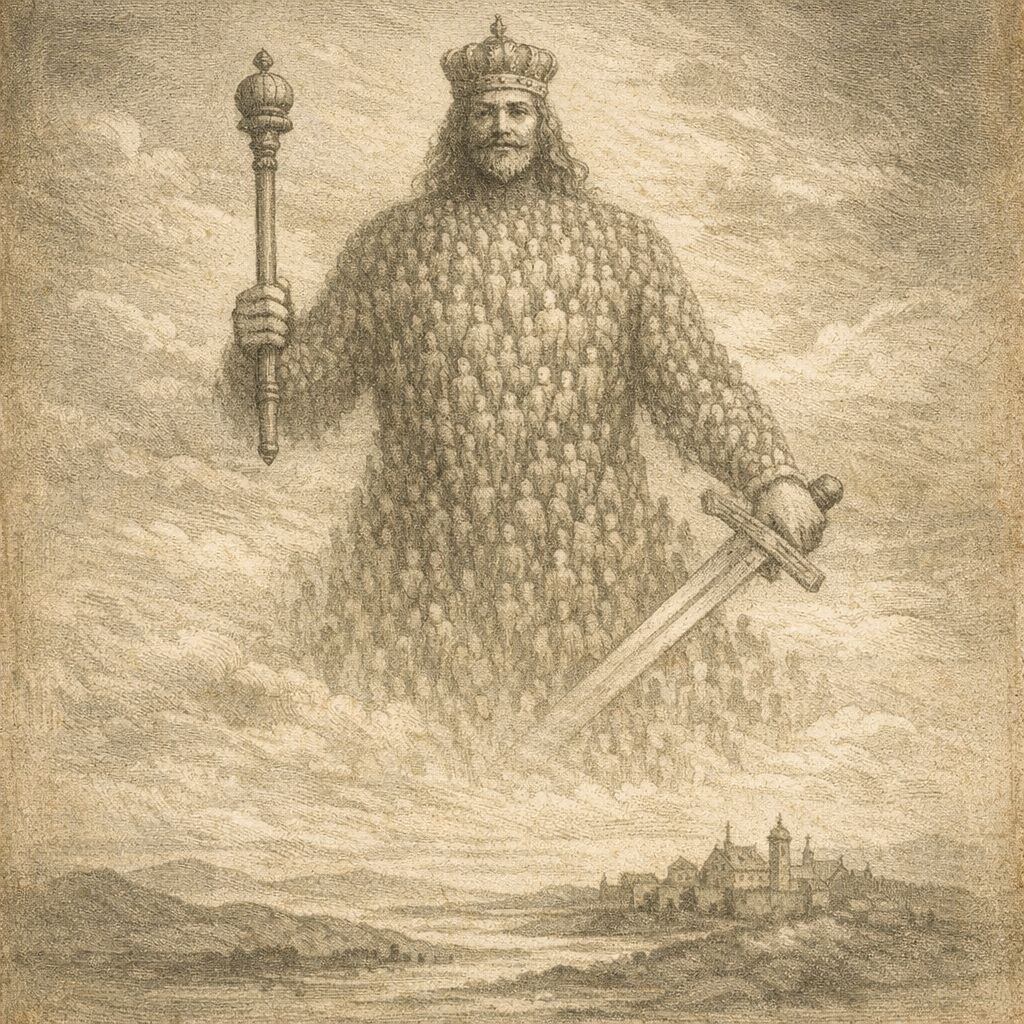
The Leviathan is created by covenant: each person agrees with every other person to give up their natural right of self-governance to a single representative — a man or an assembly — on condition that everyone else does the same. This covenant is not an agreement between the people and the sovereign; it is an agreement among the people themselves. The sovereign is not a party to the covenant but its product — and therefore cannot be bound by it or held in breach of it.
I Authorise and give up my Right of Governing my selfe, to this Man, or to this Assembly of men, on this condition, that thou give up thy Right to him, and Authorise all his Actions in like manner.
The Mortal God
Hobbes calls the Leviathan a mortal god — the greatest power achievable by human art, just below the immortal God who created nature. The sovereign holds all the power of every subject, unified in one person or assembly. This unification is what makes peace possible: where power is divided, there is always the possibility of conflict between the parts, and the state of nature reasserts itself in the form of civil war. Hobbes had lived through the English Civil War; for him, divided sovereignty was not a safeguard but a catastrophe.
This is the Generation of that great LEVIATHAN, or rather (to speake more reverently) of that Mortall God, to which wee owe under the Immortall God, our peace and defence.
Why Sovereignty Cannot Be Limited
Hobbes is relentless in defending the indivisibility and irrevocability of sovereignty. Subjects cannot protest the sovereign's actions on the grounds that they did not consent — because they have already authorised those actions by the covenant. They cannot appeal to a higher law — because the sovereign is the source of civil law, and there is no superior authority to adjudicate between subjects and sovereign. They cannot overthrow the sovereign — because to do so is to authorise one's own punishment, as every subject is author of the sovereign's acts.
This does not mean subjects are without protection. Hobbes insists that the sovereign's power is limited by the original purpose of the covenant: preserving life. Subjects retain the right to refuse orders to kill themselves, and the sovereign who fails to protect his subjects forfeits their obligation. But within the vast space between that minimal limit and absolute power, sovereignty is total. The Leviathan is a disturbing vision — and Hobbes knows it. His point is that the alternative is worse.
The creation of the sovereign by covenant is described in Chapter XVII of Part II. The famous "Mortall God" phrase appears at the end of that chapter. Hobbes's account of the limits of sovereign power — and the rights subjects retain — runs through Chapters XVIII and XXI.
Related Concepts