The Danger of False Certainty
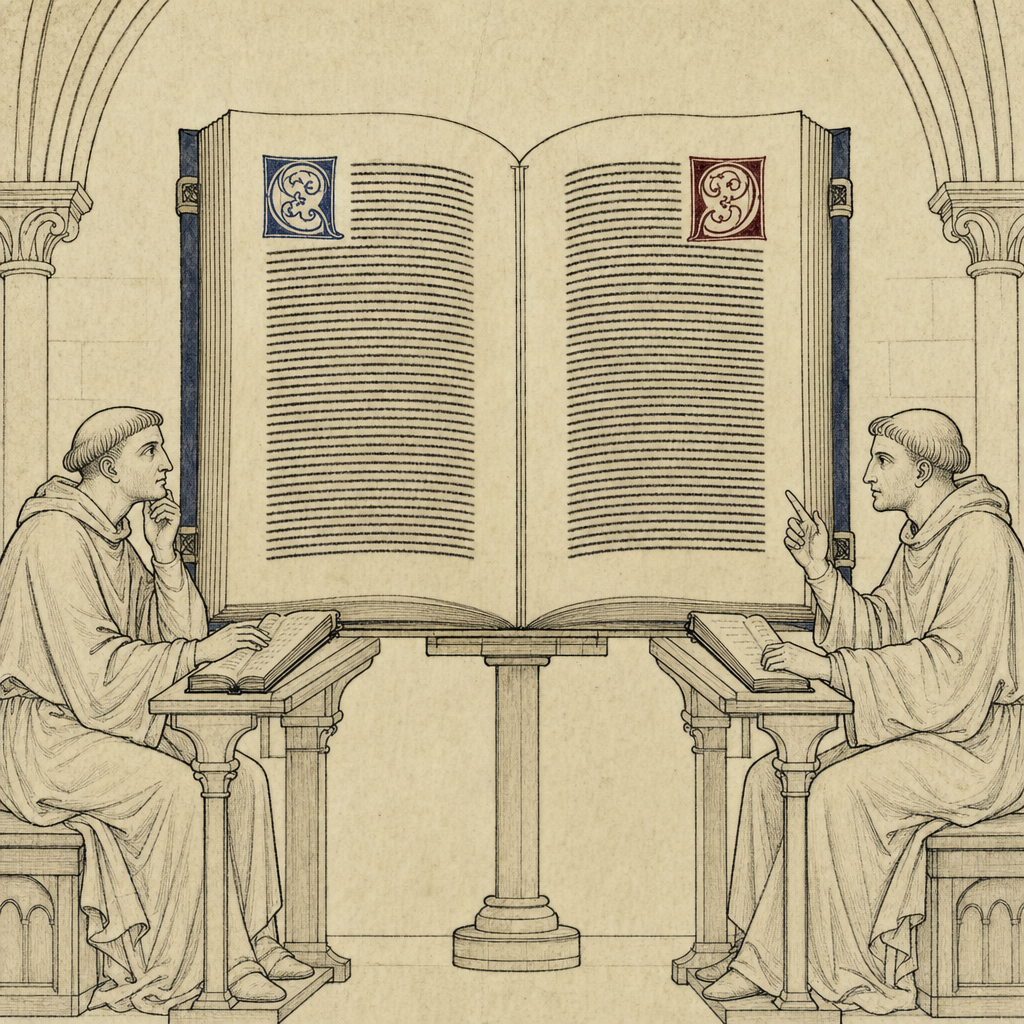
Abelard worries about the person who has never seriously doubted. Such a person does not actually hold their beliefs — their beliefs hold them, unreflectively, by custom and repetition. A faith that has never been tested does not know what it believes or why; it cannot defend itself against a serious objection; it cannot distinguish between the essential and the peripheral. The willingness to question is therefore not a symptom of weak faith but a precondition of mature faith.
Socratic Roots
Abelard's method has deep roots in Platonic dialectic. Socrates, as Abelard knew him through Latin sources, proceeds by questioning — not asserting but asking, not answering but revealing the contradictions in others' answers. Abelard imports this interrogative stance into Christian theology, with the crucial difference that his questions are addressed not to individuals but to texts, and his goal is not the confession of ignorance but the resolution of apparent contradictions through charitable reading and sustained argument.
Inquiry as Devotion
For Abelard, to think carefully about God is to honour God. A theology that refuses to think — that suppresses difficult questions in the name of orthodoxy — fails God by treating divine truth as too fragile to withstand scrutiny. The intellect is a faculty given by God, and its exercise in theological inquiry is itself a form of worship. This is the most fundamental conviction behind Sic et Non: that rigorous inquiry and genuine piety are not merely compatible but inseparable.
The phrase "dubitando enim ad inquisitionem venimus; inquisitione veritatem percipimus" appears in Abelard's prologue to Sic et Non and is one of the most cited sentences in medieval philosophy. It echoes the Socratic tradition while reframing doubt as a theological virtue rather than a spiritual danger.
Related Concepts