Contradiction as Starting Point
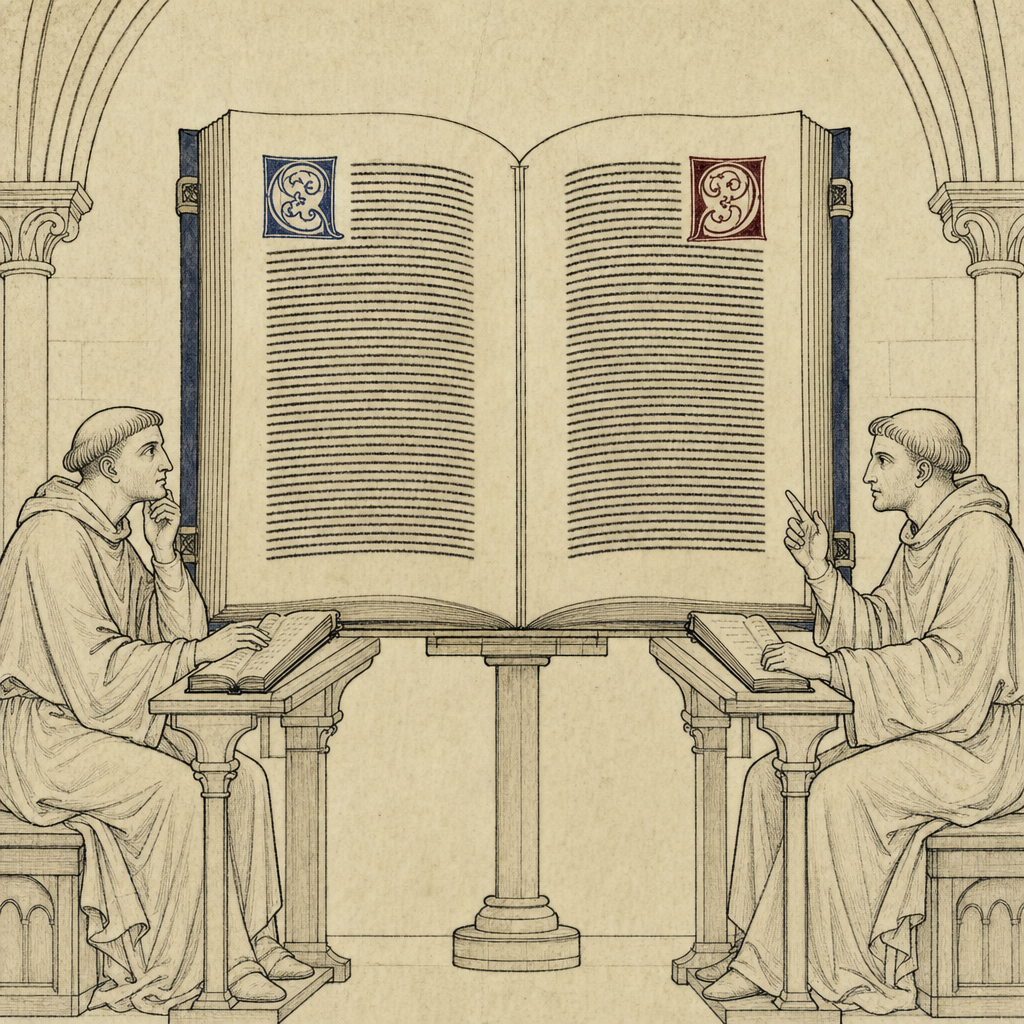
Medieval scholars before Abelard were well aware that Church Fathers contradicted each other. The standard response was to minimise the conflict, appeal to a higher authority, or simply choose one side. Abelard's innovation in Sic et Non is to make the contradiction the starting point rather than a problem to be dissolved. He assembles 158 theological questions and, for each, lines up contradictory citations from Augustine, Jerome, Ambrose, Gregory, and others — without adjudicating between them.
Rules for Reading Authority
The prologue to Sic et Non is itself a masterclass in hermeneutics. Before presenting any of the 158 questions, Abelard lays out principles for interpreting apparently contradictory authorities: consider whether a text is authentic; ask whether the author later retracted it; distinguish between a firm statement and a tentative one; determine whether the author is speaking for himself or reporting another's view; attend to context and the question being addressed. These rules do not dissolve authority — they make its exercise intelligent.
Reason as the Servant of Faith
Abelard's critics accused him of reducing theology to dialectic. His actual position is more nuanced. Reason does not replace faith or authority; it mediates between competing authorities and renders their content intelligible. "By doubting we come to enquiry," he writes in the prologue, "and by enquiry we perceive the truth." The goal is understanding, not the suspension of belief. Sic et Non is a training manual: it produces readers who can think, not readers who have stopped believing.
Sic et Non was composed around 1120 and circulated widely in cathedral schools. Its method directly influenced Peter Lombard's Sentences (c. 1150) and ultimately Aquinas's Summa Theologiae, both of which adopt the objection-reply format that Abelard pioneered.
Related Concepts