Two Conceptions of Time
There are, Bergson says, two possible ideas of time: one free from all alloy, the other surreptitiously bringing in the idea of space. The clock’s time — homogeneous, divisible, made of identical moments set side by side — is space in disguise. The other, pure duration, is what consciousness lives when it simply lets itself be.
Pure duration is the form which the succession of our conscious states assumes when our ego lets itself live, when it refrains from separating its present state from its former states.
The Melody
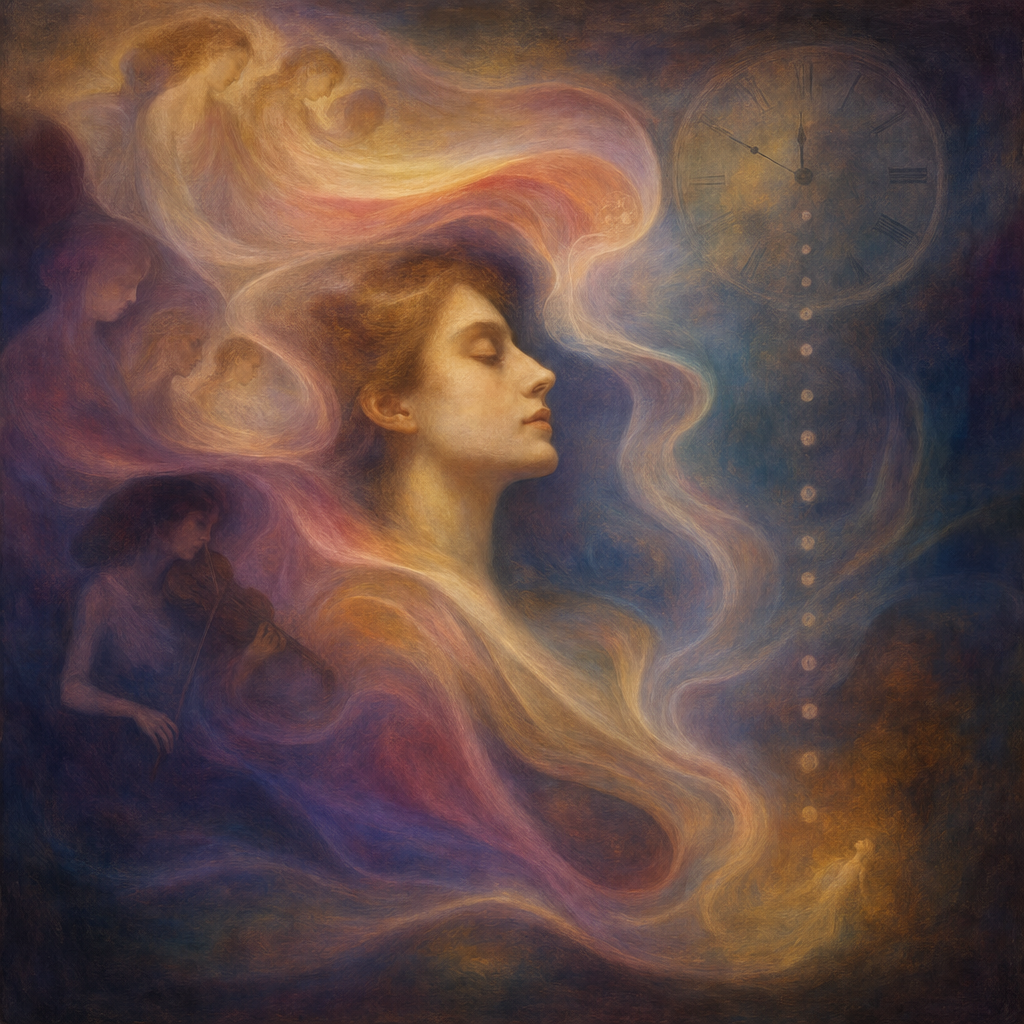
Bergson’s recurring image is a tune. The notes of a melody succeed one another, yet we perceive them in one another; each interpenetrates the next, and the whole is felt as an organic unity. Interrupt the rhythm and it is not the added length but the changed quality of the whole phrase that tells us something is wrong. Duration has this structure: succession without separation, multiplicity without number.
Why It Matters
Almost every philosophical puzzle Bergson touches — intensity, motion, free will — arises, he argues, from importing spatial habits into this inner flow. Restore pure duration, and the puzzles dissolve. The task of philosophy is to think in time rather than in space, to recover the immediate data of consciousness beneath the symbols we have laid over them.
Pure duration is defined in Chapter II of Time and Free Will (1889, trans. F. L. Pogson 1913).
Related Concepts