Against Allegorical Reduction
The Enlightenment had two main strategies for handling mythology: read it as allegory (the gods are personifications of natural forces or moral qualities) or dismiss it as error (primitive humanity's confused attempt to explain what science now explains better). Schelling rejects both. Myths are not allegories because their creators did not experience them as standing for something else — the Greek did not think Zeus was a symbol for thunder; he experienced Zeus as a living divine power. And myths are not mere errors because they contain genuine revelatory content that later, more explicit forms of religious consciousness have inherited and transformed.
The Theogonic Process
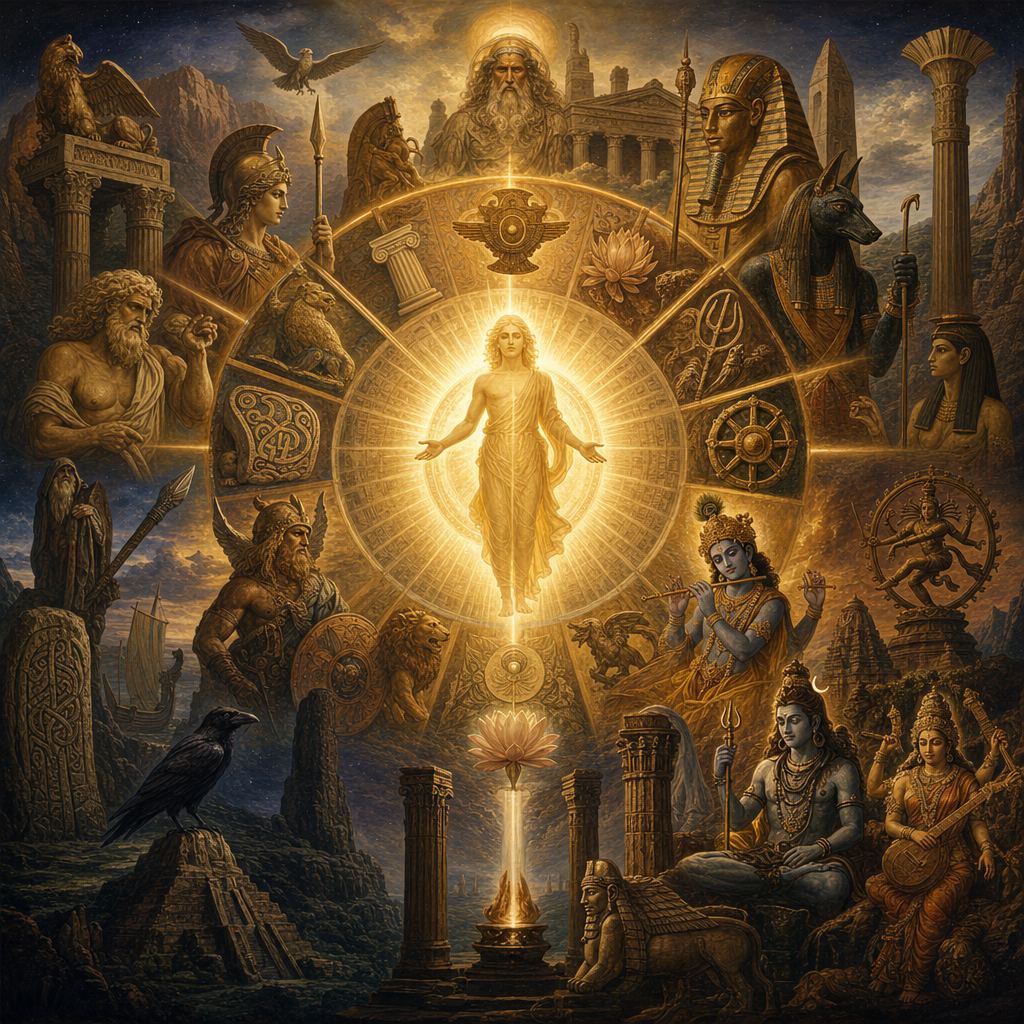
Schelling reads the history of world mythology as a theogonic process — a process through which divinity gradually discloses and articulates itself in human consciousness. The successive figures of Greek mythology — from the dark, chthonic powers of the earliest cult through the Olympians to the mystery religions and finally to the philosophical theology of the Stoics and Neoplatonists — are successive moments in the self-revelation of the Absolute, each disclosing something real while remaining partial. The same process, differently articulated, runs through Egyptian, Indian, and Norse mythology.
Christianity as Completion, Not Cancellation
Christianity does not, in Schelling's account, render mythology false. Rather, it is the point at which what mythology had disclosed in the mode of polytheistic succession becomes explicitly unified: the multiple divine figures of mythology are recognised as moments within the single divine life, now disclosed as trinitarian. Mythology is the preparation; Christianity is the fulfilment. But even Christianity is not the end — Schelling envisions a third age in which the full content of revelation is comprehended philosophically, in the mode of genuine knowledge rather than merely faith.
The Philosophy of Mythology was delivered as lectures in Berlin from 1841, alongside the Philosophy of Revelation. Both were published posthumously in Schelling's collected works. The audience included Marx, Kierkegaard, Bakunin, and Engels — most of whom left disappointed that Schelling's promised new philosophy turned out to be, as they saw it, theological apologetics.
Related Concepts