Philosophy as Hermeneutics
In the positive philosophy, philosophy does not stand above religion and mythology as their rational judge. Rather, philosophy takes its content from what has actually happened in the history of human religious consciousness — the mythological succession, the revelatory events, the doctrinal formulations of the major religious traditions — and attempts to comprehend this content philosophically. This is philosophy in a hermeneutical mode: receptive, attentive, seeking to understand rather than to replace or dissolve.
The Claim of Positive Revelation
Schelling insists that genuine revelation — the disclosure of the divine in historical events — is not reducible to universal rational principles that any reasonable person could have derived in advance. If the Incarnation, for example, is simply an illustration of the universal truth that the finite and infinite are one, then it adds nothing that Spinoza or Hegel had not already established by pure reason. But if it is a genuine event — an actual occurrence in which the divine freely entered history in a particular form — then it has content that positive philosophy must receive rather than construct.
Influence on Comparative Religion
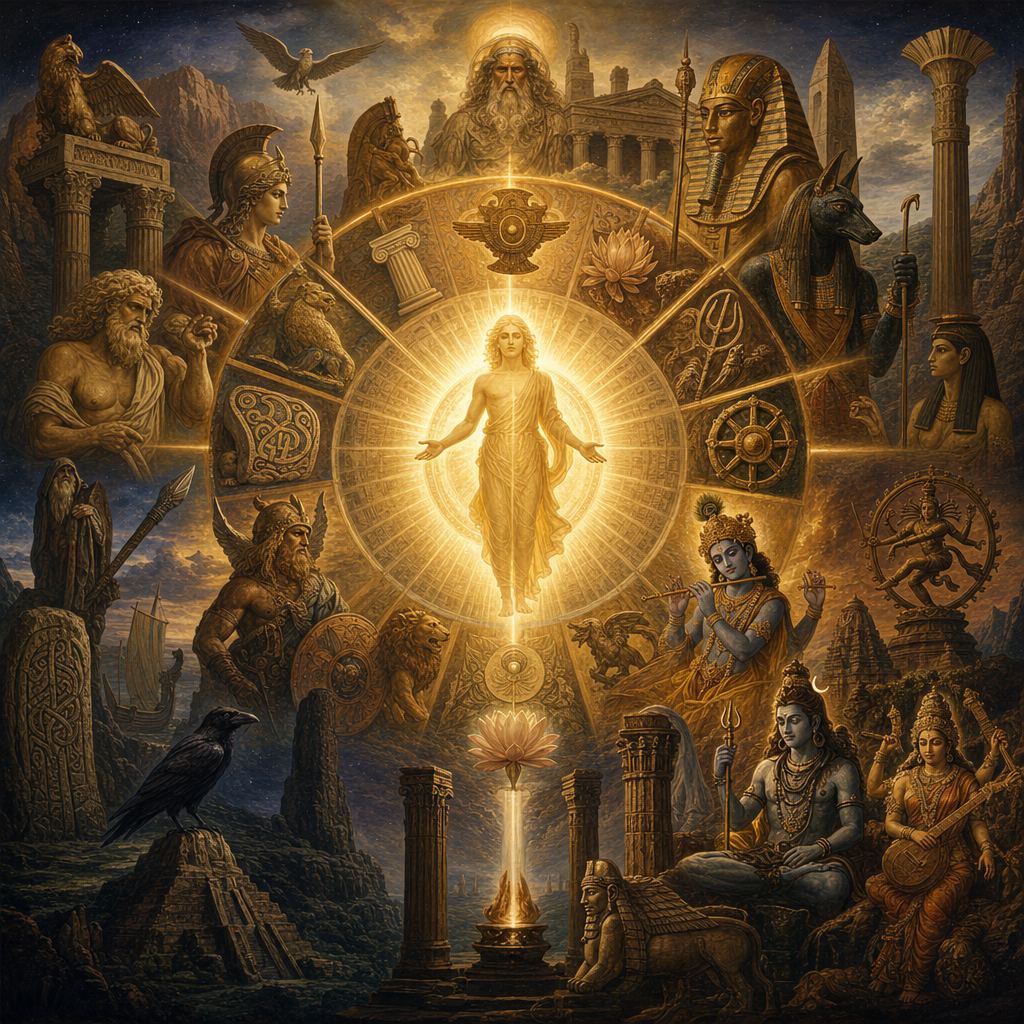
The philosophical engagement with the full range of world mythologies — Greek, Egyptian, Indian, Norse — as genuine sources of insight, each capturing a real moment in the theogonic process, effectively founded comparative mythology as a philosophical discipline. Schelling's students and readers — including Friedrich Creuzer, whose Symbolik und Mythologie drew directly on Schelling — established the academic study of comparative religion in nineteenth-century Germany. The idea that non-Christian religions are not mere error but earlier stages of a single revelatory process shaped liberal Protestant theology through the end of the century.
The Philosophy of Mythology and the Philosophy of Revelation were delivered together as the positive philosophy in Berlin. Their influence on comparative religion, on liberal Protestant theology (Tillich acknowledged a decisive Schellingian debt), and on the phenomenology of religion has been disproportionate to their direct readership.
Related Concepts