Arithmetic from Logic
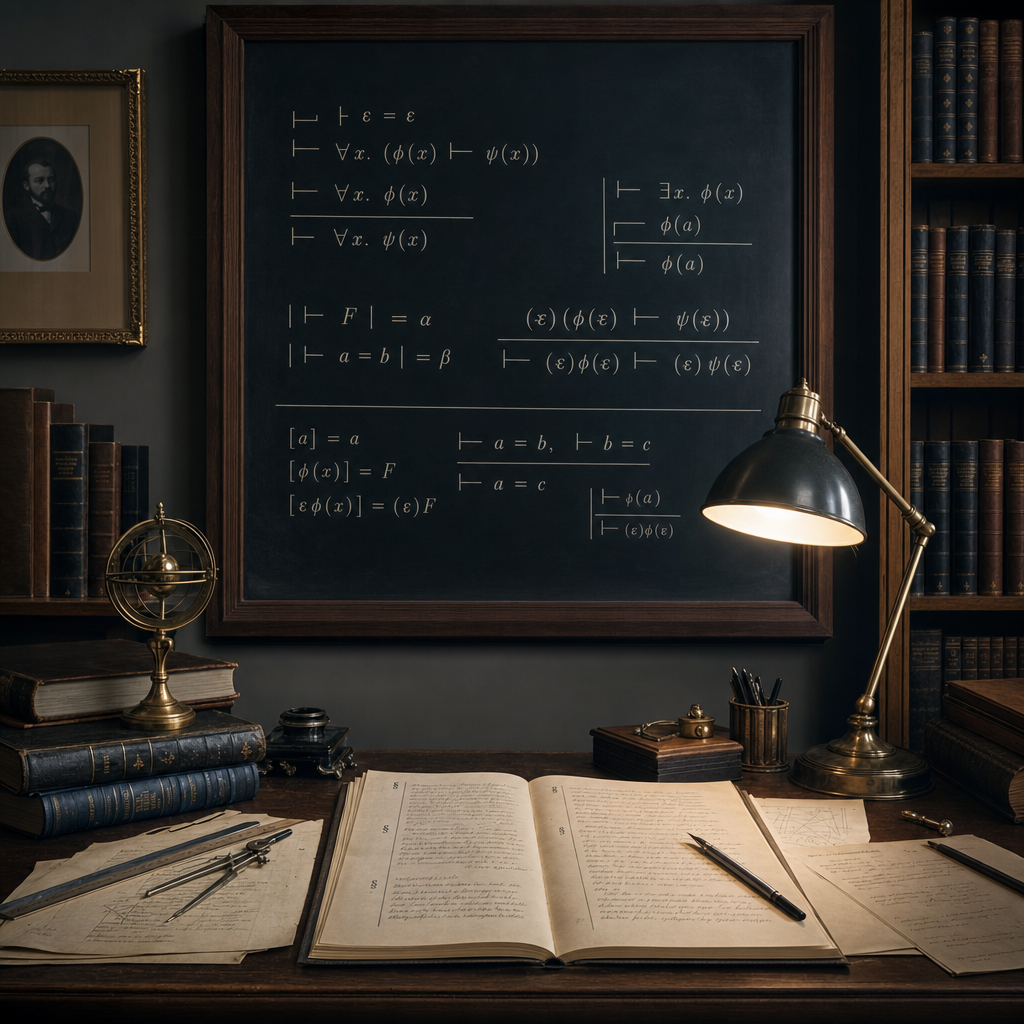
The central challenge for logicism is to define the natural numbers — 0, 1, 2, 3, … — without appealing to any non-logical notions. Russell, following Frege, proposes to define numbers as classes of equinumerous classes: the number 2 is the class of all pairs, the number 3 the class of all triples. Addition, multiplication, and the other arithmetic operations can then be defined in terms of class operations. This is not a mere reformulation in different notation: it is a genuine reduction, showing that numerical facts follow from purely logical facts about the existence and membership of classes.
The Scope of the Programme
Russell's ambition extends beyond arithmetic to all of mathematics: geometry, analysis, and the theory of real numbers are all to be reduced to logic. The strategy is to show that the apparently specific subject matter of each mathematical discipline is really a matter of abstract structural relations — relations that logic can characterise without any appeal to intuition, spatial or temporal representation, or specifically mathematical insight. Mathematics is not a special cognitive faculty but logic applied with unusual rigour and abstraction.
Logicism After the Paradox
Russell's discovery of his own paradox — the set of all sets that do not contain themselves — struck at the heart of logicism, since it showed that the unrestricted class-formation on which the programme depended was inconsistent. The solution Russell and Whitehead developed — the theory of types — introduces restrictions that prevent the paradox but at the cost of considerable complexity. Whether the resulting system is genuinely "purely logical" has been debated ever since. Gödel's incompleteness theorems (1931) later showed that no consistent formal system capable of expressing arithmetic can prove all arithmetical truths from logical axioms alone, dealing a further blow to the logicist ambition.
The Principles of Mathematics (1903) contains Russell's first systematic statement of logicism. The programme was pursued in detail in Principia Mathematica (1910–13), co-authored with Alfred North Whitehead. Gottlob Frege had independently developed a logicist programme in his Grundgesetze der Arithmetik (1893); Russell's letter informing Frege of the paradox is one of the most famous exchanges in the history of philosophy.
Related Concepts