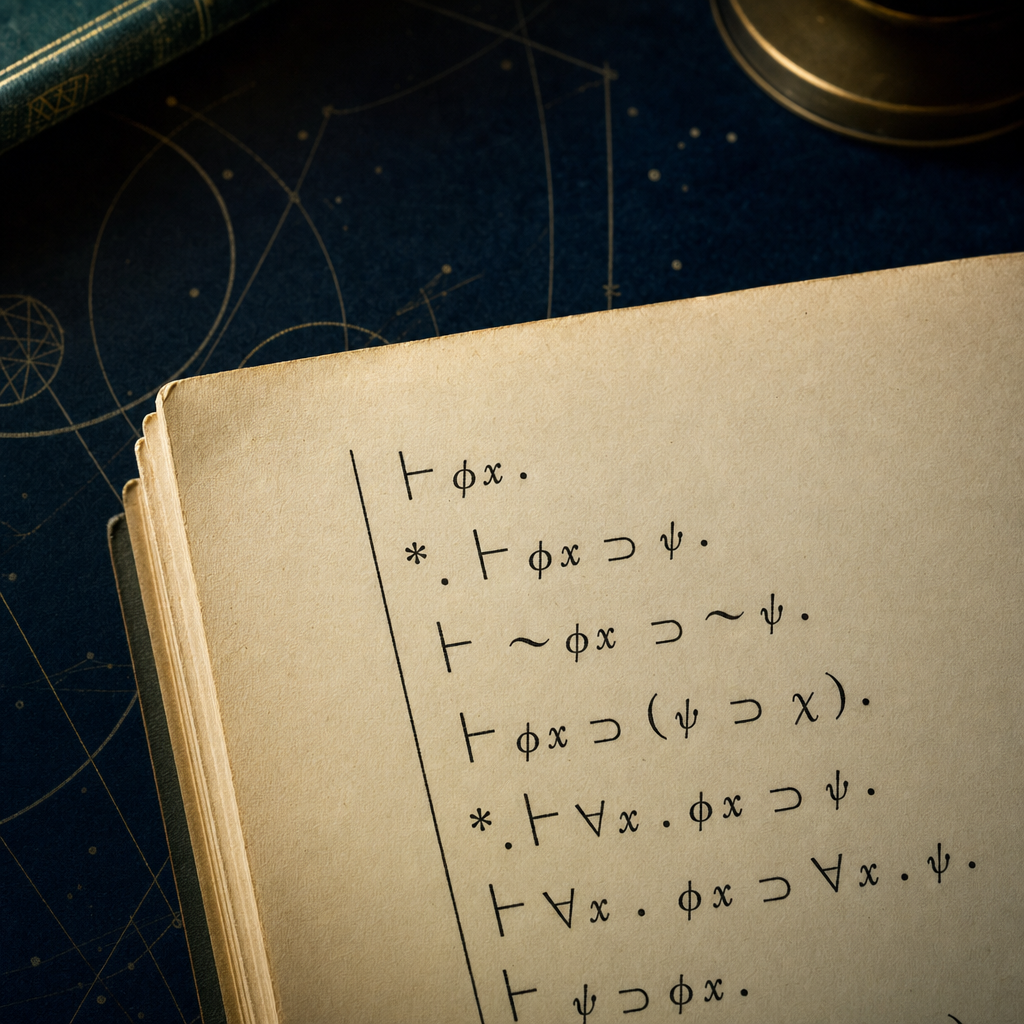
Principia Mathematica, written by Alfred North Whitehead and Bertrand Russell and published in three volumes between 1910 and 1913, is one of the most ambitious and consequential works in the history of logic and the foundations of mathematics. The project is the fullest realisation of logicism — the thesis, inherited from Gottlob Frege, that all of mathematics can be derived from purely logical principles without appeal to special mathematical intuitions or axioms beyond logic itself. Beginning from a system of symbolic logic, Whitehead and Russell construct, step by meticulous step, the whole of arithmetic and much of set theory and analysis, culminating in the proof of such results as 1+1=2 (which does not appear until several hundred pages in). The work is equally famous for its technical machinery — the ramified theory of types, introduced to block the logical paradoxes (including Russell's own) that had threatened Frege's programme — and for its philosophical ambition: to demonstrate that the truths of mathematics are, at bottom, logical truths, knowable by pure reason.
Full text not available
This work isn't available here yet. In the meantime you can purchase a copy on Amazon, or check back later, as we are always adding books to our library.
As an Amazon Associate we earn from qualifying purchases.
More by Bertrand Russell


Mysticism and Logic and Other Essays
Bertrand Russell
1918
Mysticism and Logic and Other Essays
Bertrand Russell
More by Alfred North Whitehead




Science and the Modern World
Alfred North Whitehead
1925
Free
Science and the Modern World
Alfred North Whitehead