Against Kant on Arithmetic
Kant had classified arithmetic as synthetic a priori: its truths are necessary and knowable without experience, but they are genuinely ampliative — they tell us something beyond what is contained in the concepts themselves. For Kant, our intuition of time underlies our grasp of numerical sequence. Frege argues that this is wrong: arithmetic requires no intuition at all. Its truths are analytic — expressible in purely logical terms — and Kant was misled by the inadequacy of traditional logic.
The Logicist Programme
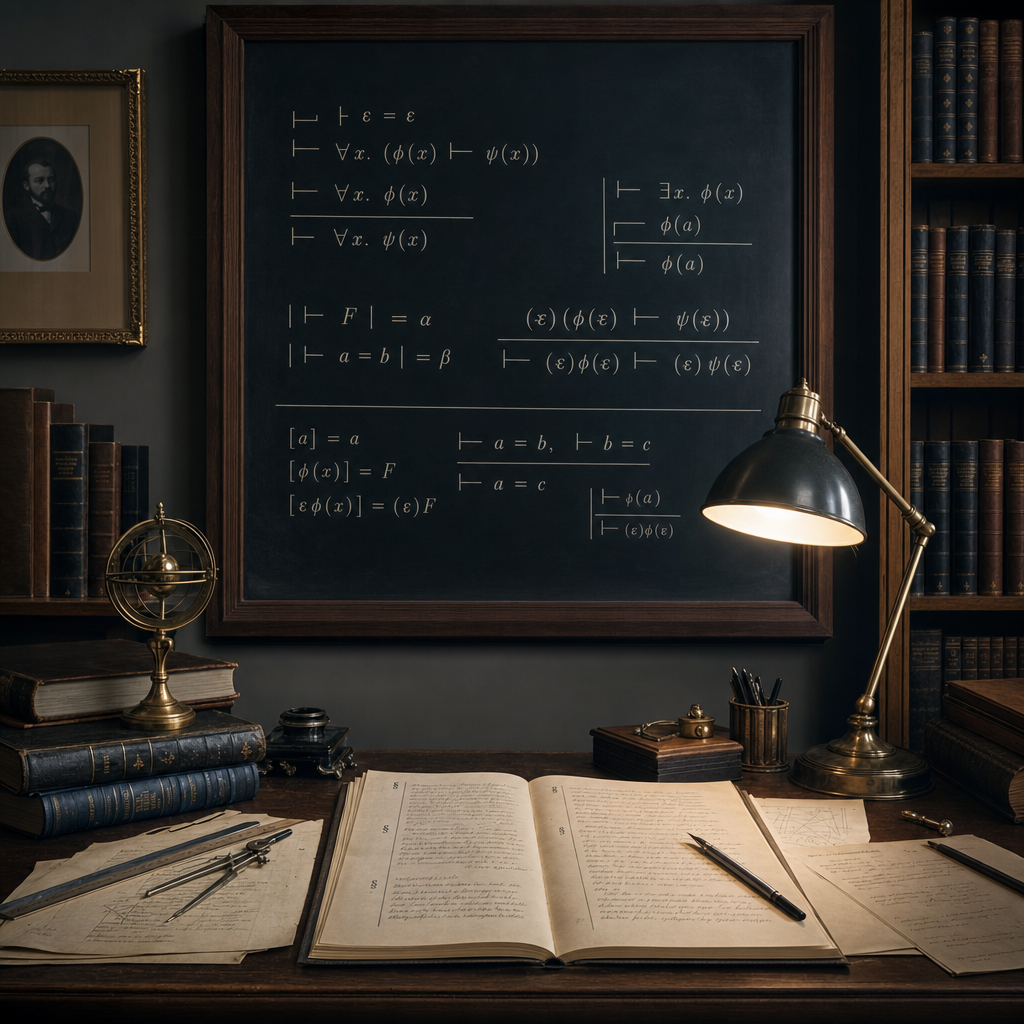
Frege's programme is to define all arithmetical concepts in purely logical terms and derive all arithmetical theorems from logical axioms alone. In Foundations he sketches this programme; in Grundgesetze der Arithmetik (1893) he attempts to execute it formally. The programme was undermined by Russell's paradox in 1902, which showed that Frege's fifth basic law — allowing the formation of the extension of any concept — was inconsistent.
The Philosophical Legacy
Though Frege's original logicism was refuted, its legacy is immense. It established the standard of rigour for foundational work in mathematics, introduced the formal tools — quantifier logic, the distinction between first and second order — that made modern logic possible, and set the agenda for the philosophy of mathematics in the twentieth century. Neo-logicism (Crispin Wright, Bob Hale) argues that a restricted version of the programme survives Russell's paradox.
The logicist programme is announced in Foundations of Arithmetic (1884) and executed, with flaws, in Grundgesetze der Arithmetik (vol. I, 1893; vol. II, 1903). Russell's paradox was communicated to Frege in 1902, just as volume II was in press.
Related Concepts