The Pluralism of Formal Systems
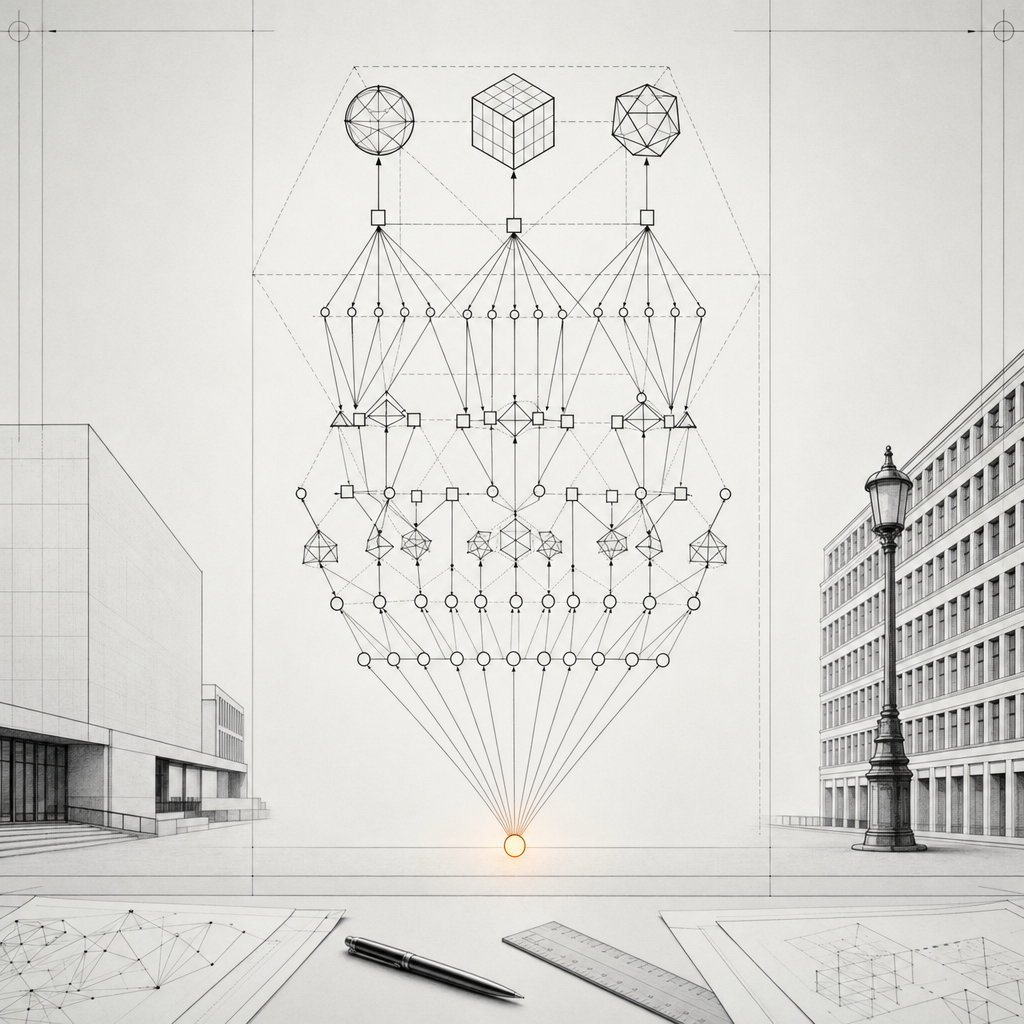
Classical logic — Aristotelian syllogistic and its Fregean reformulation — was long treated as the uniquely correct account of valid inference: its laws were supposed to be necessary truths about the structure of thought or of being. But the development of alternative logics in the late nineteenth and early twentieth centuries (intuitionist logic, many-valued logics, modal logics) raised the question: which is correct? Carnap's response in the Logical Syntax of Language is to dissolve the question. There is no uniquely correct logic because "correctness" is the wrong category: different formal systems are different languages, and the choice between them is a choice of linguistic framework, not a discovery of metaphysical truth.
The Material Mode and the Formal Mode
The Principle of Tolerance is supported by Carnap's distinction between the material mode and the formal mode of speech. When philosophers say "the number five exists" or "the real world is made of physical events," they speak in the material mode — as if making claims about the structure of reality. When they say "the numeral 'five' is a primitive sign in Language L" or "every statement of Language L can be translated into a physical-event statement," they speak in the formal mode — making explicit that they are discussing properties of a linguistic framework. The confusions of traditional metaphysics arise from treating formal-mode statements as if they were material-mode claims about the world.
The Legacy
The Principle of Tolerance had contradictory effects. It liberated logicians from the pretence that they were discovering metaphysical truths and turned philosophy of logic into the explicit study of formal systems and their properties — a move that enormously accelerated progress in mathematical logic. But it also seemed to deprive logic of any normative force: if any logic is permissible, on what grounds do we choose? Carnap's answer — that the choice is pragmatic, made on the grounds of theoretical utility — was developed into the framework of pragmatic conventionalism, but it raised a new question: utility for what? The debates it inaugurated about the grounds of logical revision continue in contemporary philosophy of logic.
The Principle of Tolerance is stated in §17 of the Logical Syntax of Language and is the programmatic core of the entire work. Quine accepted the tolerance principle but argued in "Truth by Convention" (1936) that it cannot ground analyticity — the category on which Carnap's distinction between logic and empirical fact depends. This tension runs through the entire subsequent debate between Carnap and Quine.
Related Concepts