Frege's Inheritance
The logicist thesis was first articulated rigorously by Gottlob Frege, who argued in the Grundlagen der Arithmetik (1884) that natural numbers are logical objects — the extensions of concepts — and that all of arithmetic follows from purely logical laws. Russell and Whitehead inherited this programme but inherited also its central difficulty: Frege's system was inconsistent, as Russell's own paradox demonstrated in 1902. The paradox — does the set of all sets that do not contain themselves contain itself? — showed that Frege's naive comprehension principle (for every predicate, there is a set of all things satisfying it) led to contradiction. Principia Mathematica is, in large part, a technically sophisticated attempt to save logicism by building a system powerful enough to derive mathematics but constrained enough to avoid the paradoxes.
The Programme Executed
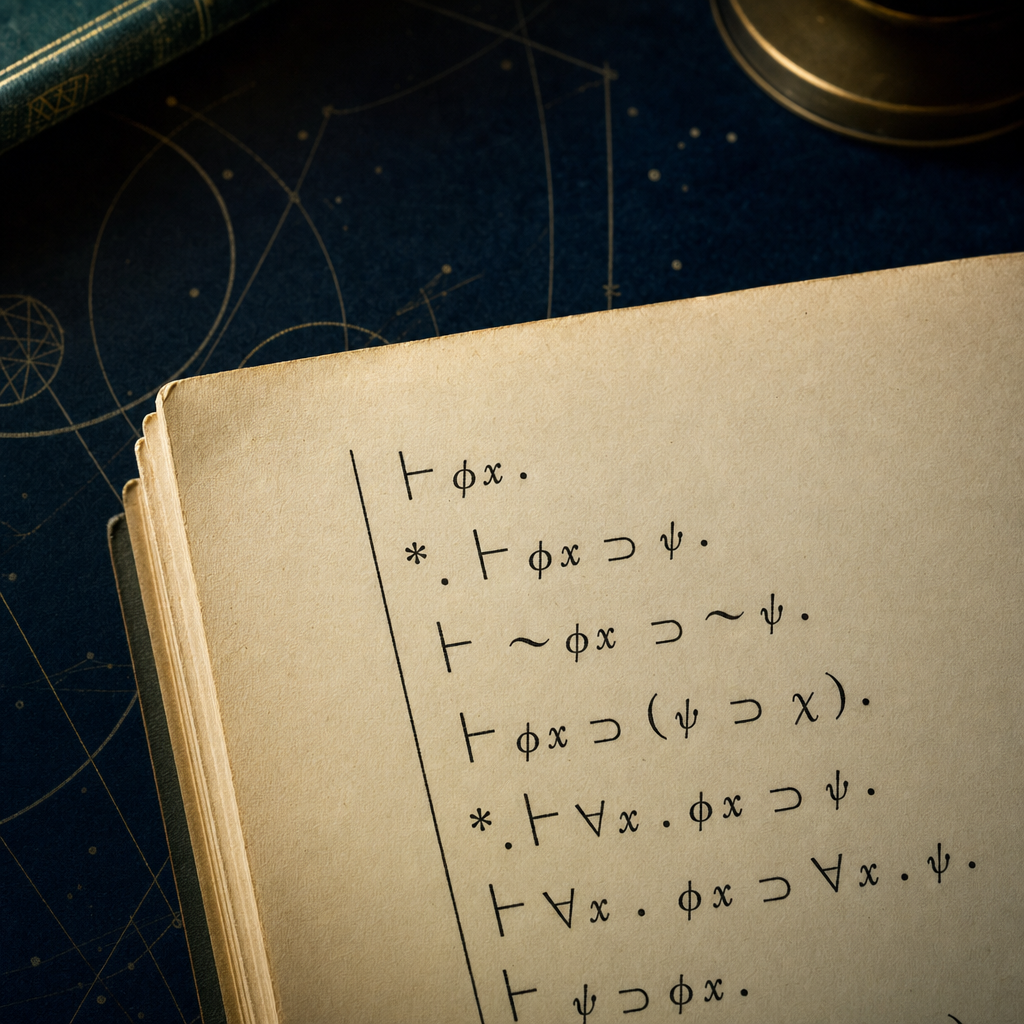
Principia Mathematica begins from a handful of primitive logical notions — negation, disjunction, propositional functions, the universal quantifier — and a set of axioms, then proceeds to define the mathematical objects and prove the mathematical theorems that follow from them. The derivation of arithmetic takes several hundred pages: 1+1=2 does not appear until Volume II, page 362. This is not pedantry but philosophy: the point is to show, at every step, that the construction appeals to nothing beyond logic. The programme succeeds, within the limits imposed by the type theory, for large portions of classical mathematics.
Gödel's Challenge
Logicism in the strong Fregean-Russellian sense did not survive the twentieth century's most important result in mathematical logic. Gödel's incompleteness theorems (1931) demonstrated that any consistent formal system powerful enough to express basic arithmetic contains truths that cannot be proved within the system — and, moreover, cannot prove its own consistency. This was not a refutation of logicism as such but imposed fundamental limits on what any formal system could achieve. Whether Principia's brand of logicism can survive Gödel's results in some modified form remains a live debate in the philosophy of mathematics.
Logicism as a philosophical thesis is developed by Russell in Introduction to Mathematical Philosophy (1919), a more accessible companion to the technical machinery of Principia Mathematica. Frege's original programme is set out in the Grundlagen (1884) and the Grundgesetze (1893–1903).
Related Concepts