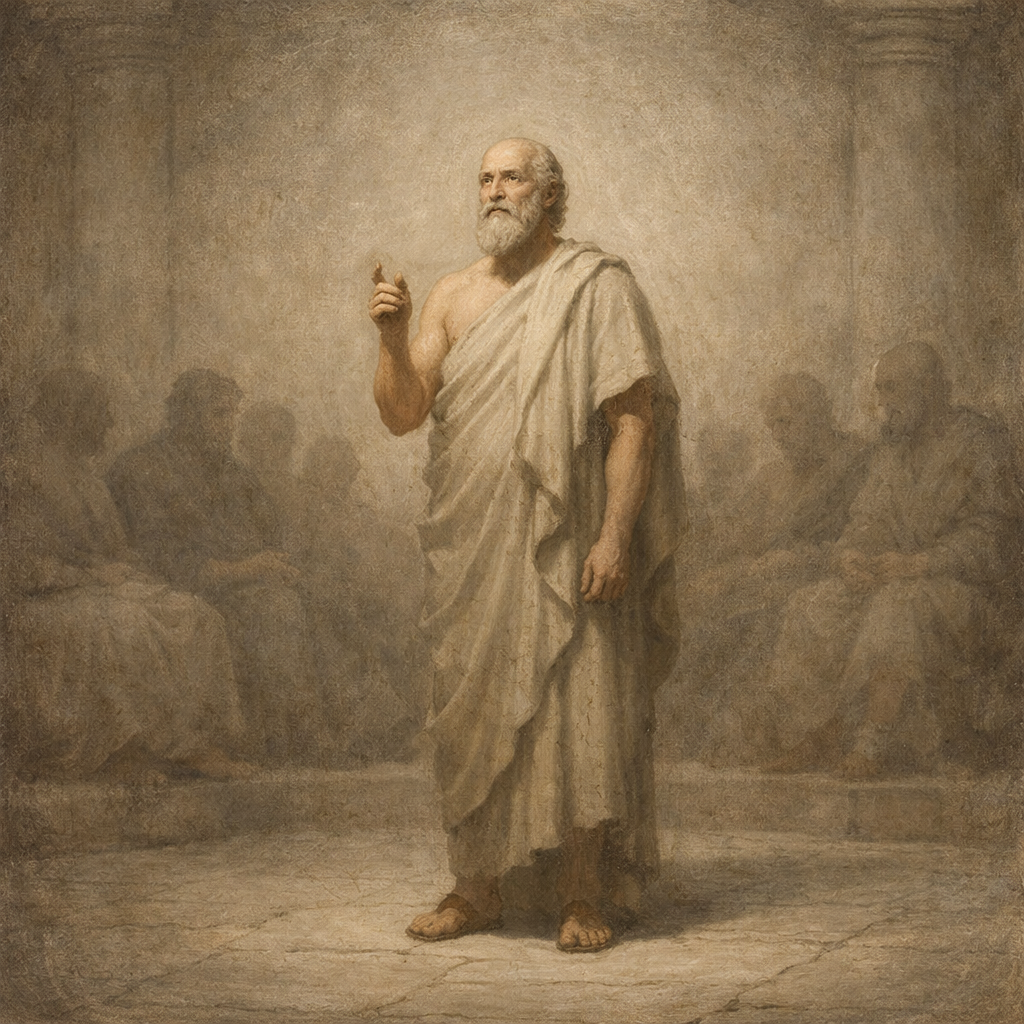
The Laws Speak
Socrates asks Crito to imagine the Laws and Constitution of Athens appearing in person and asking: "Socrates, what do you intend to do? Are you not, by this action which you are attempting, intending to destroy us — the laws — and the whole city, so far as in you lies?" The personification is philosophically significant: it frames the issue not as Socrates vs. his accusers but as Socrates vs. the entire legal and social order that has made his life possible. This shifts the question from whether this particular verdict was just to whether a citizen ever has the right to unilaterally override the city's decisions.
The Argument from Benefit
The Laws make a quasi-contractual argument. Socrates has lived in Athens for seventy years, benefiting from its protection, education, and social order. He could at any time have emigrated if he found Athens's laws unjust. He did not. By staying, he has implicitly agreed to abide by the city's decisions. To escape now would be to take the benefits while rejecting the burdens — a form of dishonesty that Socrates, of all people, cannot endorse. The analogy to parents is explicit: the city stands to Socrates as a parent to a child, and one owes the city a deeper obedience than one owes even one's parents.
Obedience or Persuasion
The Laws offer Socrates two options: obey, or persuade the city that its decision is wrong through legitimate means. Flight is not one of the options. This is not because the verdict was just — Socrates maintains throughout that it was unjust — but because unilateral flight would be an act of force rather than argument. The philosophical commitment to persuasion over force is constitutive of Socratic method itself: a man who has spent his life arguing that one should only act on good reasons cannot abandon that commitment the moment it becomes personally costly.
The Limits and Legacy
The Crito's argument has been enormously influential and enormously contested. Critics note that it seems to prove too much: it would justify obedience to any legal system, however tyrannical, as long as one has benefited from living under it. Socrates himself qualifies it — the Apology makes clear that if the law commanded him to stop philosophising, he would disobey. So there is some limit to the duty of obedience, even in Socrates's own account. The Crito does not resolve the tension between political obligation and the demands of conscience; it establishes it with unmatched clarity.
The Crito's social contract argument anticipates Locke's tacit consent theory by two millennia. Locke argues that living in and benefiting from a political order constitutes tacit consent to its authority. The analogy to the Laws' argument in the Crito is striking, though Locke, unlike Socrates, draws egalitarian political conclusions from the same basic structure.
Related Concepts