The Impracticality of Empire
Paine begins with geography and logistics: a government three thousand miles away, with communication that takes months in each direction, cannot govern well. Every decision made in London about American affairs is made on outdated information; every appeal from the colonies takes six months to receive a response. This is not a critique of British intentions but of the structural impossibility of competent government across such distances with such communications technology. The colonial relationship must either evolve or end — and evolution, Paine argues, is mere postponement of the inevitable.
A Continent Against an Island
The most famous passage in Common Sense is perhaps the simplest: "There is something absurd in supposing a continent to be perpetually governed by an island." This is not a legal argument or a philosophical argument but a plain observation about scale and proportion. America had already a larger population than Britain and resources incomparably greater; it was governed by a nation a fraction of its size across an ocean, for that nation's benefit rather than its own. Paine trusted his readers to feel the force of this without elaboration. They did.
The Founding Moment
Paine's most ambitious argument is that the American crisis represents a unique moment in world history: the opportunity to found a republic from scratch, on rational principles, without the burden of feudal precedent, hereditary privilege, or established church. Every constitution in Europe had been imposed by conquest or accumulated through custom without ever being freely chosen. America could be the first nation to choose its own form of government by rational deliberation — and in doing so could provide a model for the eventual emancipation of the entire world. The cause of America, Paine famously declared, is in great measure the cause of all mankind.
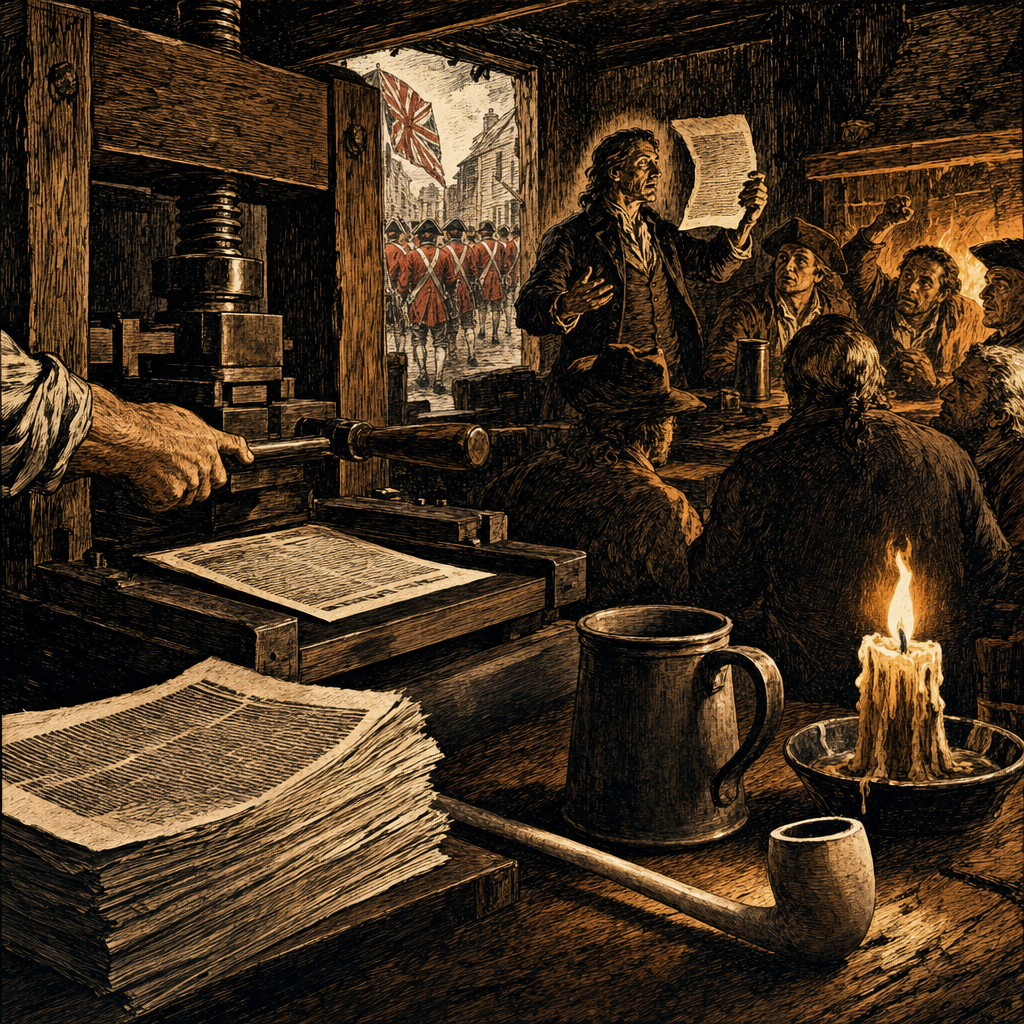
Common Sense sold approximately 120,000 copies in its first year — an extraordinary number for a colonial population of roughly 2.5 million. Washington ordered it read to his troops. It was reprinted in Britain and translated across Europe. Its direct influence on the Declaration of Independence is debated but its indirect influence, through the shift in popular mood it accomplished, is not.
Related Concepts