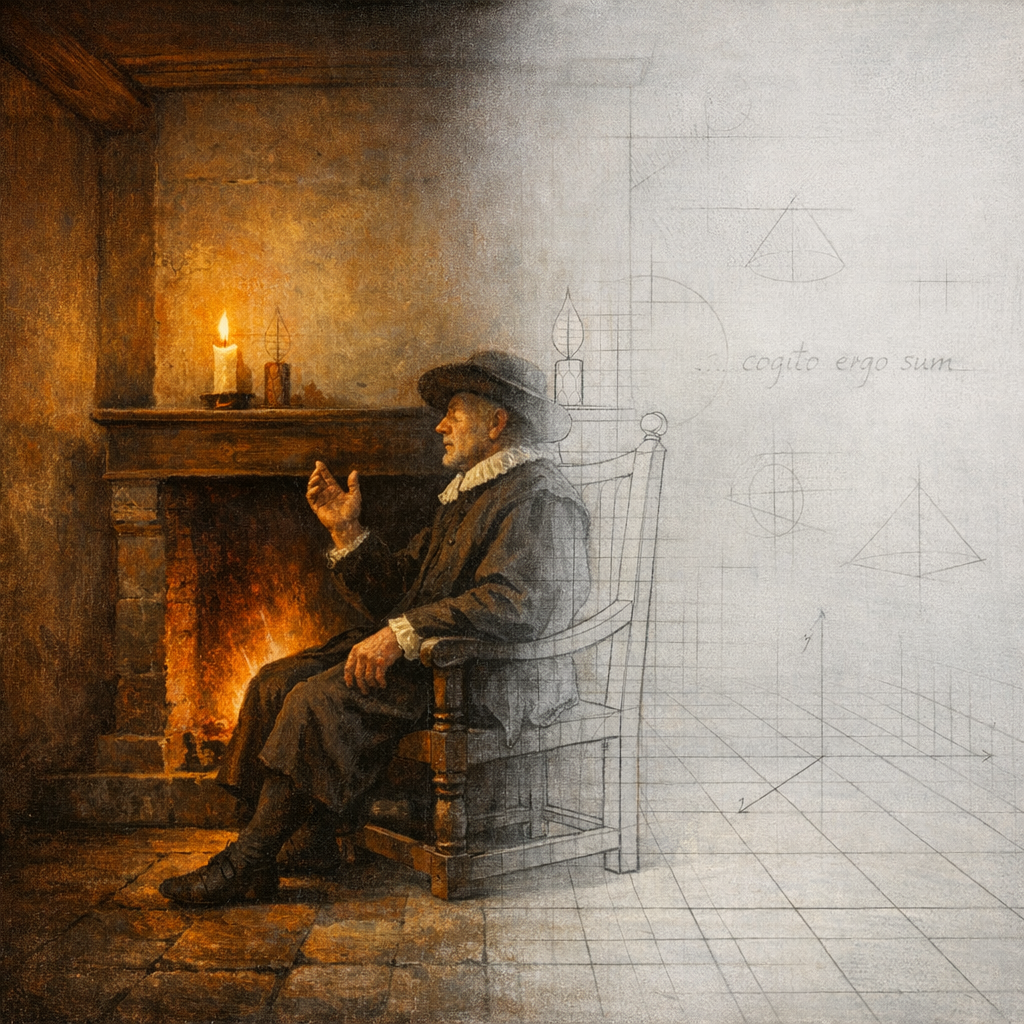
The Wax Before the Flame
The wax is freshly taken from the comb. It has a colour, a shape, a smell, and a sound when struck. Everything the senses could want. Then Descartes holds it to the fire.
I speak of this particular Wax, for of Wax in general the notion is more clear.
What the Wax Really Is
Every sensory quality has vanished, yet we all agree it is the same wax. So what is the wax? Not any of its sensory properties. The wax is something extended, flexible, and mutable — a characterisation that cannot be given by the senses or imagination, since the wax can take on infinitely many shapes that imagination could never run through. Only the intellect can grasp it.
And now behold of my own accord am I come to the place I would be in; for seeing I have now discover’d that Bodies themselves are not properly perceived by our senses or imagination, but only by our understanding, and are not therefore perceived, because they are felt or seen, but because they are understood; it plainly appears to me, that nothing can possibly be perceived by me easier, or more evidently, than my Mind.
The Lesson for the Self
The wax argument is not really about wax. It is a proof that the mind knows itself more clearly than it knows any material thing. If the intellect alone grasps what the wax is, the intellect's grasp of itself must be even more direct and certain. Every act of perceiving the wax confirms that the perceiver exists — which is just the cogito again, arrived at from a different direction.
Gassendi objected that we can imagine the wax's mutability well enough without needing pure intellection. Leibniz developed the idea that substance persists through accidental change into his theory of monads. The argument anticipates Locke's distinction between primary and secondary qualities.
Related Concepts