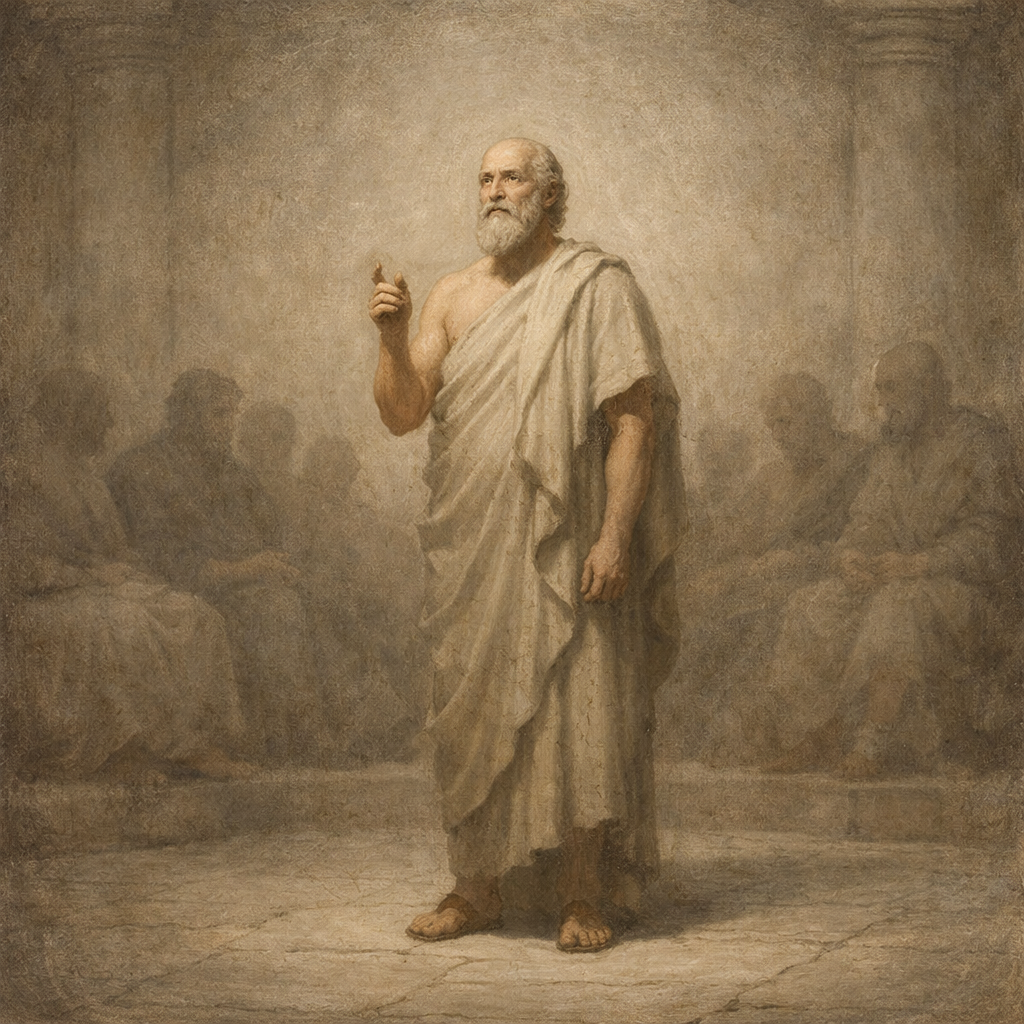
Against Common Sense
The conventional Greek moral view — shared by the poets, the aristocratic tradition, and most ordinary Athenians — was that it is right to help friends and harm enemies. Reciprocity in kind was a moral expectation: if you are wronged, you are entitled to wrong in return. Socrates rejects this entirely and without qualification. One should never do wrong, period — not even to a person who has wronged you, not even to an enemy, not even when the city itself has acted unjustly. The wrongness of a harmful act is not diminished by the provocation that occasioned it.
The Argument
Socrates's argument is simple: wrongdoing harms the soul of the one who does wrong, regardless of whether it is retaliatory. The soul is damaged by injustice in the same way the body is damaged by disease. If Socrates escapes, he acts unjustly — breaking his implicit agreement with the Laws — and thereby harms his own soul. The fact that the city has wronged him first does not make his wrongdoing harmless. He cannot cure the city's injustice by committing his own; he can only add to the total injustice in the world and corrupt himself in doing so.
The Unconditional Character
What is striking about Socrates's principle is its unconditional character. He does not say "do not return wrong for wrong unless the provocation is severe enough" or "unless your own life is at stake." The principle holds even now, with his execution hours away. This unconditional commitment is, in a sense, the demonstration of the principle's seriousness: a moral commitment that one abandons when it becomes personally costly is not a genuine moral commitment but a contingent preference. Socrates's death is the proof that he means what he says.
The principle that one should never return wrong for wrong is also central to the Sermon on the Mount ("turn the other cheek") and to Stoic ethics, which similarly holds that wrongdoing harms the agent regardless of its target or provocation. Whether Socrates's argument for the principle is adequate — or whether it assumes rather than establishes the key premise that wrongdoing always harms the soul — is a matter of continuing debate.
Related Concepts