What Grounds the Ground?
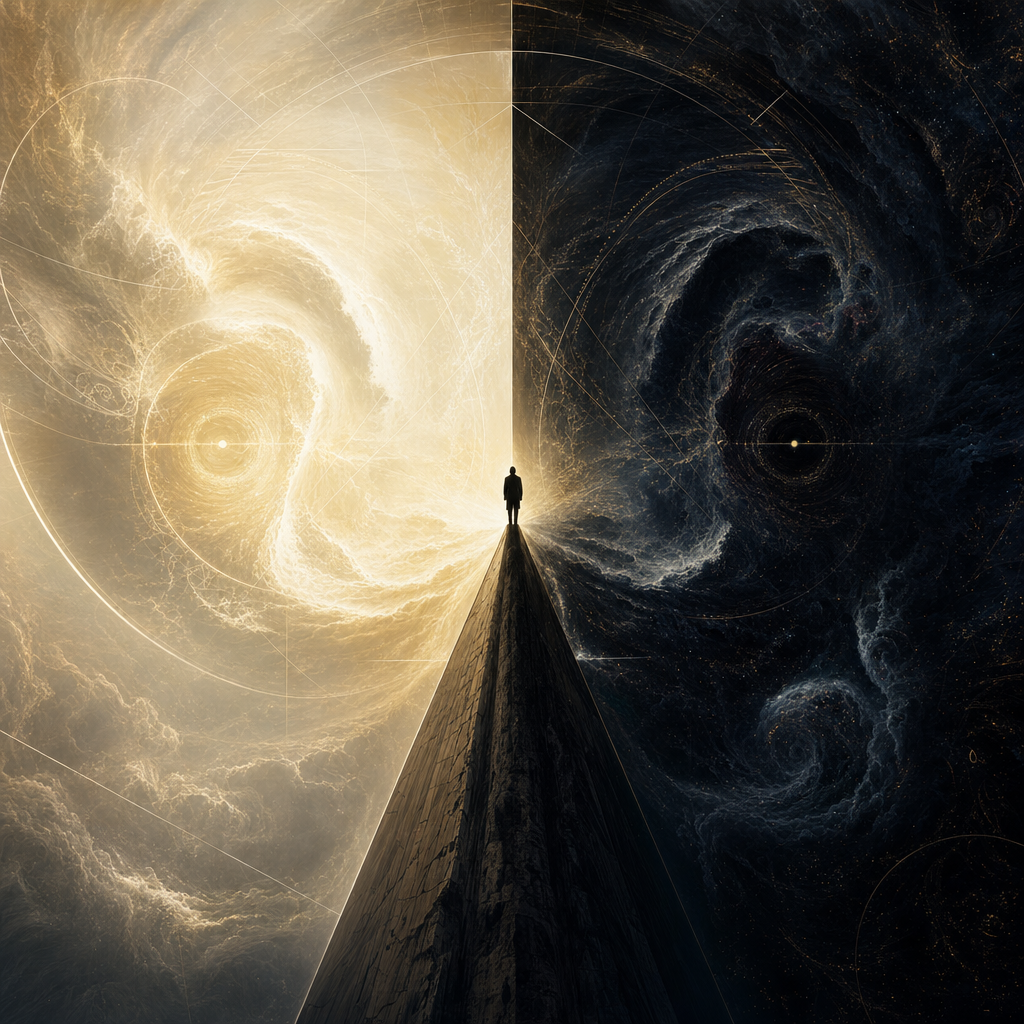
If God's existence rests on a dark ground, one is naturally driven to ask: what grounds that ground? Schelling's answer is the Ungrund — literally "un-ground" or "groundlessness." The Ungrund is not a third entity above or below God; it is the absolute indifference prior to any distinction whatsoever. It cannot be called being or non-being, God or world, because all of these distinctions presuppose it. It is the point from which the whole drama of divine self-disclosure begins — the absolute beginning that is no beginning because it is prior to time.
Mystical Sources
Schelling explicitly draws on Jakob Böhme's mystical theology, which also posits a groundless abyss (Ungrund) as the hidden foundation of the divine nature. But where Böhme's Ungrund is an immediate mystical intuition, Schelling deploys it within a rigorous philosophical argument as the necessary precondition for both freedom and evil. Without the Ungrund's absolute indifference, there would be no space in which the distinction between ground and existence, dark and light, good and evil could arise. The Ungrund is the formal condition of the possibility of freedom.
Legacy: Existentialism and Process Theology
The Ungrund became one of Schelling's most influential concepts. In process theology, it informs accounts of God as containing within the divine nature an element of sheer potentiality or creativity prior to any determination. In existentialism, it anticipates the abyss — the groundlessness — at the heart of human existence that Kierkegaard, Heidegger, and Sartre each articulate in their own terms. The insight that existence has no antecedent rational foundation — that the very question "why is there something rather than nothing?" cannot be answered by reason — is one of Schelling's permanent contributions to philosophy.
The concept of the Ungrund appears in Schelling's Philosophical Investigations into the Essence of Human Freedom (1809) and is developed further in the fragmentary Ages of the World and the late positive philosophy lectures.
Related Concepts