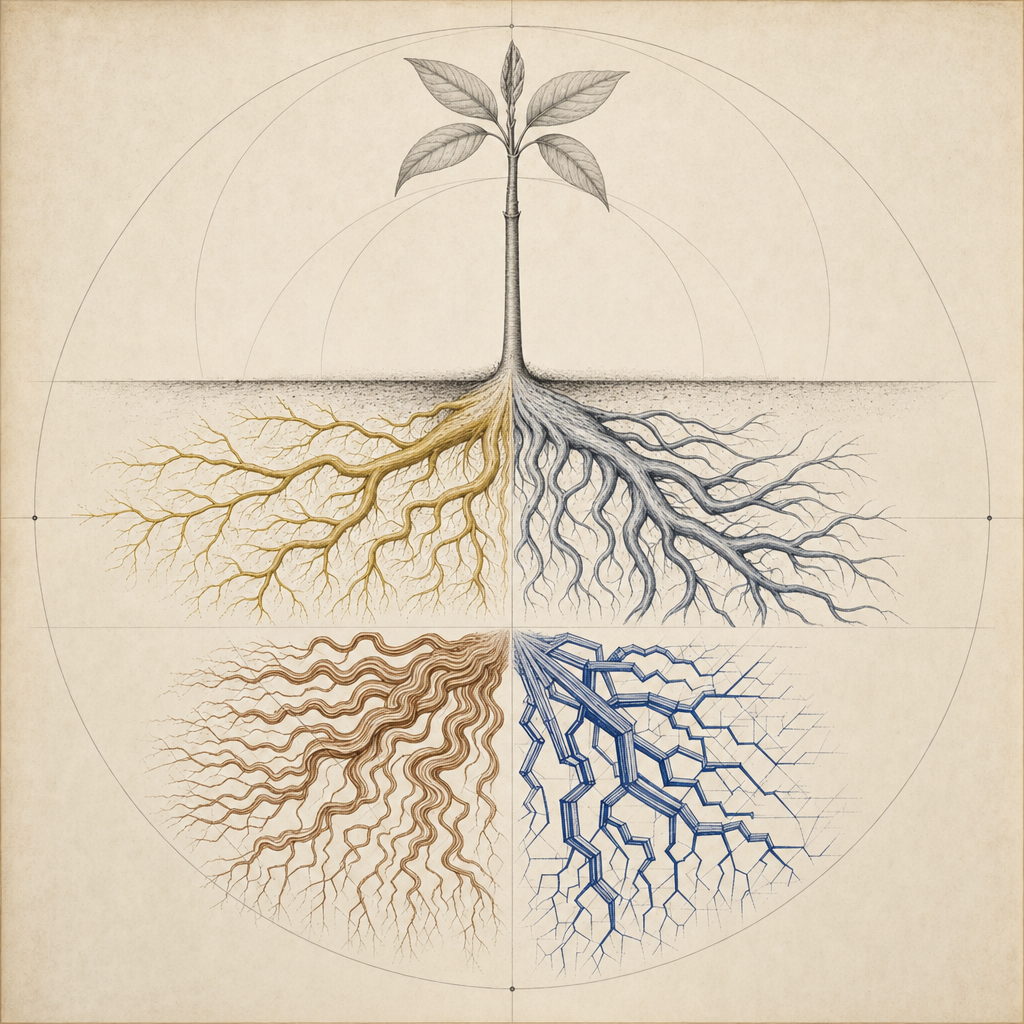
Ground of Becoming: Causality
In the domain of empirical objects — the world of physical things and events — the principle of sufficient reason takes the form of causality. Every change has a cause; every event is necessitated by a prior state of affairs. Causality is not a loose "because" connecting events post hoc; it is a necessary and universal connection that the intellect imposes on all experience of change. Science is the systematic elaboration of causal relations within this domain. Crucially, causality connects states and events — not things in themselves.
Ground of Knowing: Logic and Proof
In the domain of abstract concepts and propositions, the principle takes the form of logical grounding. A proposition has a sufficient ground if it follows from other propositions already known to be true. This is the domain of argument, proof, and deduction — entirely distinct from the causal nexus of events. When philosophers confuse logical grounding with causation — treating God's existence as a logical conclusion, or treating mental states as caused by material events in the same sense that billiard balls collide — they generate pseudo-problems that dissolve once the forms are separated.
Ground of Being and Ground of Acting
Mathematical objects (numbers, geometric figures, pure relations) have their ground of being not in causality or logic but in the necessary connections between their own parts — as when a triangle's angles sum to 180 degrees by virtue of what a triangle is. The fourth form — the ground of acting, or motivation — governs the will. Every voluntary action has a sufficient ground: the motive that moved the agent, working on the agent's character. Motivation is not physical causality (it works through cognition) nor logical grounding (it compels but does not demonstrate). Understanding that motivation is its own form of necessity is the basis of Schopenhauer's later account of freedom and determinism.
The four roots are presented in §§20–43 of the revised 1847 edition. Schopenhauer's analysis of motivation as the fourth form directly anticipates the ethics of The Two Fundamental Problems of Ethics (1841), where the determinism of character and motivation is systematically worked out.
Related Concepts