Beyond the Powers of the Soul
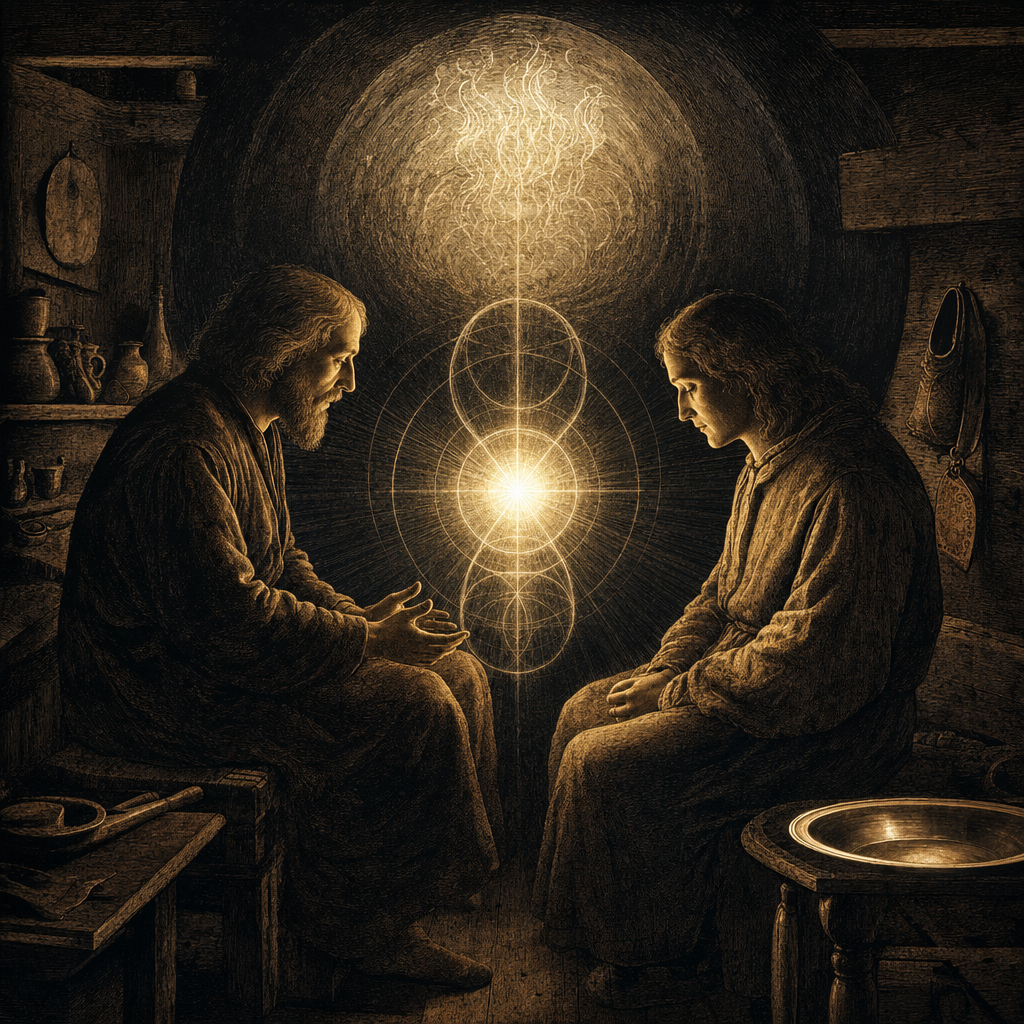
Medieval psychology divided the soul into its powers: memory, understanding, and will. Eckhart does not deny these faculties, but he insists they do not reach the deepest truth about the soul. Above and beneath them — his spatial metaphors deliberately contradict each other — there is a ground (Grunt) that has never been touched by time, multiplicity, or sin. It is the soul's hidden root, the part of it that has always already been with God.
The Uncreated in the Creature
The most scandalous feature of Eckhart's teaching is that the ground of the soul is, in some sense, uncreated. This does not mean the soul is God in its entirety — Eckhart is not a simple pantheist — but that its innermost point participates in divinity in a way that precedes the creation of the individual. The soul was in God before it was in the body, and that primordial dwelling never entirely ceased. The ground is where the creature touches the Creator without intermediary.
Stillness as the Condition of Union
The ground cannot be reached by effort. It is disclosed only when the soul's ordinary activity — striving, grasping, even praying — falls silent. Eckhart's instruction is not to cultivate virtue so as to merit union but to release the very desire for achievement. In the ground, there is nothing to acquire because nothing is lacking. The soul discovers it has always already been at home.
The doctrine of the Seelengrund runs through the German Sermons and surfaces explicitly in Sermon 2 (Intravit Iesus) and Sermon 48 (Beati pauperes spiritu). It was among the propositions examined in the papal bull In agro dominico (1329).
Related Concepts