The Problem with Rational Theodicy
Standard theodicy treats evil as the absence of good, or as a necessary means to a greater end, or as a consequence of finite freedom misused. Schelling finds all these answers inadequate because they reduce evil to something merely negative — a lack, an accident, a by-product. But evil as it actually presents itself in history is not merely negative; it has its own terrible energy and coherence. An account of evil must explain not only how good creatures can fail to be good, but how there can be active, creative malice.
The Ground and the Existence
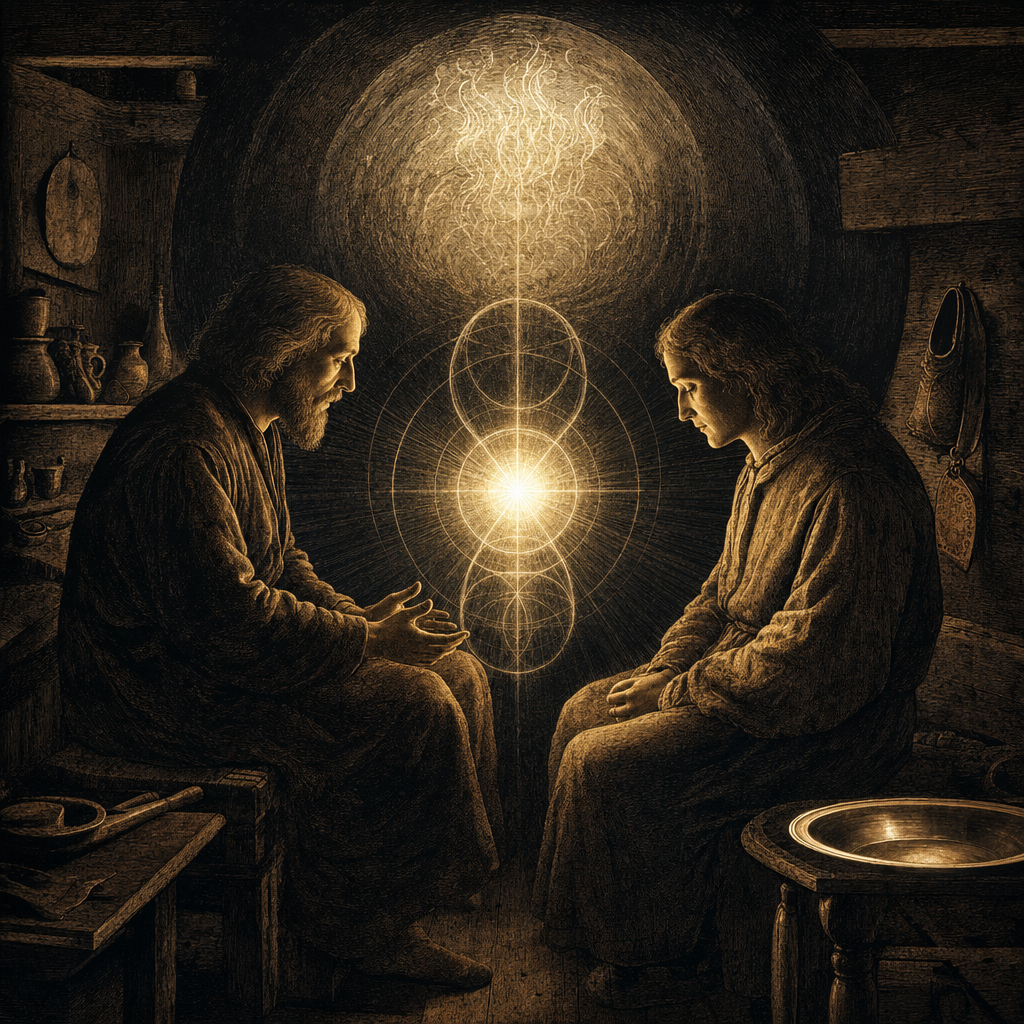
Schelling's solution distinguishes between God's ground and God's existence. God's existence — the luminous, loving, self-aware aspect of divinity — rests on a prior ground that is in God but not itself God in the proper sense. This ground is dark, irrational, and self-contracting — the sheer thrust of existence that underlies and enables the divine self-disclosure but is not identical with it. In God, this ground is always already subordinated to love and understanding; the two are inseparably unified. But in finite creatures, the distinction remains separable.
How Evil Enters
In the human being, the dark ground of selfhood — the will to be oneself, to contract into oneself, to make particularity the centre — can be elevated above the universal principle of love. This is not a mere failure of will but an active inversion: the selfhood that in God is a necessary moment within a larger unity becomes, in the fallen creature, an absolute principle. Evil is not the absence of God but a perverse imitation of God — the dark ground asserting itself as if it were the whole. This is why evil has a genuine, terrifying depth that mere weakness or ignorance cannot explain.
Philosophical Investigations into the Essence of Human Freedom (1809) is considered by many commentators, including Heidegger, to be the greatest work of German Idealism. Its distinction between ground and existence became central to later existentialist and process-theological thought.
Related Concepts