Descent as Necessary Overflow
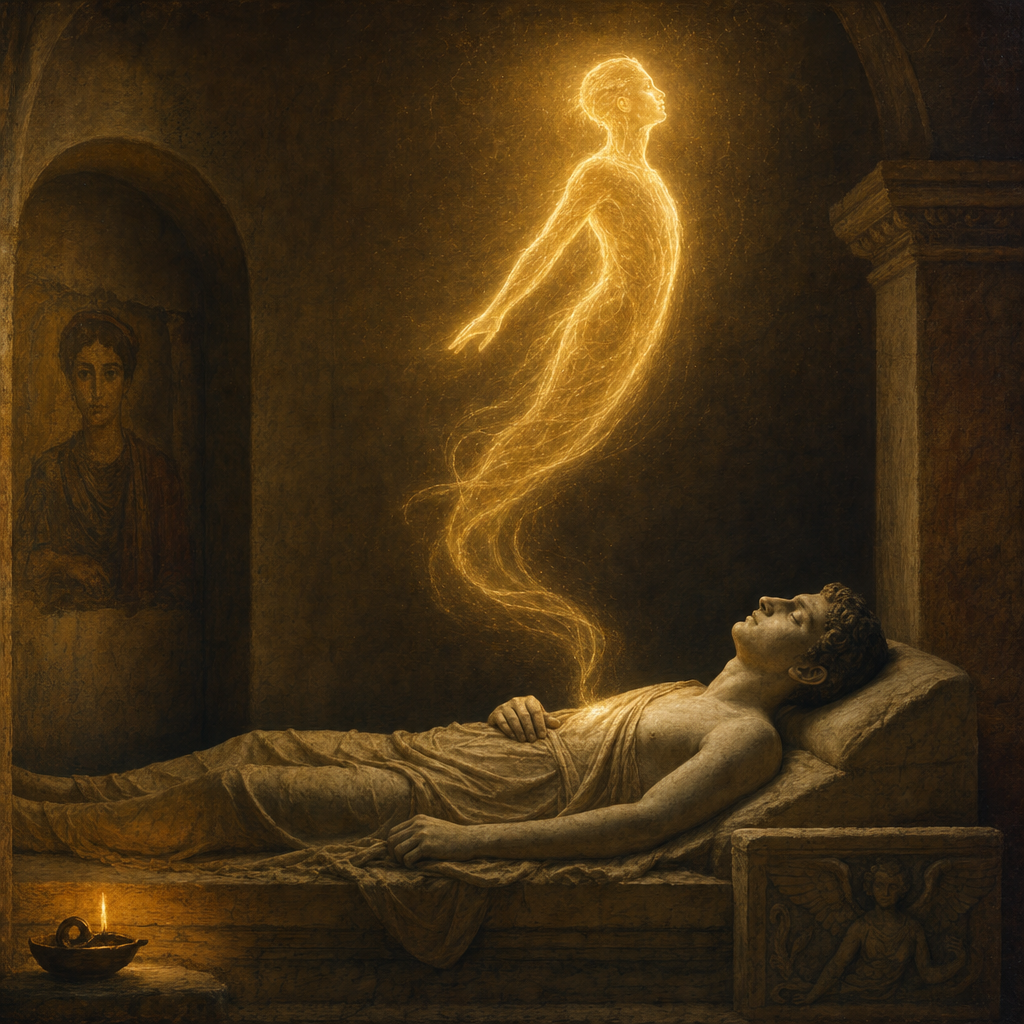
Just as the One's perfection overflows into Intellect, and Intellect's contemplative activity overflows into Soul, so Soul's life overflows into the material world. The soul does not "fall" into a body as a punishment or by mistake: the generation of the physical cosmos is the necessary expression of Soul's nature. Matter, left to itself, is formless and chaotic; Soul's administration is what gives matter the order, regularity, and beauty that we observe in the natural world. The individual soul's entry into a particular body is the most localised expression of this universal principle: it brings intelligible Form to a portion of matter that would otherwise be lifeless.
The Risk of Forgetting
Though the descent is natural and not a punishment, it carries a genuine risk: the soul may become so absorbed in the concerns of bodily existence that it forgets its origin and its true nature. Immersed in sensation, appetite, and the pressing demands of survival and reproduction, the soul may lose sight of the intelligible world from which it came and to which it belongs. This forgetting is the condition that philosophy exists to address. The soul in this state is like a person who has wandered so far from home that they no longer remember where home is — and who mistakes the landscape of their wandering for the only possible landscape.
Embodiment and Moral Choice
Plotinus holds a complex view of the soul's moral responsibility in embodied life. The soul is not simply the passive victim of its bodily conditions: it retains, even at the lowest levels of descent, the freedom to orient itself toward or away from Intellect. This is what makes moral praise and blame coherent — and what makes philosophy possible at all in conditions of embodiment. The soul that has genuinely understood its situation — that it is a stranger in the body, a traveller passing through — can use its embodied existence as an opportunity for philosophical ascent rather than as a reason for despair. Matter is not the enemy; it is the school.
The soul's descent is treated in Ennead IV.8 ("On the Descent of the Soul into Bodies"), which addresses earlier Platonic and Pythagorean accounts directly. Plotinus's position — that descent is natural but carries risk — differs from Porphyry's starker anti-body stance and from Iamblichus's later view that the soul descends entirely.
Related Concepts