Against Materialism
Plotinus takes aim at accounts of the soul as a harmony — the arrangement and balance of bodily elements — or as a body of any kind, however rarefied. If the soul were a harmony, it would exist only as long as the elements it harmonises remain in the right configuration, and it would perish when the body dissolves. Against this, Plotinus argues that a harmony does not know itself, does not desire, does not initiate action. These activities require something that acts from within, from a principle that is not a property of matter at all. The soul's thinking and willing are not emergent properties of a physical system but activities that proceed from a genuinely non-physical reality.
Self-Knowledge as Evidence
The soul's most striking capacity is its ability to reflect on itself — to know its own knowing, to desire its own desiring. This reflexive self-awareness cannot be explained by any arrangement of material parts: no configuration of atoms can look at itself as a whole, because the whole is just the sum of the parts, and no part is large enough to contain the whole within it. The soul's self-knowledge is possible only because the soul is not a complex of parts but a unity — and a unity that is genuinely transparent to itself in a way that no material aggregate can be. This unity and self-transparency are precisely the marks of what belongs to the intelligible rather than the sensory world.
The Indestructibility of What Gives Life
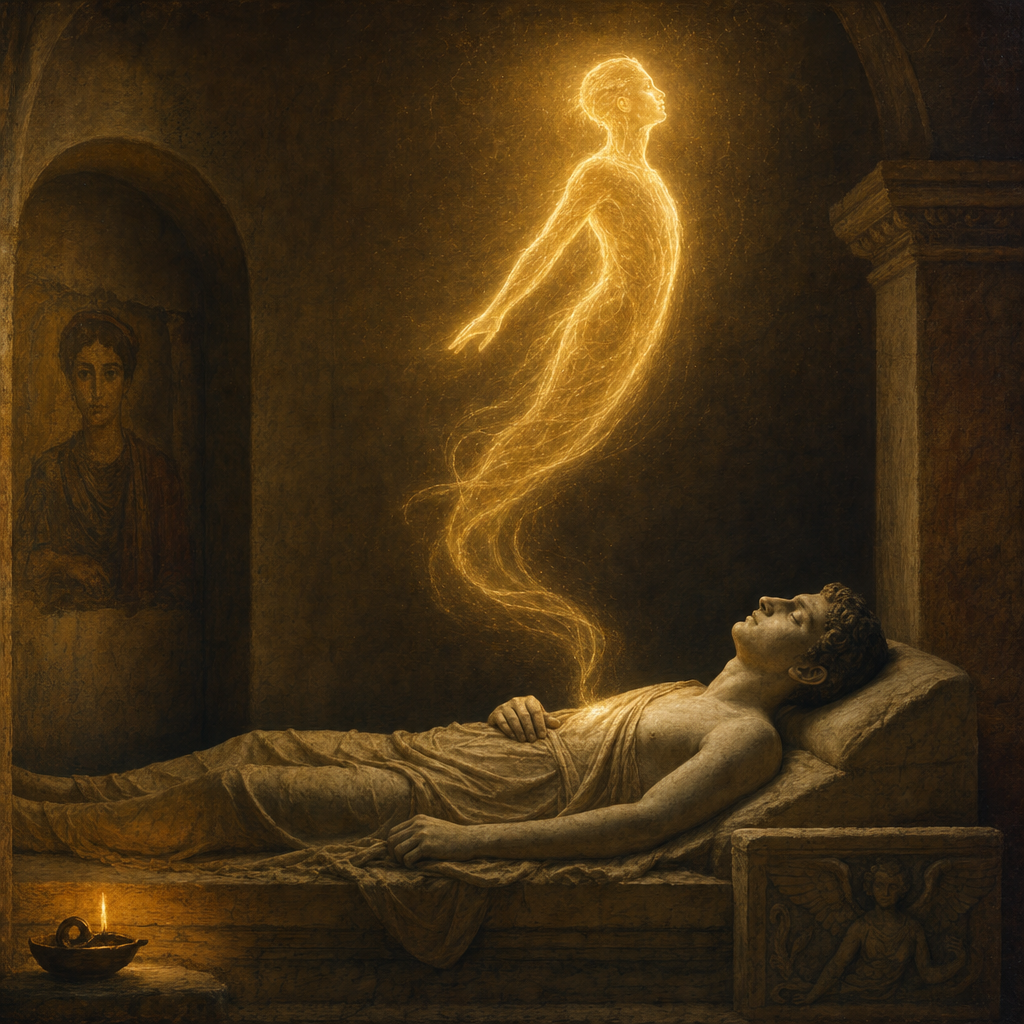
A further argument: what gives life to a body cannot be killed by the processes of the body, for the same reason that what gives heat cannot be cooled by something it heats. The soul is the principle of life — it is what animates matter, what makes an organism a living thing rather than a corpse. The soul cannot, in the same moment, be the principle of life and also the kind of thing that life's departure destroys. When the body dies, the soul does not perish with it: the body dies precisely because the soul has left it. The soul is not in the body as fire is in fuel — consumed in the process of giving warmth — but as a Form that can inhabit and depart from many different material vehicles without being altered by any of them.
The argument from self-motion draws on Plato's Phaedrus (245c–246a) as well as Aristotle's De Anima. Plotinus develops his most sustained arguments for the soul's immortality in Ennead IV.7, though the theme runs throughout Enneads IV and V.
Related Concepts