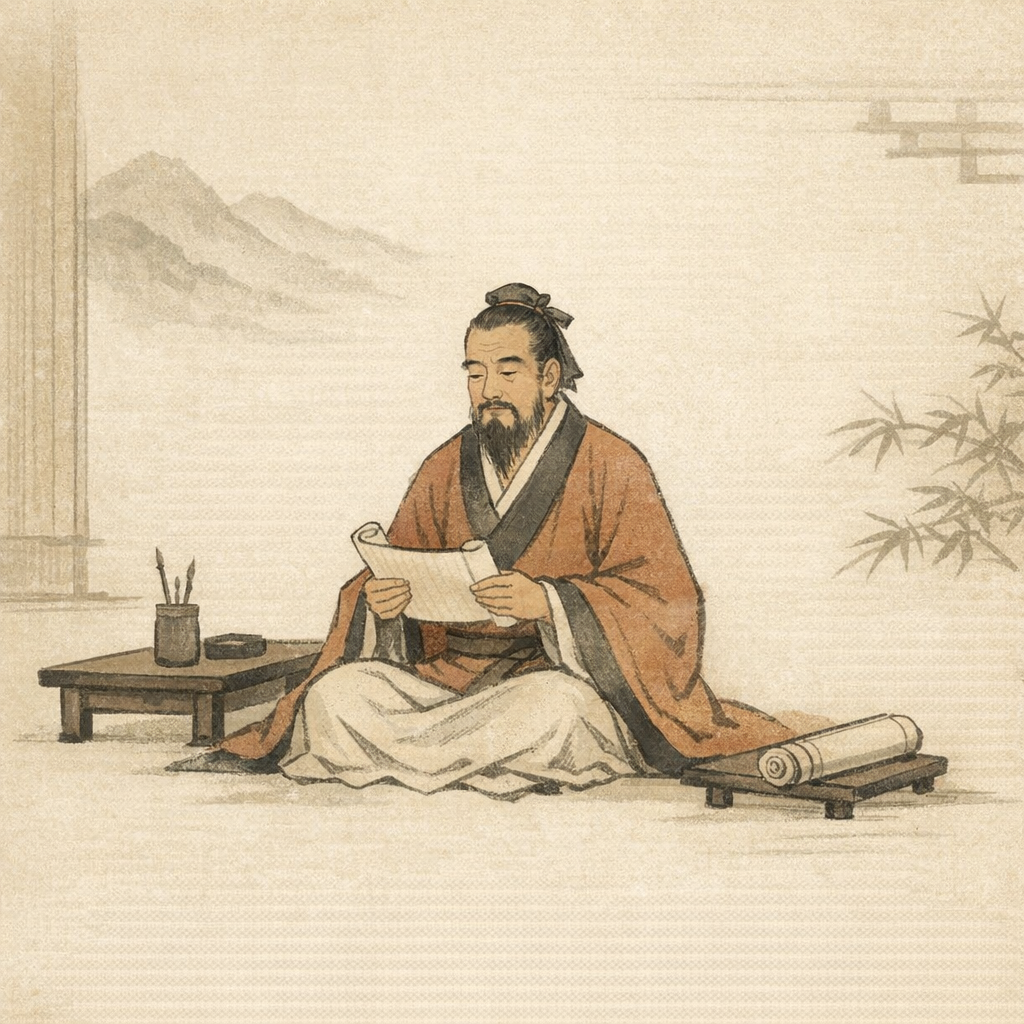
The Root of All Virtue
Confucius's disciple Yu identifies filial piety and fraternal respect as the root from which all benevolent action grows. This is not a claim that family love is the whole of morality, but that it is where ren is first practised and first felt. The person who has genuinely cultivated love within the family will naturally extend it outward. The capacity for goodness unfolds from what is nearest.
Ren as Practical Conduct
When Chung-kung asks what perfect virtue consists in, Confucius gives a portrait of ren in action: treat every stranger as an honoured guest; approach every public duty as if it were a sacred rite; and never impose on others what you would not wish imposed on yourself. These three principles are not separate rules but a single orientation — the constant turning of attention outward, with care.
It is, when you go abroad, to behave to every one as if you were receiving a great guest; to employ the people as if you were assisting at a great sacrifice; not to do to others as you would not wish done to yourself; to have no murmuring against you in the country, and none in the family.
Reciprocity — The One Thread
Confucius teaches that his entire doctrine can be summed up in a single word: shu, reciprocity. It is the negative form of the Golden Rule — not "do unto others" but "do not do to others what you would not have done to you." This asymmetry is deliberate. It demands less presumption: rather than projecting one's own preferences onto others, it asks only that one not impose what one knows to be unwelcome.
Is not RECIPROCITY such a word? What you do not want done to yourself, do not do to others.
Ren and the Difficulty of Attainment
Throughout the Analects Confucius is reluctant to pronounce anyone — even his most gifted disciples — perfectly virtuous. Ren is not a threshold to be crossed once, but a standard of continuous effort. The person of ren does not even for the space of a single meal act contrary to it: in moments of haste, they cleave to it; in seasons of danger, they cleave to it still.
The concept of ren appears hundreds of times across the Analects. The passages quoted here come from Books XII and XV (Chapters 6 and 8 of this edition). The definition of shu as reciprocity is reported by Tsang in Book IV.
Related Concepts