Beyond the Crystalline Spheres
The Aristotelian cosmos was bounded: a finite sphere of fixed stars beyond which nothing existed, not even space. This boundary was not merely physical but metaphysical — the outer sphere was what held the cosmos together, gave it its structure, and separated it from the divine. Bruno demolished this picture. If the universe is bounded, what lies beyond the boundary? Not nothing, for nothing cannot have a location. There must be space beyond, and if there is space beyond, there is no absolute boundary — the universe is infinite.
Infinite Worlds
An infinite universe, Bruno argues, must contain an infinite number of worlds — suns with their planetary systems, many of them inhabited. This was the most scandalous implication of his cosmology. The uniqueness of the Earth and the human had been a cornerstone of both Aristotelian cosmology and Christian theology. Bruno's infinite universe dissolved this uniqueness utterly: the Earth is one of infinitely many worlds, the human one of infinitely many kinds of rational beings. The theological implications — for the Incarnation, for salvation, for the authority of Scripture — were enormous and were noted at his trial.
The Infinity of God and the Infinity of the World
Bruno's argument for an infinite universe was not merely empirical but theological. A finite universe would impose a limit on God's creative power: why would an infinitely powerful creator produce only a finite effect? The infinity of the world mirrors and expresses the infinity of its cause. This did not mean the world and God are identical — Bruno was a panpsychist, not a straightforward pantheist — but that the world's infinity is a necessary expression of the divine plenitude, and that any finite cosmos would represent a failure of divine generosity.
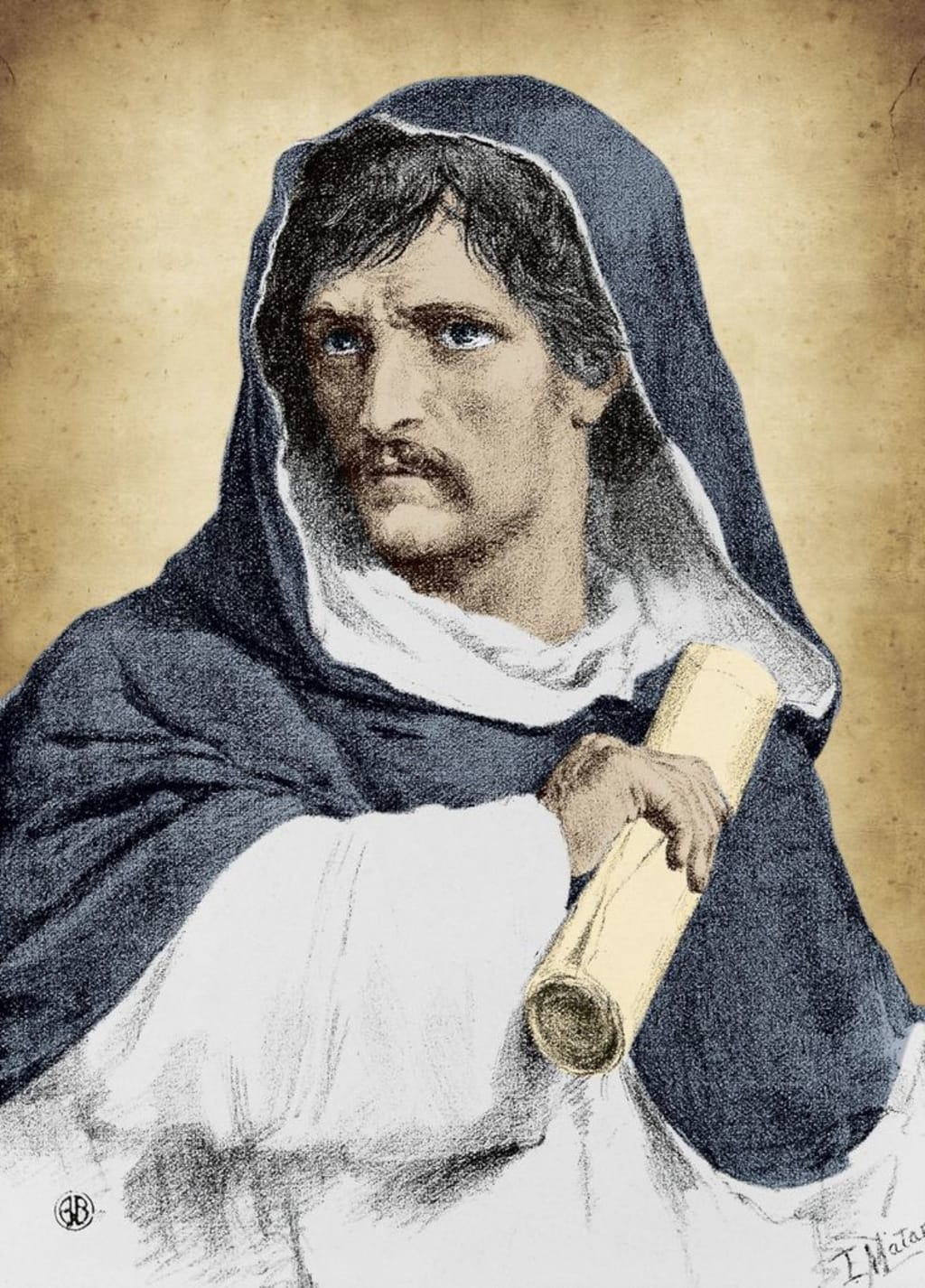
On the Infinite, Universe, and Worlds (De l'infinito, universo e mondi) was published in London in 1584. Bruno's cosmological doctrines were among the charges reviewed at his trial by the Roman Inquisition (1593–1600), though the precise grounds for his execution remain disputed.
Related Concepts