Cusa's Inheritance
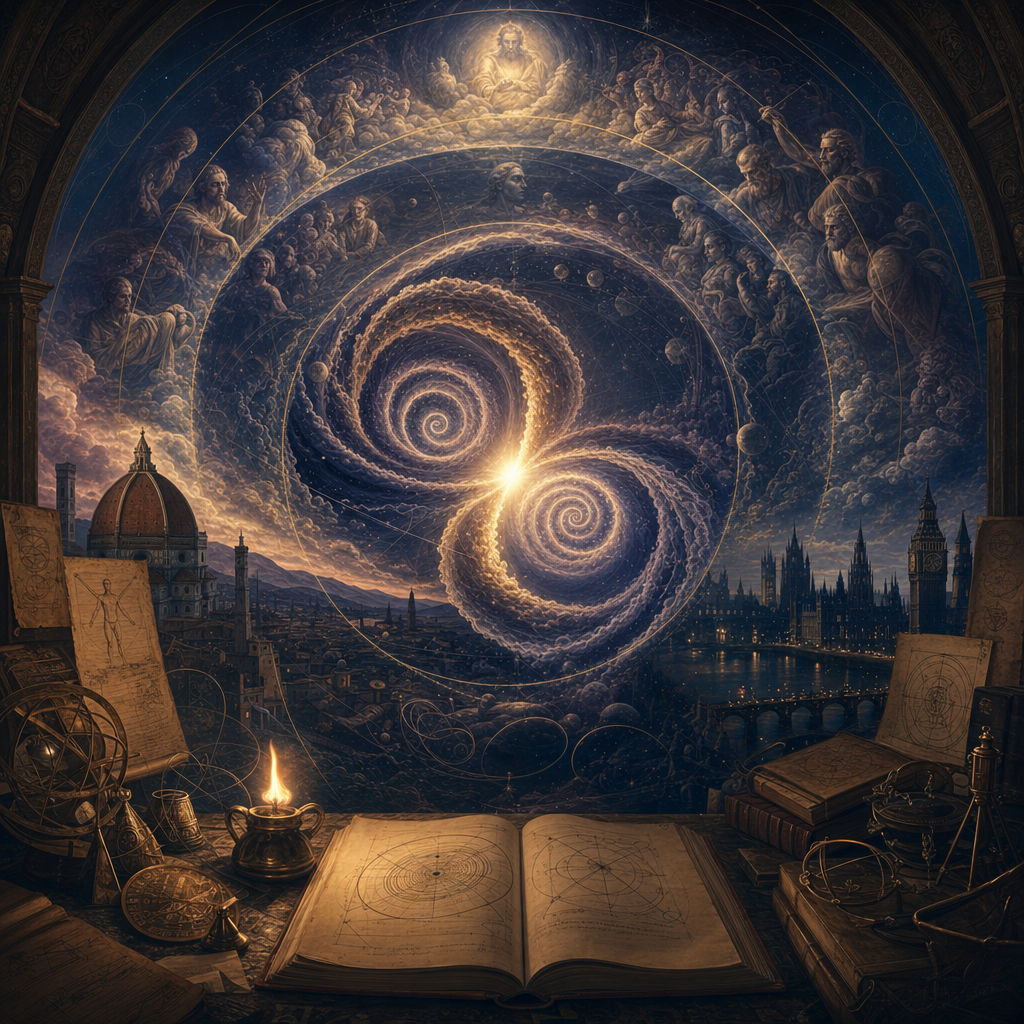
Nicholas of Cusa had argued in De Docta Ignorantia (1440) that in God, the absolute maximum and the absolute minimum coincide: God is both the greatest possible being and the one beyond which nothing can be more minimal, since he is the ground of all being. Differences that are absolute in finite things — large and small, many and one — dissolve in the absolute. Bruno takes this Cusan insight and relocates it from the strictly theological to the cosmological: the infinite universe itself is the locus of coinciding opposites, not a separate divine realm.
Matter and Form in the Infinite
In Aristotelian physics, matter and form are sharply distinguished: matter is pure potentiality, form is actuality, and the two are never identical. Bruno dissolves this distinction in the infinite. In an infinite universe, the distinction between form (actuality) and matter (potentiality) no longer applies in the same way: the infinite is both perfectly actual (nothing is outside it that it could become) and the source of all particular forms. Matter and form are merely different ways of describing the same infinite reality from a finite perspective.
The Practical Implications
The coincidence of opposites is not merely an abstract metaphysical principle for Bruno — it has implications for how the philosopher approaches the world. If all opposites coincide in the One, then the philosopher who grasps this coincidence achieves a perspective from which apparent conflicts dissolve: the conflict between nature and spirit, between matter and mind, between the worldly and the divine. This is the beginning of wisdom, and it is what makes the philosopher different from the ordinary person who takes the world's apparent divisions for absolute realities.
On Cause, Principle and Unity (De la causa, principio et uno) was published in London in 1584. The dialogue form allows Bruno to have his various interlocutors embody different philosophical positions, with the Brunian figure (Teofilo) offering the synthesis.
Related Concepts