Mathematical Analogy
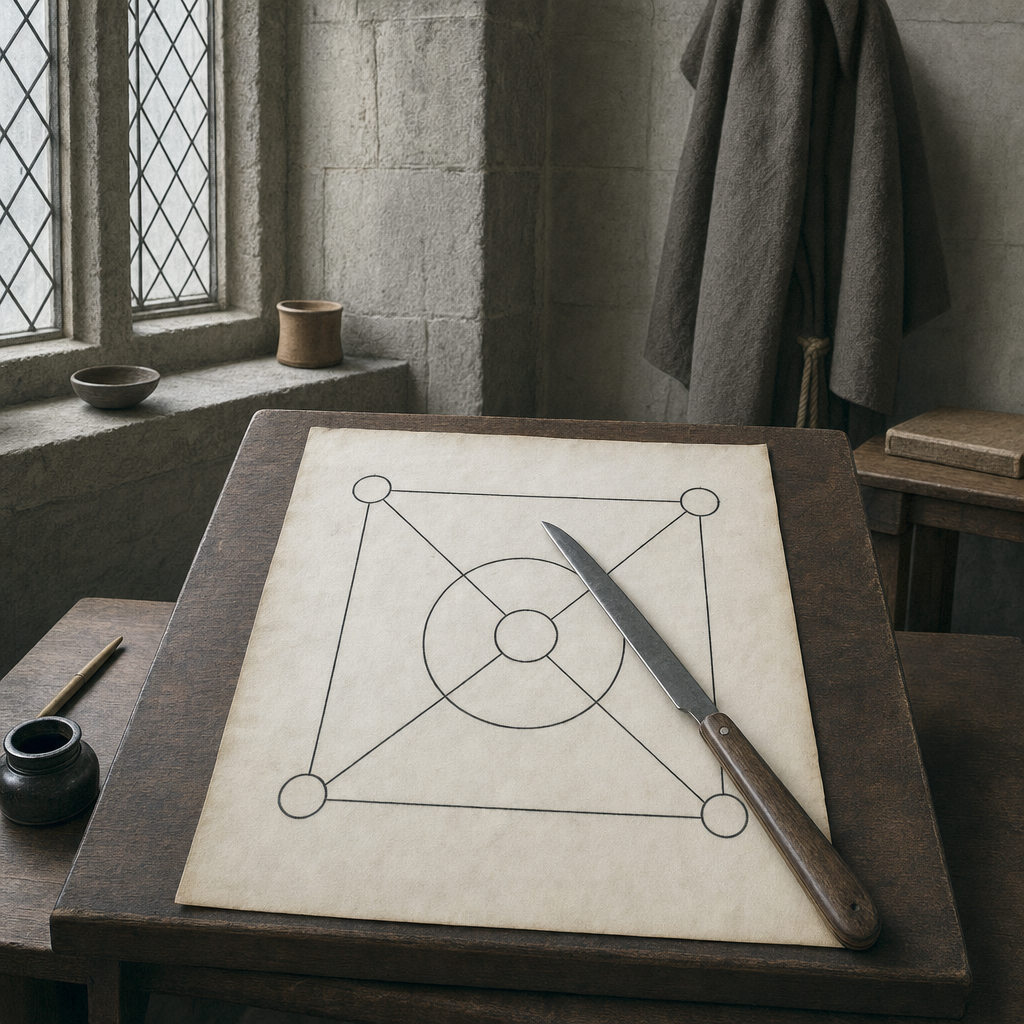
Cusa illustrates the coincidence of opposites with mathematical examples that were genuinely novel for his time. Consider a circle with a very large radius: as the radius increases without limit, the arc of the circle approaches a straight line. In the infinite circle, the arc and the straight line coincide — maximum curvature and zero curvature become identical at the limit. Similarly, an infinite triangle would have angles summing to more than 180 degrees in any finite triangle approaching 180 degrees on a flat surface; at the limit, the three angles would coincide in a single point. These mathematical intuitions give a precise (if analogical) sense to the claim that the distinctions of finite things dissolve at the infinite.
God as the Coincidence of Maximum and Minimum
In finite reality, maximum and minimum are at opposite ends of every scale. But God, as the absolute maximum — that than which nothing greater can be conceived — is also the absolute minimum: nothing is so great that God is not greater, and nothing is so small that God is not present within it as its being. God is both the greatest and the most intimate, the most exalted and the most immanent. This coincidence is not a logical contradiction for Cusa but a feature of the infinite that finite rational categories cannot contain. The principle of non-contradiction, he argues, applies within the domain of the finite; at the infinite, it no longer governs.
Implications for Mystical Theology
The coincidence of opposites gives Cusa a conceptual framework for interpreting the mystical claim that union with God involves the transcendence of all distinctions. To enter the divine darkness — the apophatic region where all concepts fail — is to approach the point where opposites coincide and where the mind, having given up all its finite categories, can rest in a presence that exceeds all representation. Cusa's doctrine also has implications for his understanding of creation: the world is the infinite contracted into the finite — an unfolding (explicatio) of the divine complication (complicatio) in which all things coincide in God. Creation is the simultaneous explication of all things from the coincidence that is God.
The coincidence of opposites is introduced in De Docta Ignorantia I.4 and developed throughout Books I and II. It influenced Giordano Bruno's cosmological philosophy, was taken up by Hegel as an anticipation of his dialectic, and has been studied extensively in twentieth-century scholarship on Renaissance Neoplatonism.
Related Concepts