The World Soul
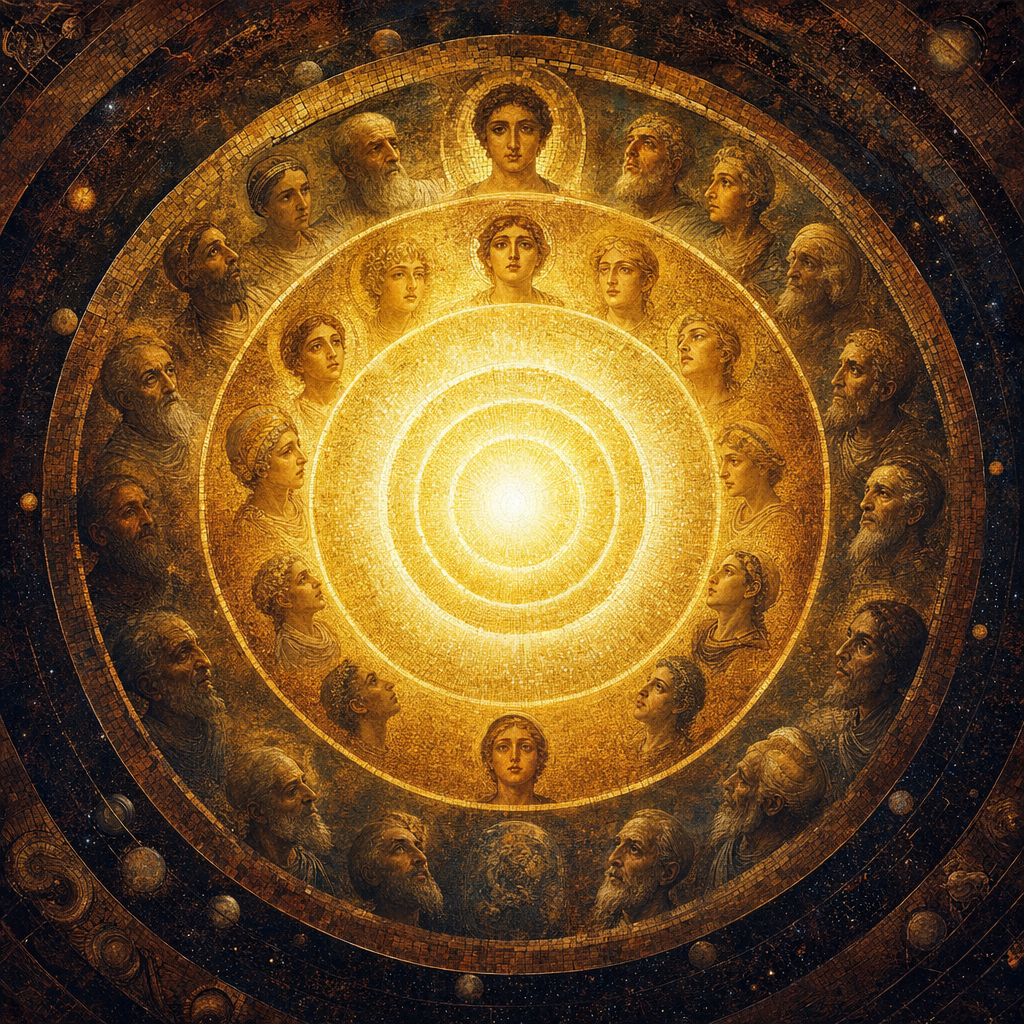
Universal Soul — the Soul of the cosmos — is distinct from the individual souls of human beings, animals, and plants, though all are expressions of the same principle. The World Soul orders the cosmos not through deliberation or effort but through the natural overflow of its contemplation of Intellect: order descends into matter as naturally as warmth descends from a fire. The beauty and regularity of the cosmos — the orbits of the stars, the succession of the seasons, the generation of life — are all expressions of the World Soul's continuous, effortless administration. For Plotinus, this provides the strongest possible argument that the cosmos is not the product of an indifferent mechanism but of a living, intelligent reality.
Individual Souls
Individual souls are portions of Universal Soul — "parts" not in the sense of spatial divisions but in the sense of distinct centres of activity that share in the same essential nature. Each soul retains its own perspective, its own history of choices and contemplations, its own degree of closeness to or distance from Intellect. Yet no soul is entirely cut off from the higher reality: even the most degraded soul, immersed in bodily pleasure and sensory appetite, retains a higher part that remains in Intellect, untouched by the fall. This "undescended soul" is Plotinus's explanation for why humans are always capable of philosophical awakening, however apparently lost they may be.
The Soul's Two Faces
The soul stands between two worlds: above it, Intellect, which it contemplates and from which it draws its intelligible life; below it, matter, which it orders and animates. These two orientations constitute the soul's characteristic condition: it is always pulled in both directions at once, never entirely at home in either. In its highest activity — pure contemplation of the Forms — it is most fully itself, most fully alive; in its lowest activity — the management of bodily desires and sensory pleasures — it is most estranged from itself, most forgetful of its source. Philosophy is the discipline by which the soul learns to orient itself consistently toward its higher face, and thereby to become what it most essentially is.
The doctrine of Universal Soul and its relationship to individual souls is developed throughout the fourth Ennead, especially IV.3–4. The claim that the highest part of the soul never fully descends into the body is controversial within the Plotinian corpus and was disputed by later Neoplatonists.
Related Concepts