Like Knows Like
Plotinus inherits from earlier Greek thought the principle that like knows like: the eye can see light because it is itself light-like; the soul can know the Good because it participates in goodness. Applied to beauty, this means that the soul's capacity to perceive beauty is a function of its own degree of beauty. A soul degraded by vice and absorbed in bodily pleasures becomes dull to beauty, unable to see what is genuinely there. Conversely, the soul that has been purified by philosophical practice becomes increasingly sensitive — capable of perceiving beauty in ever more refined and abstract forms.
The Inner Statue
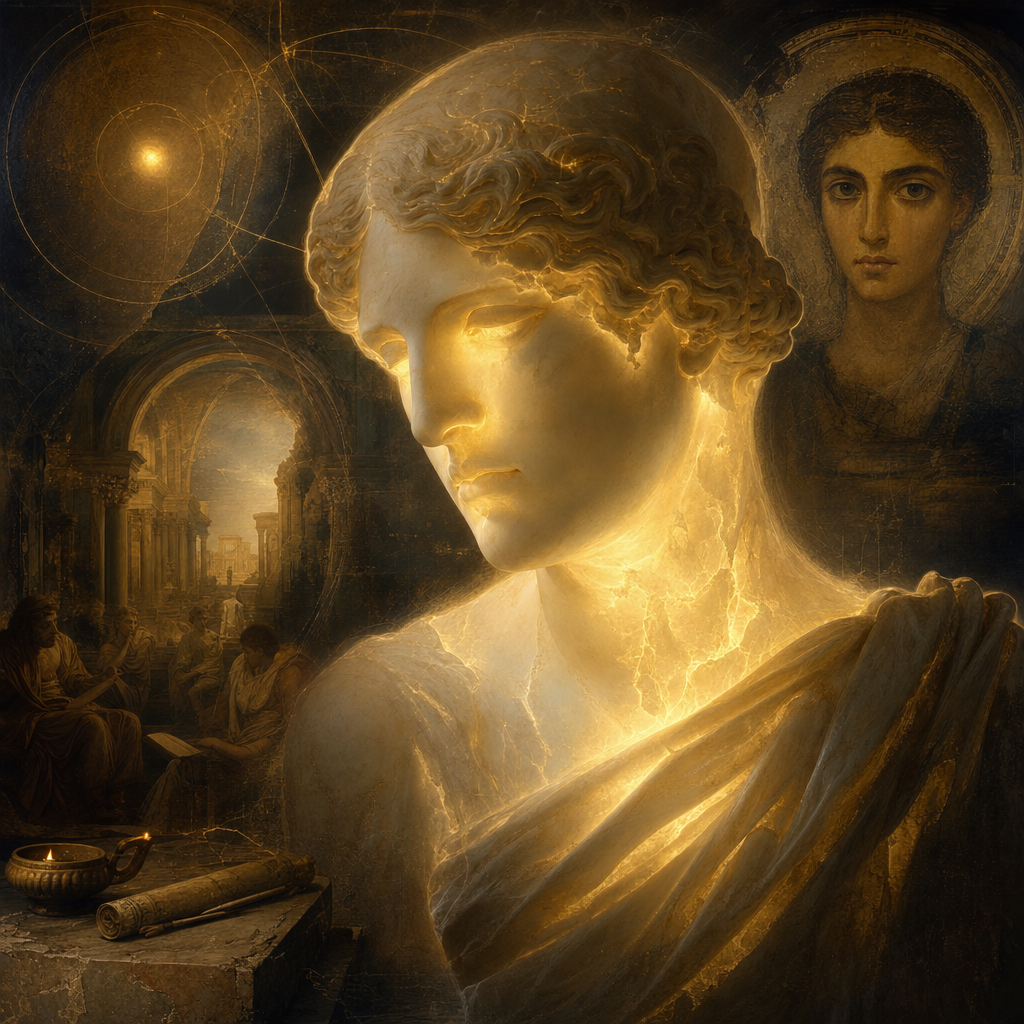
In one of the most striking images in the Enneads, Plotinus compares the work of philosophical self-cultivation to the work of a sculptor. Just as a sculptor removes what is superfluous from a block of marble to reveal the form within, so the philosopher must strip away from the soul everything that is foreign to it — vice, excessive attachment to the body, the restless craving for external goods — until what remains is the soul's own beauty, which was there all along, covered over. "Never stop working your statue," Plotinus counsels. The soul is the sculptor, the material, and the work at once.
Turning Inward
The final movement of On the Beautiful is an injunction to turn inward. Having ascended through external beauty to the beauty of virtues and knowledge, the soul must eventually abandon even intellectual engagement with objects and withdraw into itself — not as an act of narcissistic self-absorption but as the recognition that the source it has been seeking externally is present within. The One that is the source of all beauty is also what the soul most fundamentally is. To go inward, all the way in, is to arrive at the same place that the outward ascent through beauty was pointing toward.
The sculptor image appears in Ennead I.6.9, one of the most celebrated passages in the Enneads. The principle of like knowing like has roots in Empedocles and Plato's Timaeus.
Related Concepts