The Intelligible World as Living Beauty
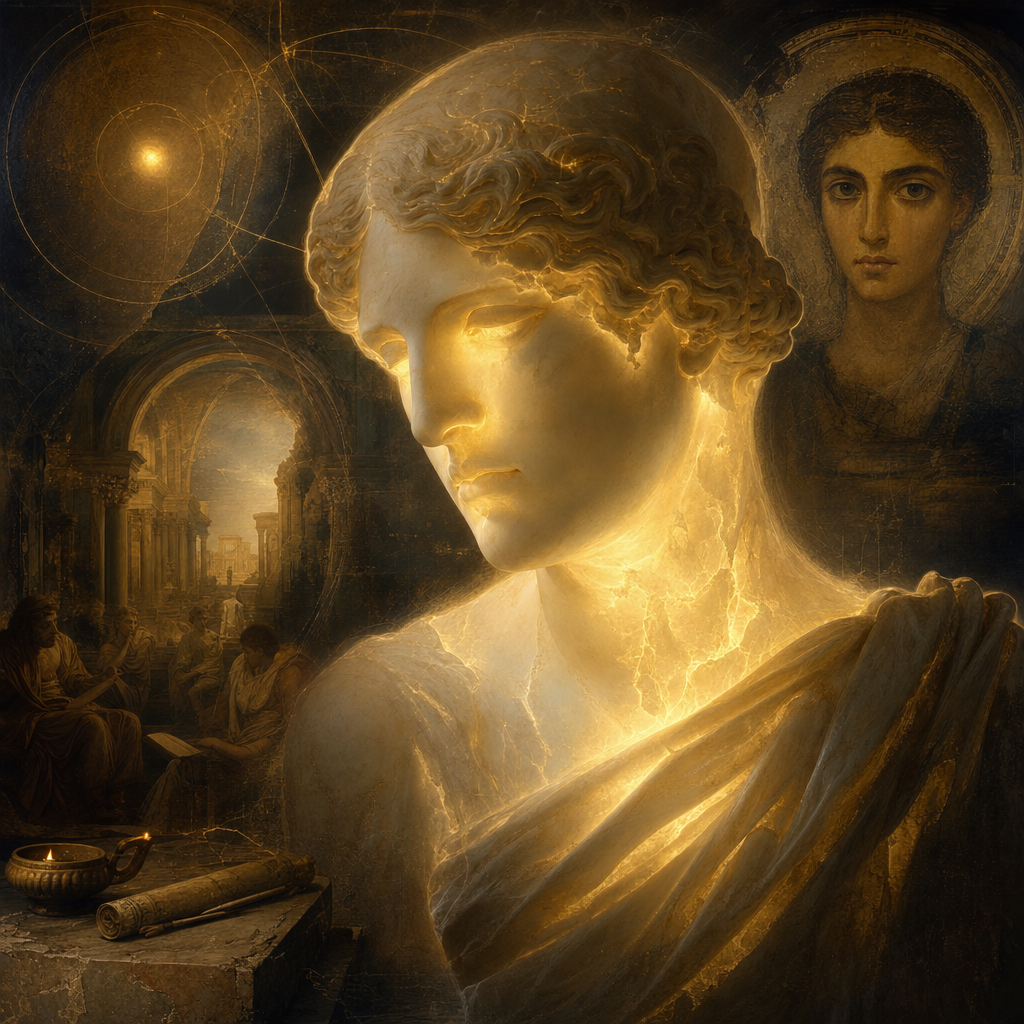
Intellect, for Plotinus, is not a cold logical machinery but a living, luminous whole — a world in which each Form is fully present in every other, in which there is no obscurity, no separation, no privation. The beauty of the intelligible world is not the beauty of arrangement or proportion but the beauty of complete self-transparency: everything there is fully what it is, perfectly illuminated, holding nothing back. To enter this world — as the philosopher does in the highest reaches of contemplation — is not to look at beauty but to become it, to be constituted by the same luminous Form one was previously trying to see.
Sensible Beauty as Trace
The beauty we encounter in material things is a trace or shadow of intelligible beauty — real enough to move us, attenuated enough to leave us unsatisfied. When we see a beautiful face, what moves us is not the particular configuration of flesh and bone but the Form that shines through it: an intimation of the intelligible that the material can carry only imperfectly, and which matter's mutability will eventually extinguish. This is not a reason to despise sensible beauty but to use it correctly — as a ladder, not a destination. The lover of beauty who stops at bodies has mistaken the signpost for the place it points to.
Beauty and Truth
In the intelligible world, beauty and truth converge. The Forms are not merely beautiful objects of contemplation — they are the truth of everything that exists. To know the Form of Justice is simultaneously to know what justice most fully is and to be in contact with a beauty more satisfying than any sensory pleasure. For Plotinus, this convergence is not accidental: the Good, the Beautiful, and the True are three aspects of a single principle, refracted through the different relations in which the soul stands to the One. The philosopher, the lover, and the mystic are ultimately pursuing the same reality.
Intelligible beauty receives its most sustained treatment in Ennead V.8 ("On Intelligible Beauty"), though it is also central to I.6. Plotinus's account influenced Pseudo-Dionysius the Areopagite and, through him, the entire tradition of Christian mystical aesthetics.
Related Concepts