The Problem of Parallel Fall
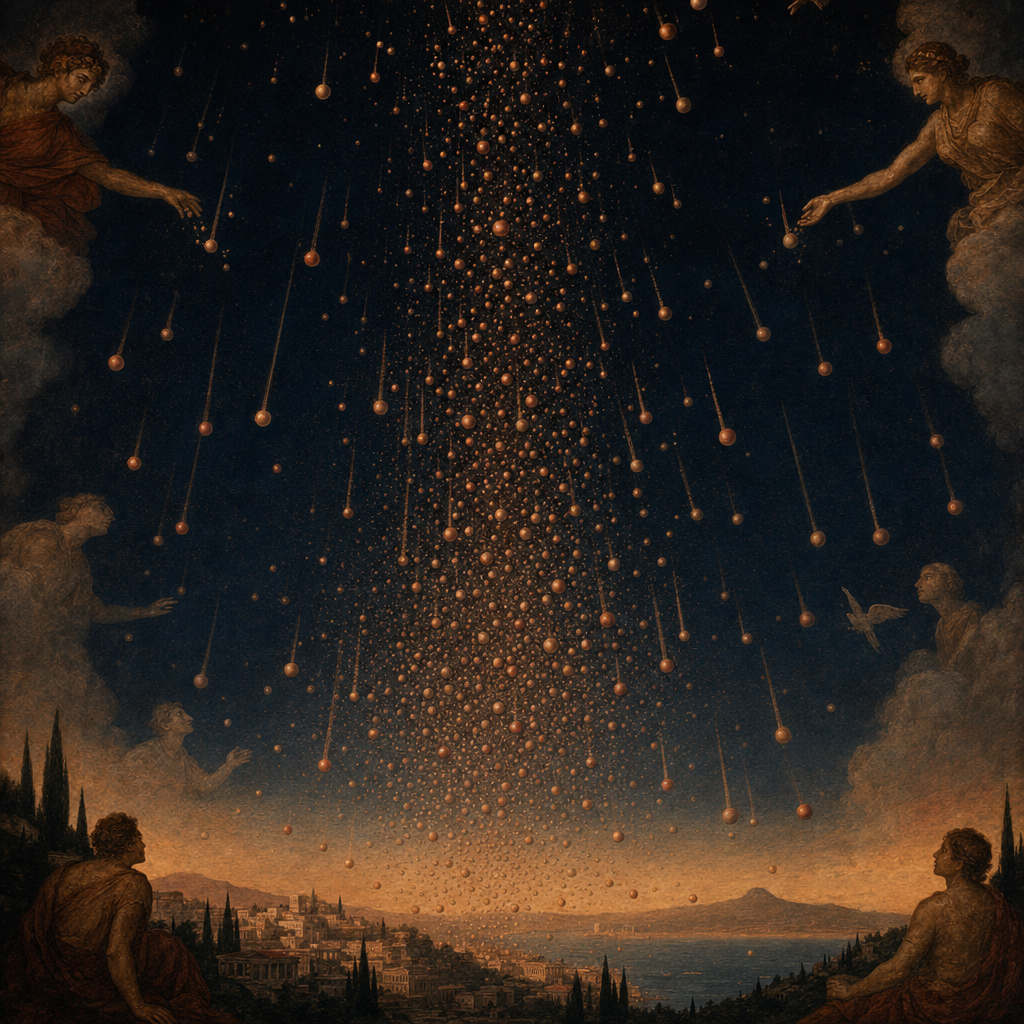
Epicurus inherited from Democritus the idea that atoms fall through void under their own weight. But Democritus's atoms, falling in parallel, would never collide — they would stream past one another forever in empty darkness and nothing would ever exist. Epicurus's innovation, transmitted to us almost entirely through Lucretius, was to stipulate that atoms deviate very slightly, at unpredetermined times and places, from their straight course. This swerve — the clinamen — is the source of all collisions, all combinations, all the astonishing variety of the visible world.
The atoms, as their own weight bears them down Plumb through the void, at scarce determined times, In scarce determined places, from their course Decline a little—call it, so to speak, Mere changed trend. For were it not their wont Thuswise to swerve, down would they fall, each one, Like drops of rain, through the unbottomed void; And then collisions ne'er could be nor blows Among the primal elements; and thus Nature would never have created aught.
Free Will From Physics
The second problem the clinamen solves is the one that made it philosophically explosive for Cicero and later critics: determinism. If atoms move only according to fixed laws of weight and collision, then every subsequent event — including every human thought and choice — was determined at the beginning of the universe. Lucretius insists the swerve breaks this causal chain. It is not large enough to be observed directly; it does not produce random lurches in human behaviour. But it introduces, at the very base of matter, an irreducible unpredictability that severs the iron thread of fate and creates the space in which the will can operate.
Critics ancient and modern have found the clinamen problematic: a random swerve does not obviously produce free will — it produces randomness, which is hardly the same thing. But Lucretius's point is more modest. He does not claim the swerve is the will; he claims it proves that the physical universe is not wholly deterministic, and that therefore the assumption of total fatalism, which would make moral and practical life incoherent, is false. Whether the clinamen succeeds on its own terms remains a live debate.
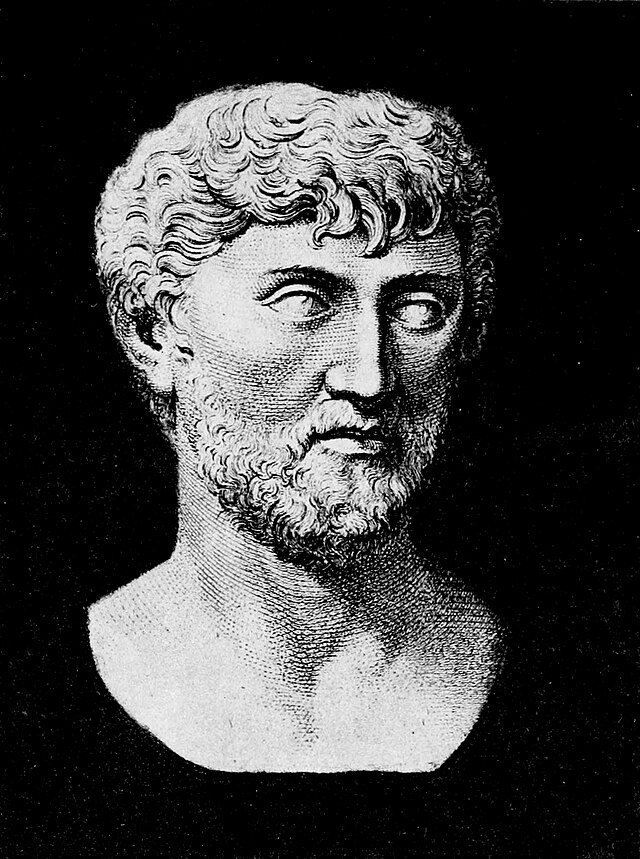
The clinamen appears in Book II of De Rerum Natura. The idea is attributed to Epicurus but survives almost entirely in Lucretius's account. Stephen Greenblatt's book The Swerve (2011) traces the rediscovery of the poem in 1417 and argues it helped ignite the Renaissance.
Related Concepts